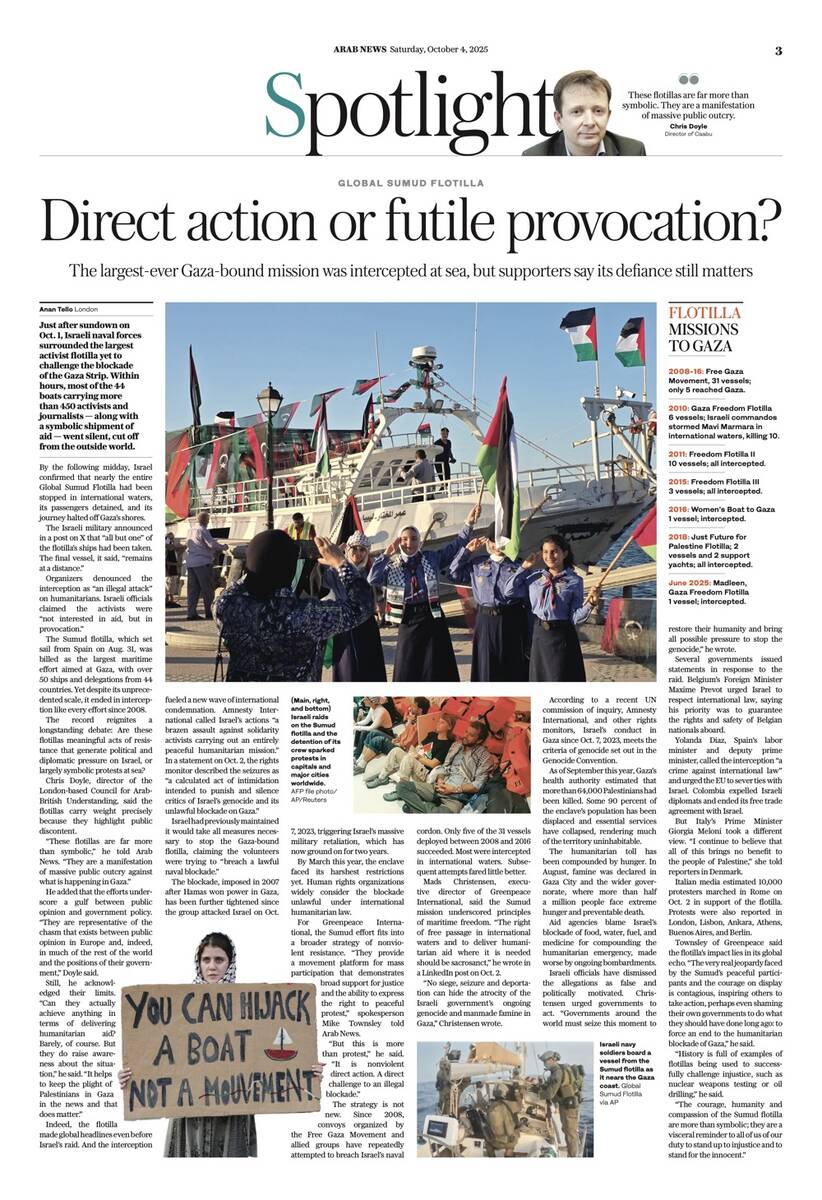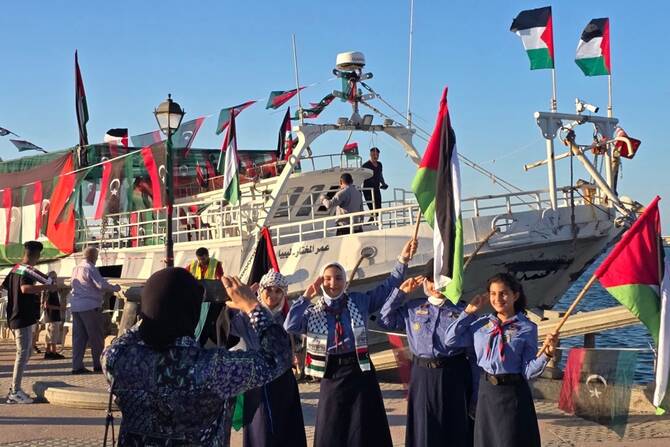

LONDON: Just after sundown on Oct. 1, Israeli naval forces surrounded the largest activist flotilla yet to challenge the blockade of the Gaza Strip. Within hours, most of the 44 boats carrying more than 450 activists and journalists — along with a symbolic shipment of aid — went silent, cut off from the outside world.
The nighttime raid drew swift condemnation from governments and rights groups, while protests erupted from Istanbul and Athens to Buenos Aires and Berlin.
By the following midday, Israel confirmed what organizers had long anticipated: nearly the entire Global Sumud Flotilla had been stopped in international waters, its passengers detained, and its journey halted off Gaza’s shores.
The Israeli military announced in a post on X that “all but one” of the flotilla’s ships had been taken. The final vessel, it said, “remains at a distance.”
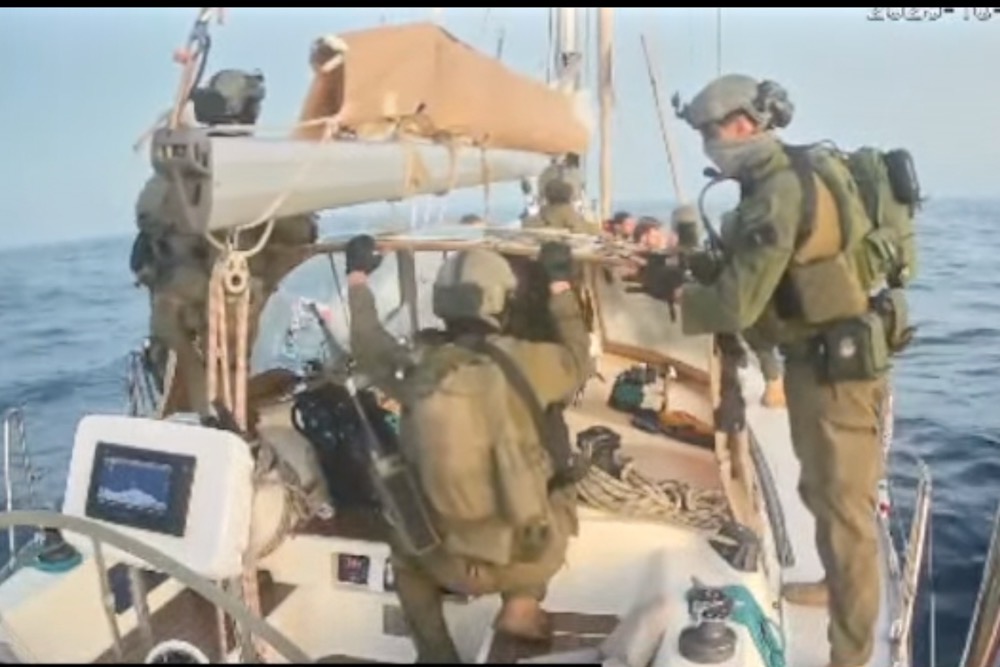
Israeli navy soldiers aboard one of the flotilla's vessels. (Global Sumud Flotilla/AP)
Organizers denounced the interception as “an illegal attack” on humanitarians. Israeli officials claimed the activists were “not interested in aid, but in provocation.”
Israel’s Foreign Ministry released photos of crew members, including Swedish activist Greta Thunberg, saying they were “making their way safely and peacefully to Israel, where their deportation procedures to Europe will begin.” It added that “the passengers are safe and in good health.”
The Sumud flotilla, which set sail from Spain on Aug. 31, was billed as the largest coordinated maritime effort aimed at Gaza, with more than 50 ships and delegations from at least 44 countries. Some vessels were forced to turn back earlier due to technical problems, according to The Associated Press.
Yet despite its unprecedented scale, the mission’s fate was similar to that of previous attempts. It was the fourth flotilla launched this year — following the Conscience, Madleen and Handala initiatives — and, like every effort since 2008, it ended in interception.
The record reignites a longstanding debate: Are these flotillas meaningful acts of resistance that generate political and diplomatic pressure on Israel, or largely symbolic protests at sea?
Chris Doyle, director of the London-based Council for Arab-British Understanding, said the flotillas carry weight precisely because they highlight public discontent.
“These flotillas are far more than symbolic,” he told Arab News. “They are a manifestation of massive public outcry against what is happening in Gaza.”
He added that the efforts underscore a gulf between public opinion and government policy. “They are representative of the chasm that exists between public opinion in Europe and, indeed, in much of the rest of the world and the positions of their government,” Doyle said.
Still, he acknowledged their limits. “Can they actually achieve anything in terms of delivering humanitarian aid? Barely, of course. But they do raise awareness about the situation,” he said. “It helps to keep the plight of Palestinians in Gaza in the news and that does matter.”

Swedish climate activist Greta Thunberg (C) and Brazilian activist Thiago Avila (R), along with other activists. (Israeli Foreign Ministry/AFP)
Indeed, the flotilla made global headlines even before Israel’s raid. And the interception — coupled with the detention of all crew members — fueled a new wave of international condemnation.
Amnesty International called Israel’s actions “a brazen assault against solidarity activists carrying out an entirely peaceful humanitarian mission.” In a statement on Oct. 2, the rights monitor said the flotilla had faced “weeks of threats and incitement by Israeli officials” as well as “several attempts to sabotage some of its ships.”
It described the seizures as “a calculated act of intimidation intended to punish and silence critics of Israel’s genocide and its unlawful blockade on Gaza.”
Israel had previously maintained it would take all measures necessary to stop the Gaza-bound flotilla, claiming the volunteers were trying to “breach a lawful naval blockade.”
The blockade, imposed in 2007 after Hamas won power in Gaza, has been further tightened since the group attacked Israel on Oct. 7, 2023, triggering Israel’s massive military retaliation, which has now ground on for two years.
By March this year, the enclave faced its harshest restrictions yet, with aid deliveries almost entirely cut off, fueling what rights groups called a man-made humanitarian catastrophe and famine. Israel said the move was intended to prevent aid being siphoned off by Hamas.
Legal experts, human rights organizations, and UN agencies widely consider the blockade unlawful under international humanitarian law, deeming it a collective punishment aimed at Gaza’s civilian population.
For Greenpeace International, the Sumud effort fits into a broader strategy of nonviolent resistance.
“Flotillas, such as Sumud, operate on multiple levels,” spokesperson Mike Townsley told Arab News. “They provide a movement platform for mass participation that demonstrates broad support for justice and the ability to express the right to peaceful protest.
“But this is more than protest. It is nonviolent direct action. A direct challenge to an illegal blockade.”

Members of the group of ships of the Global Sumud Flotilla to Gaza are seen moored at the small island of Koufonisi, south of the island of Crete. (AFP)
The strategy is not new. Since 2008, convoys organized by the Free Gaza Movement and allied groups have repeatedly attempted to breach Israel’s naval cordon. Only five of the 31 vessels deployed between 2008 and 2016 succeeded. Most were intercepted in international waters.
There are hazards involved, however. In 2010, Israeli commandos raided the Mavi Marmara, killing 10 of the more than 600 activists on board and wounding dozens. Israel apologized in 2013 for what it called “operational mistakes,” though a compensation deal with Turkiye has yet to be finalized.
Subsequent attempts fared little better.
Freedom Flotilla II in 2011 was largely prevented from sailing, with only one vessel, the French-flagged Dignite, making it to sea before it was intercepted and diverted to Ashdod. In 2015, the Swedish-flagged Marianne of Gothenburg was seized 185 km off Gaza’s coast.
In 2018, Al-Awda and Freedom were both captured in international waters. And in May 2025, Conscience was reportedly struck by drones off Malta, injuring four and severely damaging its hull.
Mads Christensen, executive director of Greenpeace International, said the Sumud mission underscored principles of maritime freedom. “The right of free passage in international waters and to deliver humanitarian aid where it is needed should be sacrosanct,” he wrote in a LinkedIn post on Oct. 2.
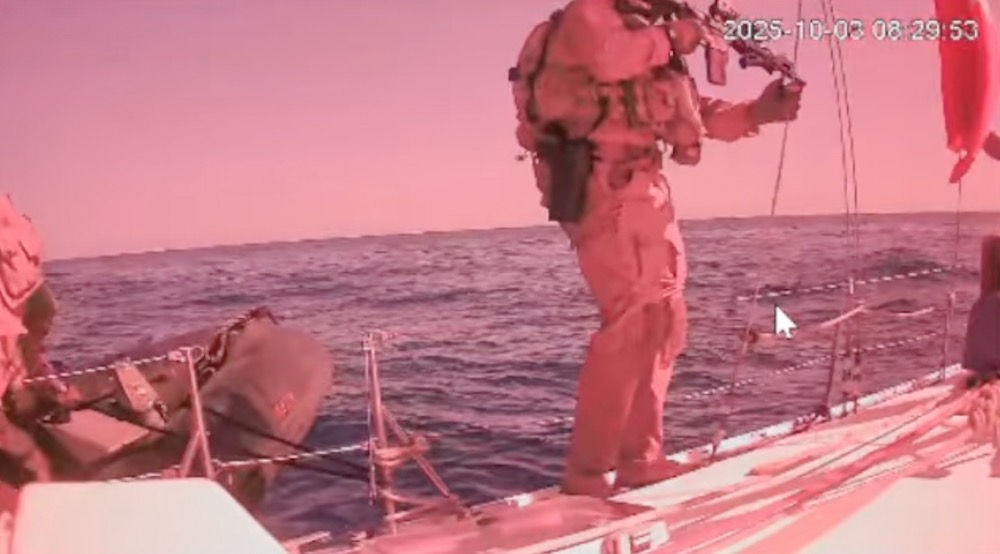
Israeli forces intercepting ‘Marinette’. (Global Sumud Flotilla/AP)
“No siege, seizure and deportation can hide the atrocity of the Israeli government’s ongoing genocide and manmade famine in Gaza,” Christensen wrote, demanding that the flotilla’s crews be “returned to their vessels and allowed to proceed to Gaza unmolested.”
According to a recent UN commission of inquiry, Amnesty International, and other rights monitors, Israel’s conduct in Gaza since Oct. 7, 2023, meets the criteria of genocide set out in the Genocide Convention.
As of September this year, Gaza’s health authority estimated that more than 64,000 Palestinians had been killed. Some 90 percent of the enclave’s population has been displaced and essential services have collapsed, rendering much of the territory uninhabitable.
The humanitarian toll has been compounded by hunger. In August, the Integrated Food Security Phase Classification system declared famine in Gaza City and the wider governorate, where more than half a million people face extreme hunger and preventable death.
The Gaza Humanitarian Foundation, created by Israel and the US to distribute aid in place of the UN-led mission, has drawn international condemnation for alleged politicization, links to covert military agendas, and deadly violence at its militarized distribution sites.
Aid agencies blame Israel’s blockade of food, water, fuel, and medicine for compounding the humanitarian emergency unfolding in Gaza, made worse by the ever-escalating military response, ongoing bombardments, and the destruction of civilian infrastructure.
Israeli officials have dismissed the allegations as false and politically motivated.

People take part in a protest outside the Foreign Office in central London. (AFP)
Christensen urged governments to act. “In the face of the courage of their citizens trying to do what they should have done long ago — break the humanitarian siege of Gaza — governments around the world must seize this moment to restore their humanity and bring all possible pressure to stop the genocide,” he wrote.
Several governments issued statements in response to the raid. Belgium’s Foreign Minister Maxime Prevot urged Israel to respect international law, saying his priority was to guarantee the rights and safety of Belgian nationals aboard and ensure their quick return.
Yolanda Diaz, Spain’s labor minister and deputy prime minister, called the interception “a crime against international law” and demanded that Israel immediately release those it had detained. Writing on the social platform Bluesky, she urged the EU to sever ties with Israel.
Malaysia’s Prime Minister Anwar Ibrahim condemned the interception as “intimidation and coercion” against unarmed civilians carrying life-saving supplies.
Colombia went further, expelling Israeli diplomats and ending its free trade agreement with Israel. In a post on X, President Gustavo Petro called the raid “a new international crime.”
But Italy’s Prime Minister Giorgia Meloni took a different view, criticizing the flotilla’s mission.
“We will do everything we can to ensure these people can return to Italy as soon as possible,” she told reporters in Denmark. “I continue to believe that all of this brings no benefit to the people of Palestine.”
She added that “it will bring many inconveniences to the Italian people,” referring to a strike Italian unions called for Oct. 3 in solidarity with the flotilla.

Protesters hold a large Palestinian flag during a demonstration in Athens. (Reuters)
Italian media estimated 10,000 protesters marched in Rome on Oct. 2 in support of the flotilla, while in London, hundreds gathered across London and outside Downing Street. Protests were also reported in Brussels, Lisbon, Ankara, Athens, Madrid, Buenos Aires, and Berlin.
Townsley of Greenpeace said the flotilla’s impact lies in its global echo.
“The very real jeopardy faced by the Sumud’s peaceful participants and the courage on display is contagious, inspiring others to take action, perhaps even shaming their own governments to do what they should have done long ago: to force an end to the humanitarian blockade of Gaza,” he said.
“History is full of examples of flotillas being used to successfully challenge injustice, such as nuclear weapons testing or oil drilling,” he said.
“The courage, humanity and compassion of the Sumud flotilla are more than symbolic, they are a visceral reminder to all of us of our duty to stand up to injustice and to stand for the innocent.”