

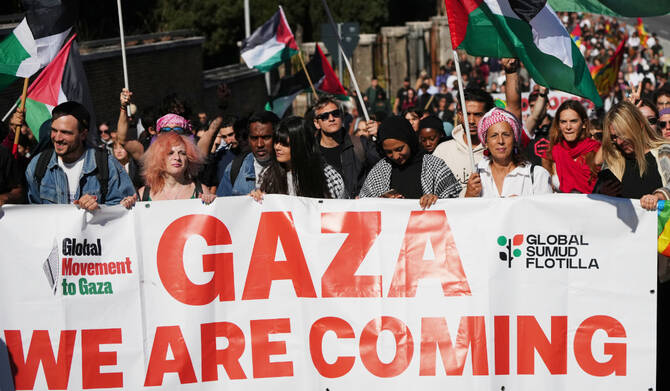

ROME: Over 200,000 people protested across Italy on Friday as they downed tools in support of the Gaza aid flotilla in a strike that caused widespread disruption.
Demonstrators condemned the treatment of the Global Sumud Flotilla that sailed to challenge Israel’s blockade of Gaza, where the UN has reported famine conditions after nearly two years of war.
The Italian strike, called by the USB and CGIL unions, followed demonstrations on Thursday in cities across the world, including Milan and Rome, where some 10,000 people marched from the Colosseum.
Protesters marched again on Friday, setting off from the vast plaza outside Rome’s central Termini train station, where services were canceled or delayed.
Among the crowd, estimated at least 80,000 by police, was Giordano Fioramonti, 19, protesting alongside other youngsters, university students, and professors.
“It’s also our civic duty to show how angry and unhappy we are with what is happening in the world, with our government, to show our support for the flotilla, especially for Palestine, for the Gazans who are being killed, tortured, and massacred,” said Fioramonti.
Up and down the country, thousands of people gathered for marches and flashmobs, from Turin and Trento in the north to Bari and Palermo in the south, according to local media, which reported that they sometimes blocked highways or train tracks.
Police said over 80,000 people were demonstrating in Milan, where a sea of people clapped and waved the Palestinian flag as they made their way through the streets, carrying a massive banner reading: “Free Palestine, Stop the War Machine.”
Police set off smoke bombs to remove several hundred protesters who had broken off from the main march to occupy a ring road in Milan, television images showed.
Organizers said 50,000 people were marching in Turin and 40,000 in Genoa, while 10,000 protesters were blocking the port of Naples.
National rail firm Trenitalia warned the national strike would last until 8:59 p.m. on Friday.
Protesters occupied train stations from Perugia to Cagliari, according to local media.
“Today, 1 million Italians will be left stranded on trains alone,” Deputy Prime Minister Matteo Salvini told the Mattino Cinque television show.
Commercial traffic was blocked at the port of Livorno, local media reported.
Images in Bologna showed protesters marching down a section of the motorway that circles the city, a key artery between the south and the northeast.
Italy’s Foreign Ministry announced that Israel had released four Italian parliamentarians out of the 40 Italians detained from the flotilla.
The two members of parliament and two members of the European Parliament were due to return to Rome on Friday, the ministry said.
“The flotilla was trying to do what European governments and the EU should be doing, namely, breaking this blockade of humanitarian aid that is causing a real famine in Gaza,” said Elly Schlein, head of the Democratic Party, or PD, the main opposition party.
“We call for a total arms embargo, as voted for by Spain. We call for full recognition of the State of Palestine,” she said.
The head of Italy’s right-wing government, Prime Minister Giorgia Meloni, had called the flotilla a “dangerous, irresponsible” initiative, even while Italy sent a navy frigate to assist.
She condemned the national strike, in comments at an EU meeting in Copenhagen Thursday, adding that “long weekends and revolution do not go together.”
Meloni’s reluctance to overtly criticize Israel has spurred a wave of protests in recent weeks.
“You say you are a Christian Italian mother, but you should know that your policies toward Israel offend Christians, mothers, and all Italians who do not feel represented,” said one protester in Rome on Friday, Giuliano Ferrucci, 60.
Italy’s strike watchdog has called Friday’s action illegal on the grounds that unions did not give the required 10 days’ notice.
It “is not just any strike, it has a huge emotional impact and must be handled with care,” the head of the Strike Guarantee Commission, Paola Bellocchi, told Corriere della Sera daily.


