Gaza crisis features in march remembering 1968 Mexican massacre

1 / 5
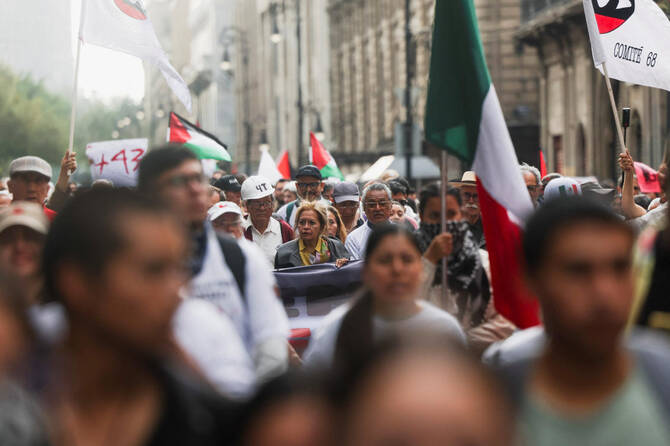
Demonstrators carry Palestinian and Mexican flags during a march to mark the 57th anniversary of the 1968 Tlatelolco Square massacre, in which students were shot dead by the military, in Mexico City, Mexico, October 2, 2025. REUTERS/Henry Romero
2 / 5
A demonstrator wearing a mask holds a placard that reads "This government is also complicit in the disappearances" during a march to mark the 57th anniversary of the 1968 Tlatelolco Square massacre, in which students were shot dead by the military, in Mexico City, Mexico, October 2, 2025. REUTERS/Henry Romero
3 / 5
Demonstrators carry Palestinian and Mexican flags during a march to mark the 57th anniversary of the 1968 Tlatelolco Square massacre, in which students were shot dead by the military, in Mexico City, Mexico, October 2, 2025. REUTERS/Henry Romero
4 / 5
Demonstrators display banners and Palestinian flags during a march to mark the 57th anniversary of the 1968 Tlatelolco Square massacre, in which students were shot dead by the military, in Mexico City, Mexico, October 2, 2025. REUTERS/Henry Romero
5 / 5
The Mexican flag waves during a march to mark the 57th anniversary of the 1968 Tlatelolco Square massacre, in which students were shot dead by the military, in Mexico City, Mexico, October 2, 2025. REUTERS/Henry Romero
Short Url
Updated 03 October 2025
Follow

Gaza crisis features in march remembering 1968 Mexican massacre

  • The annual march in Mexico City to commemorate the 1968 student massacre has been overshadowed by demands to end the humanitarian crisis in Gaza

MEXICO CITY: The annual march to commemorate the 1968 massacre of protesting students in Mexico’s capital was eclipsed Thursday by demands to end a humanitarian crisis halfway around the world in Gaza.
The Oct. 2 march that has regularly been used not only to remember that earlier massacre, but also Mexico’s tens of thousands of other missing and abuses of authority, was this year full of Palestinian flags and signs demanding an end to Israel’s military operations in Gaza.
“We feel empathy not only for ours, for those our grandparents died for, but for all men and women around the world who are suffering what at one time we suffered,” said Edgar López, a 23-year-old economics student, who marched with a Palestinian flag on his back.
Protesters marched from the Tlatelolco plaza where in 1968 Mexican troops attacked students demanding an end to Mexico’s militarization and greater freedoms, leaving a never established death toll believed to be in the hundreds, to the capital’s central plaza.
While much of the march was peaceful some groups vandalized storefronts and threw objects, including Molotov cocktails, at the hundreds of police guarding the National Palace.
Mexico City officials estimated the march drew 10,000 people and authorities said there were about 350 who were masked and acting aggressively.
AP journalists saw at least three other journalists attacked by police and protesters, and a police officer cornered and attacked by protesters.
Local press reported at least six injured police, but authorities did not immediately confirm that number.
A smaller spontaneous protest had broken out in the capital the previous night after Israel detained members of a flotilla carrying humanitarian aid. Among those detained were six Mexicans.
Mexico President Claudia Sheinbaum said earlier Thursday that her administration had demanded their immediate repatriation.


Colombia’s top guerrilla leader threatens vote disruption

Updated 2 sec ago
Follow

Colombia’s top guerrilla leader threatens vote disruption

BOGOTA: Colombia’s most-wanted guerrilla leader Ivan Mordisco threatened to disrupt the country’s 2026 presidential election, in a video released on Tuesday, in response to deadly military strikes against his armed group.
The military operations were part of President Gustavo Petro’s intensifying attacks against groups involved in cocaine trafficking, following fierce pressure from US President Donald Trump over his alleged inaction on drug production.
Mordisco, the leader of a dissident faction of the former FARC guerrillas, said the strikes that have killed dozens were a “declaration of war.”
In the video, Mordisco warned of repercussions for next year’s election, which will determine the successor to the country’s left-wing president who is constitutionally barred from running again.
“We wanted the 2026 electoral process to be as smooth as possible, but given the advance of warmongering actors, we have no choice but to take a stand,” he said.
Authorities have confirmed military strikes have claimed the lives of 15 minors since August, sparking public outrage.
The teenagers had been abducted by the same armed groups in the soldiers’ crosshairs.
Petro’s policies were “pandering to the gringos, who are thirsty for the blood of Colombian children,” Mordisco said, referring to Americans.
The president has launched a manhunt with a million-dollar reward to capture Mordisco, whom he likens to cocaine baron Pablo Escobar who was slain in 1993.
Mordisco leads a dissident faction that rejected the 2016 peace agreement that led to the disarmament of the former FARC. His group controls cocaine production in several regions of the country.
The lead-up to Colombia’s 2026 election has already been marred by violence, with candidate and opposition senator Miguel Uribe shot while campaigning in June. He died in hospital in August and police blamed the shooting on guerrillas.