

Six protesters, three policemen killed in Azad Kashmir unrest as government calls for dialogue

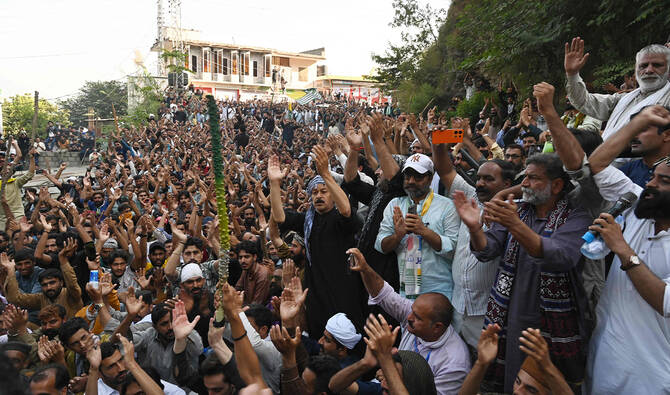
Awami Action Committee (AAC) activists shout slogans during a demonstration in Muzaffarabad, capital of Pakistan-administered Kashmir, on October 1, 2025. (AFP)
Short Url
Updated 03 October 2025
Follow

Six protesters, three policemen killed in Azad Kashmir unrest as government calls for dialogue

  • The Azad Jammu and Kashmir government’s call to resume dialogue follows shutter-down strikes, wheel-jam protests and clashes across the disputed northern region
  • The protesters demand an end to special allowances for government officials, electricity and wheat at discounted rates, similar to subsidies in other parts of Pakistan

ISLAMABAD: At least six protesters and three policemen have been killed in days of protests in Azad Kashmir, the region’s Press Information Department (PID) said on Wednesday, with the government urging the demonstrators to return to dialogue with authorities.

The statement came hours after Azad Jammu and Kashmir (AJK) Prime Minister Chaudhry Anwar ul Haq appealed for an end to protests organized by the Jammu Kashmir Joint Awami Action Committee (JKJAAC) in the disputed northern region since Sept. 29, saying the government is ready to talk to the protesters.

The call to resume dialogue followed shutter-down strikes, wheel-jam protests and clashes across Azad Kashmir. The JKJAAC civil rights alliance is demanding an end to special allowances for government officials and the supply of electricity and wheat at discounted rates, similar to subsidies in other parts of Pakistan.

The protests have turned violent over the course of the last three days as protesters and police came face to face and clashed at various locations. JKJAAC leaders accuse the government of reneging on promises and say at least 12 people have been killed, claims denied by regional authorities.

“As a result of the violent protests of the Joint Awami Action Committee in Azad Kashmir, six civilians and three police personnel have been killed so far,” the AJK PID said in a statement. “About 172 police personnel have been injured, of which 12 police personnel are seriously wounded. Fifty civilians have also been injured in the violent protests.”

The statement appealed to the public to remain peaceful, not to listen to “fake news on social media under a specific agenda” and to share only authentic and verified news.

Kashmir is divided between India and Pakistan, but both claim it in its entirety. Azad Kashmir is the part administered by Pakistan.

“For resolving any conflict, the best and most well-known way in the world, which has been used continuously and will continue to be used, is through dialogue,” AJK PM Haq said at a press conference on Wednesday.

“The government is ready to talk to you [JKJAAC], your legitimate demands will be resolved as soon as possible. The path of violence will only go toward the loss of human lives.”

The JKJAAC rejected the government’s claims and its member, Syed Hafeez Hamdani, said in a written statement that 12 of its supporters had been killed in the protests and more than 200 injured.

“All have suffered gunshot wounds,” the statement read. “The claim that our demands have been accepted is contrary to the facts… If our demands had been accepted, we would have had no reason to keep protesting.”

Meanwhile, Pakistan PM Shehbaz Sharif expressed concern over the situation in Azad Kashmir and decided to expand the negotiation committee for a peaceful resolution of the issue at the government level, according to his office.

The committee includes Senator Rana Sanaullah, federal ministers Sardar Yousaf and Ahsan Iqbal, former AJK president Masood Khan and Qamar Zaman Kaira.

“The Prime Minister directed that the law enforcement agencies should exercise restraint and tolerance with the protesters,” Sharif’s office said. “The Prime Minister said that public sentiments should be respected and any unnecessary harshness should be avoided.”

He said his government was always ready to resolve the problems of its Kashmiri brothers.

“The Prime Minister, expressing deep concern over the unpleasant incidents that took place during the protests, has ordered a transparent investigation into the incident,” it added.

In May 2024, a similar wave of protests paralyzed the region. After six days of strikes and violent clashes that left at least four dead, PM Sharif approved a grant of Rs 23 billion ($86 million) for subsidies on flour and electricity, and a judicial commission to review elite privileges.

Protest leaders suspended their campaign at that time but warned that failure to implement the package would fuel fresh unrest.


Return of millions of Afghans from Pakistan and Iran pushes Afghanistan to the brink, UN warns

Updated 14 February 2026
Follow

Return of millions of Afghans from Pakistan and Iran pushes Afghanistan to the brink, UN warns

  • Afghan authorities provide care packages for those returning that include food aid, cash, a telephone SIM card and transportation
  • But the returns have strained resources in a country struggling with a weak economy, severe drought and two devastating earthquakes

GENEVA: The return of millions of Afghans from neighboring Pakistan and Iran is pushing Afghanistan to the brink, the U.N. refugee agency said on Friday, describing an unprecedented scale of returns.

A total of 5.4 million people have returned to Afghanistan since October 2023, mostly from the two neighboring countries, UNHCR’s Afghanistan representative Arafat Jamal said, speaking to a U.N. briefing in Geneva via video link from Kabul, the Afghan capital.

“This is massive, and the speed and scale of these returns has pushed Afghanistan nearly to the brink,” Jamal said.

Pakistan launched a sweeping crackdown in Oct. 2023 to expel migrants without documents, urging those in the country to leave of their own accord to avoid arrest and forcible deportation and forcibly expelling others. Iran also began a crackdown on migrants at around the same time.

Since then, millions have streamed across the border into Afghanistan, including people who were born in Pakistan decades ago and had built lives and created businesses there.

Last year alone, 2.9 million people returned to Afghanistan, Jamal said, noting it was “the largest number of returns that we have witnessed to any single country.”

Afghanistan’s Taliban rulers have criticized the mass expulsions.

Afghanistan was already struggling with a dire humanitarian situation and a poor human rights record, particularly relating to women and girls, and the massive influx of people amounting to 12% of the population has put the country under severe strain, Jamal said.

Already in just the month and a half since the start of this year, about 150,000 people had returned to Afghanistan, he added.

Afghan authorities provide care packages for those returning that include some food aid, cash, a telephone SIM card and transportation to parts of the country where they might have family. But the returns have strained resources in a country that was already struggling to cope with a weak economy and the effects of a severe drought and two devastating earthquakes.

In November, the U.N. development program said nine out of 10 families in areas of Afghanistan with high rates of return were resorting to what are known as negative coping mechanisms — either skipping meals, falling into debt or selling their belongings to survive.

“We are deeply concerned about the sustainability of these returns,” Jamal said, noting that while 5% of those who return say they will leave Afghanistan again, more than 10% say they know of someone who has already left.

“These decisions, I would underscore, to undertake dangerous journeys, are not driven by a lack of a desire to remain in the country, on the contrary, but the reality that many are unable to rebuild their viable and dignified lives,” he said.