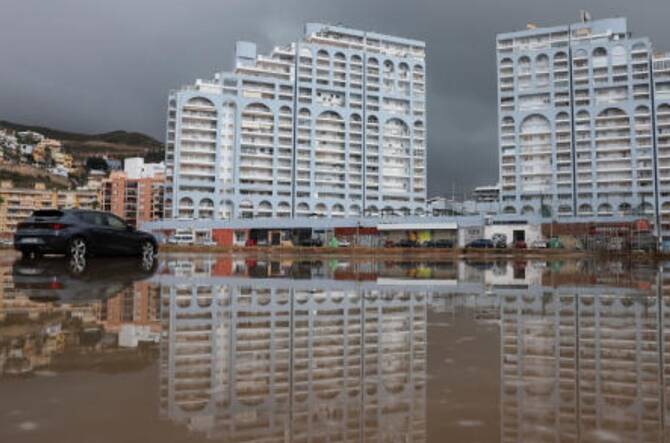
MADRID: Spain’s national weather service on Tuesday downgraded its rain alert for the eastern region of Valencia, the site of deadly flooding in 2024, but issued its highest warning for the holiday islands of Ibiza and Formentera.
AEMET said the alert level in Valencia was cut by two levels from red — its highest — to yellow, a day after torrential downpours forced schools across the region to close.
By contrast, Ibiza and Formentera were placed under red alert, with forecasters warning of “extraordinary danger” from heavy rainfall that could trigger flash floods and river surges in the Mediterranean islands.
Ibiza City, the capital of Ibiza, urged residents to avoid travel and outdoor activities and warned in a post on X against approaching streams, low-lying areas or basements.
Monday’s red alert in Valencia revived memories of October 2024, when flooding killed more than 230 people.
More than half a million pupils in Valencia missed lessons on Monday as 243 local councils closed schools as a precaution.
Images on social media showed roaring torrents of water gushing through the town of Cullera, south of the regional capital Valencia, one of the hardest-hit areas.
Cullera Mayor Jordi Mayor said residents’ compliance with calls to stay indoors “prevented many tragedies.”
“If there had been an elderly person, someone with mobility difficulties, or even children out on the streets, the consequences could have been much worse,” he told Spanish public television.
Last year’s disaster sparked public anger over the adequacy of warning systems and the emergency response. Residents have continued to stage protests, accusing officials of failing to provide timely alerts.

Rain warning lowered in eastern Spain, Ibiza on red alert
Short Url
https://arab.news/wx9cz
Rain warning lowered in eastern Spain, Ibiza on red alert
- AEMET said the alert level in Valencia was cut by two levels from red
- By contrast, Ibiza and Formentera were placed under red alert, with forecasters warning of “extraordinary danger” from heavy rainfall
US NATO envoy says allies must ‘pull weight’ after Czech defense cut
PRAGUE, March 12 : The United States’ ambassador to NATO said on Thursday that all allies must “pull their weight,” after Czech lawmakers approved a 2026 budget that cuts defense outlays.
Czech Prime Minister Andrej Babis’ government, in power since December, pushed a revamped budget through the lower house on Wednesday evening which cut the defense ministry’s allocation versus a previous proposal to 154.8 billion crowns ($7.31 billion), or 1.73 percent of gross domestic product.
That is below a NATO target of 2 percent of GDP already expected before alliance members pledged last year in the Hague to raise defense spending to 3.5 percent of GDP plus 1.5 percent on other defense-relevant investments over the next decade.
The Czech Finance Ministry says total defense spending in the budget will reach 2.07 percent of GDP, but the country’s budget watchdog has warned that includes money earmarked elsewhere, like for the transport ministry for road projects, that may not be recognized by NATO.
“All Allies must pull their weight and honor The Hague Defense Commitment,” US Ambassador to NATO Matthew Whitaker said on X on Thursday with a picture of a news headline on the Czech budget approval.
“These numbers are not arbitrary. They are about meeting the moment — and the moment requires 5 percent as the standard. No excuses, no opt-outs.”
European NATO countries are under pressure to raise defense spending amid the Ukraine-Russia war and at US President Donald Trump’s urging.
Babis, whose populist ANO party won elections last year, said in February the country was “certainly not” on the path to raising core defense spending to the 3.5 percent target, saying there was a different focus, like on health care.
The budget watchdog on Thursday reiterated “strong doubts” that some spending deemed defense in this year’s budget would meet NATO’s definition.
President Petr Pavel, a former NATO official, has also said defense cuts risked a loss of trust from allies — but has signalled he would not veto the budget.
US Ambassador to Prague Nicholas Merrick said last week the Czech Republic may slip to the bottom of NATO’s defense-spending ranks.
Czech Prime Minister Andrej Babis’ government, in power since December, pushed a revamped budget through the lower house on Wednesday evening which cut the defense ministry’s allocation versus a previous proposal to 154.8 billion crowns ($7.31 billion), or 1.73 percent of gross domestic product.
That is below a NATO target of 2 percent of GDP already expected before alliance members pledged last year in the Hague to raise defense spending to 3.5 percent of GDP plus 1.5 percent on other defense-relevant investments over the next decade.
The Czech Finance Ministry says total defense spending in the budget will reach 2.07 percent of GDP, but the country’s budget watchdog has warned that includes money earmarked elsewhere, like for the transport ministry for road projects, that may not be recognized by NATO.
“All Allies must pull their weight and honor The Hague Defense Commitment,” US Ambassador to NATO Matthew Whitaker said on X on Thursday with a picture of a news headline on the Czech budget approval.
“These numbers are not arbitrary. They are about meeting the moment — and the moment requires 5 percent as the standard. No excuses, no opt-outs.”
European NATO countries are under pressure to raise defense spending amid the Ukraine-Russia war and at US President Donald Trump’s urging.
Babis, whose populist ANO party won elections last year, said in February the country was “certainly not” on the path to raising core defense spending to the 3.5 percent target, saying there was a different focus, like on health care.
The budget watchdog on Thursday reiterated “strong doubts” that some spending deemed defense in this year’s budget would meet NATO’s definition.
President Petr Pavel, a former NATO official, has also said defense cuts risked a loss of trust from allies — but has signalled he would not veto the budget.
US Ambassador to Prague Nicholas Merrick said last week the Czech Republic may slip to the bottom of NATO’s defense-spending ranks.
© 2026 SAUDI RESEARCH & PUBLISHING COMPANY, All Rights Reserved And subject to Terms of Use Agreement.