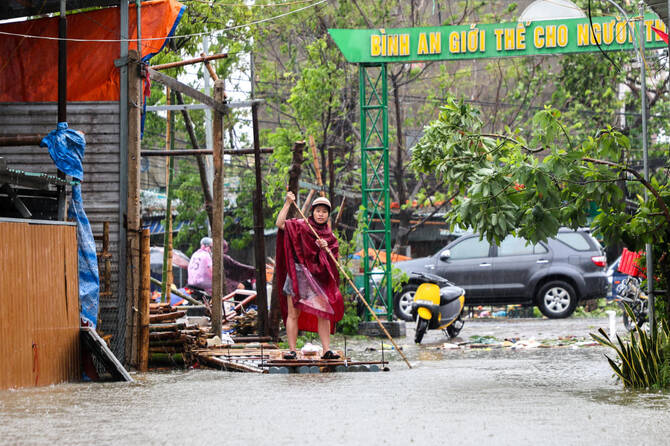
HANOI: Lingering heavy rains from a former typhoon caused more flooding and landslides in Vietnam, raising the death toll to 19 in the country with more missing.
Rainfall topped 30 centimeters (nearly a foot) in parts of Vietnam over the past 24 hours, the national weather agency said Tuesday. It warned that heavy downpours would continue.
The prolonged rain triggered flash floods and landslides that cut off roads and isolated communities from the northern mountains of Son La and Lao Cai provinces to central Nghe An province. Rivers swollen by downpours and dam discharges have caused widespread flooding and landslides in the north. The Thao River in Yen Bai rose well above emergency levels overnight, sending water up to a meter deep into homes and forcing evacuations.
Many streets in the capital, Hanoi, were flooded and authorities warned that people close to the Red River, which passes through the city, should take precautions.
State media said Tuesday that authorities were still searching for 13 missing people, including eight fishermen. Bualoi had already caused at least 20 deaths in the Philippines since Friday.
It made landfall in Vietnam early Monday then lingered, which increased the danger.
Global warming is making storms like these stronger and wetter, according to experts, since warmer oceans provide tropical storms with more fuel, driving more intense winds, heavier rainfall and shifting precipitation patterns across East Asia.


Heavy rains and flooding after Typhoon Bualoi raise death toll to 19 in Vietnam
https://arab.news/8hbub
Heavy rains and flooding after Typhoon Bualoi raise death toll to 19 in Vietnam

- Prolonged rain triggered flash floods and landslides that cut off roads and isolated communities from the northern mountains
- Global warming is making storms like these stronger and wetter, according to experts


Report highlights role of British Muslim charitable giving in supporting UK public services
- The study, “Building Britain: British Muslims Giving Back,” finds that donations from British Muslims are helping to bolster overstretched service
LONDON: British Muslim charitable giving is playing an increasingly significant role in supporting frontline public services across the UK, according to a new report by policy and research organization Equi.
The study, “Building Britain: British Muslims Giving Back,” finds that donations from British Muslims are helping to bolster overstretched services, including local councils, the NHS and welfare systems, at a time of growing financial pressure.
The report estimates that Muslim donors contribute around £2.2 billion ($2.9 billion) annually, making them the UK’s most generous community.
This figure is around four times the national giving average and rises to almost 10 times the average among higher earners.
According to the findings, Muslim-led charities are providing a wide range of support, including housing assistance, emergency cash grants, food provision and mental health services, easing demand on statutory services.
Equi points to evidence from 2023 showing that housing support delivered by the National Zakat Foundation helped prevent evictions that would have cost councils an estimated £28.8 million, with every £1 of charitable spending generating £73 in public sector savings.
The report also highlights a generational shift, with younger British Muslims increasingly directing their donations toward domestic causes such as homelessness, child poverty and mental health challenges.
Despite their growing impact, Muslim charities face a number of barriers, including de-banking, restrictive funding rules, securitization measures and what the report describes as limited recognition from government. Equi argues that these challenges are constraining the sector’s ability to maximize its contribution.
“British Muslim giving is not just generosity but a lifeline for public services that needs recognizing,” said Equi Managing Director Prof. Javed Khan.
“From preventing evictions to supporting mental health, these donations are saving millions for the taxpayer and strengthening communities across Britain. The evidence is clear that Muslim-led action is delivering frontline support where the state is struggling,” he added.
Equi is calling on policymakers to engage more closely with Muslim-led charities and to move beyond what it describes as symbolic recognition.
The report recommends measures such as UK-based match-funding schemes and greater faith literacy within policymaking, which it says could unlock billions of pounds in additional domestic spending while maintaining the UK’s global humanitarian commitments.
The study concluded that with greater collaboration between government and Muslim charities, charitable giving could play an even more transformative role in strengthening public services and social cohesion across the country.


