
JERUSALEM: US President Donald Trump gave Hamas an ultimatum of “three or four days” on Tuesday to respond to his plan for Gaza, as the militant group reviewed the proposal backed by Israel.
The plan calls for a ceasefire, release of hostages by Hamas within 72 hours, disarmament of Hamas and gradual Israeli withdrawal from Gaza, followed by a post-war transitional authority headed by Trump himself.
World powers, including Arab and Muslim nations, welcomed the proposal, but Hamas had yet to issue its response.
“We’re going to do about three or four days,” Trump told reporters when asked about any timeframe.
“We’re just waiting for Hamas, and Hamas is either going to be doing it or not. And if it’s not, it’s going to be a very sad end.”
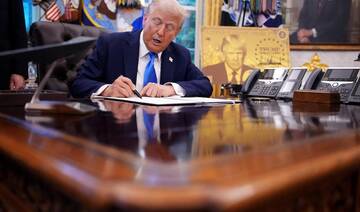
Trump announced the deal at the White House on Monday after meeting Israeli Prime Minister Benjamin Netanyahu.
On Tuesday, a Palestinian source said on condition of anonymity that Hamas had begun consultations on the plan “within its political and military leaderships, both inside Palestine and abroad.”
“The discussions could take several days due to the complexities,” the source said.
Qatar, which hosts Hamas’s exiled leadership, said the group had promised to study the proposal “responsibly,” and also said it would hold a meeting with Hamas and Turkiye later on Tuesday.
“It is still too early to speak about responses, but we are truly optimistic that this plan, as we said, is a comprehensive one,” foreign ministry spokesman Majed Al-Ansari said.
The deal demands that Hamas militants fully disarm and be excluded from future roles in the government, but those who agreed to “peaceful co-existence” would be given amnesty.
It would also see a phased Israeli withdrawal from Gaza, after nearly two years of war sparked by Hamas’s unprecedented attack on Israel on October 7, 2023.
But in a video statement posted after the joint press conference with Trump, Netanyahu said the military would stay in most of Gaza, and also that he did not agree to a Palestinian state during his talks in Washington.
“We will recover all our hostages, alive and well, while the (Israeli military) will remain in most of the Gaza Strip,” he said.
Still, Israel’s far-right Finance Minister Bezalel Smotrich, a member of Netanyahu’s coalition government, blasted the plan as a “resounding diplomatic failure.”
“In my estimation, it will also end in tears. Our children will be forced to fight in Gaza again,” he said.
“Full backing”
Trump’s plan includes deployment of a “temporary international stabilization force” — and the creation of a transitional authority headed by Trump himself and including former British premier Tony Blair.
During his press conference with Trump, Netanyahu cast doubt on whether the Palestinian Authority, which nominally runs Palestinian population centers in the occupied West Bank, would be allowed a role in Gaza’s governance.
Trump noted that during their meeting Netanyahu had strongly opposed any Palestinian statehood — something that the US plan leaves room for.
“I support your plan to end the war in Gaza which achieves our war aims,” Netanyahu said.
“If Hamas rejects your plan, Mr.President, or if they supposedly accept it and then basically do everything to counter it, then Israel will finish the job by itself.”
Trump said that Israel would have his “full backing” to do so if Hamas did not accept the deal.
Reaction was global, and swift. Key Arab and Muslim nations, including mediators Egypt and Qatar, hailed the agreement’s “sincere efforts” in the wake of their own talks with Trump last week.
Washington’s European allies promptly voiced support, with the leaders of Britain, France, Germany and Italy sharing strong expressions of support for the plan, while China and Russia also declared their backing.
“Unrealistic”
But in Gaza, people were skeptical.
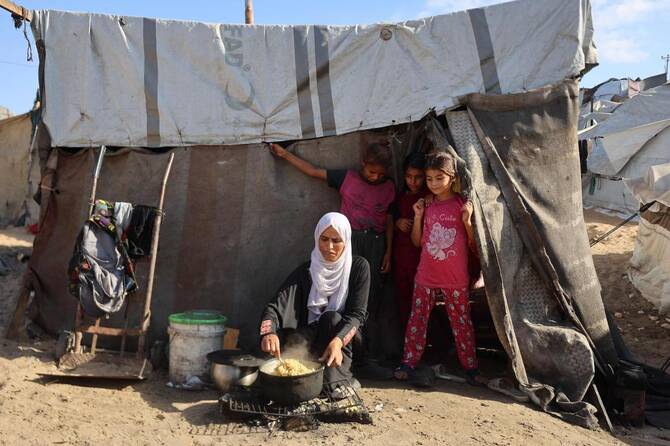
“It’s clear that this plan is unrealistic,” 39-year-old Ibrahim Joudeh told AFP from his shelter in the so-called humanitarian zone of Al-Mawasi in southern Gaza.
“It’s drafted with conditions that the US and Israel know Hamas will never accept. For us, that means the war and the suffering will continue,” said the computer programmer, originally from the southern city of Rafah, devastated by a military offensive that began in May.
Israeli air strikes and shelling continued across Gaza on Tuesday, according to the territory’s civil defense agency and witnesses.
The Israeli military said its forces were carrying out operations across the territory, particularly in Gaza City, where they have mounted a major offensive in recent weeks.
The Palestinian Authority welcomed Trump’s “sincere and determined efforts.”
Hamas ally Islamic Jihad, on the other hand, said the plan would fuel further aggression against Palestinians.
“Through this, Israel is attempting — via the United States — to impose what it could not achieve through war,” the group said in a statement.
The Gaza war was triggered by Hamas’s October 7, 2023, attack on Israel that killed 1,219 people, mostly civilians, according to an AFP tally of Israeli official figures.
Israel’s offensive has reduced much of Gaza to rubble and killed 66,055 Palestinians, also mostly civilians, according to health ministry figures in the Hamas-run territory that the United Nations considers reliable.