

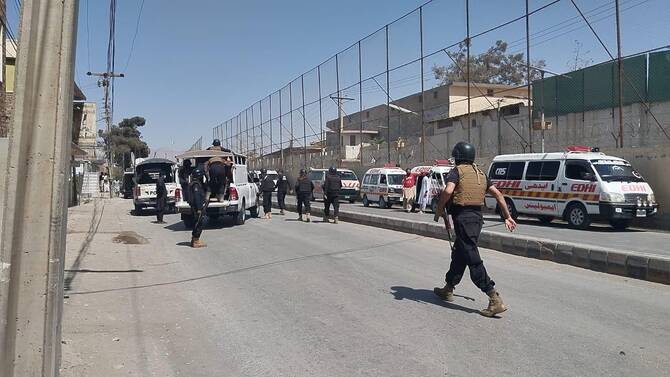
Attack on paramilitary force headquarters in Quetta leaves 10 people and four militants dead

Security officials cordon off the site after an explosion near the Frontier Corps Headquarters in Quetta on September 30, 2025. (AN Photo)
Short Url
Updated 30 September 2025
Follow

Attack on paramilitary force headquarters in Quetta leaves 10 people and four militants dead

  • Provincial health minister says many of the 32 injured are critical and being treated at Quetta’s Trauma Center
  • Balochistan chief minister says security forces responded promptly and repelled the ‘cowardly’ militant attack

QUETTA: A powerful suicide blast targeting the Frontier Corps (FC) headquarters in Quetta, the capital of Pakistan’s restive Balochistan province, killed at least 10 people and triggered a shootout in which four militants were slain, according to top provincial ministers on Tuesday.

Balochistan, which borders Afghanistan and Iran, is strategically significant for its vast mineral wealth and as a transit hub for the multibillion-dollar China-Pakistan Economic Corridor (CPEC). Yet, the province has long been gripped by separatist violence, with groups such as the Baloch Liberation Army (BLA) intensifying attacks in recent years.

So far, no militant outfit has claimed responsibility for Tuesday’s bombing.

“Ten people, including two members of Frontier Corps Balochistan and eight civilians, were killed in the suicide attack on the FC headquarters today,” provincial health minister Bakht Muhammad Kakar told journalists at the Civil Hospital after the blast. “Thirty-one injured were brought to the trauma center, with five in critical condition.”

Witnesses said a plume of smoke rose from the site on Quetta’s Haali Road, followed by gunfire that lasted more than 10 minutes.

Balochistan Chief Minister Mir Sarfraz Bugti said in televised remarks a suicide bomber drove a pickup truck into the compound to carry out the blast.

He added that several gunmen then stormed the headquarters, sparking a firefight in which paramilitary forces promptly killed four militants.

He condemned the bombing as a “cowardly act” and reaffirmed his government’s commitment to making the province peaceful and secure.

Bugti also expressed solidarity with the victims’ families and prayed for the swift recovery of the injured.

Separatist militant groups in Balochistan accuse Pakistan of depriving locals of a fair share in the province’s natural resources, allegations Islamabad denies.

However, the province has witnessed a string of high-profile attacks since the beginning of the year. In March, the BLA hijacked a passenger train, and in May, a suicide bombing in Khuzdar killed several children after targeting their school bus.

Security forces, civilians and non-local workers are frequently targeted by separatist groups in the region, though authorities have mainly relied on intelligence-based operations rather than launching a full-scale military campaign.


Pakistan to launch AI screening in January to target fake visas, agent networks

Updated 5 sec ago
Follow

Pakistan to launch AI screening in January to target fake visas, agent networks

  • New system to flag forged-document travelers before boarding and pre-verify eligibility
  • Move comes amid increasing concern over fake visas, fraudulent agents, forged papers

ISLAMABAD: Pakistan will roll out an AI-based immigration screening system in Islamabad from January to detect forged documents and prevent illegal overseas travel, the government said on Thursday. 

The move comes amid increasing concern over fake visas, fraudulent agents and forged papers, with officials warning that such activity has contributed to deportations, human smuggling and reputational damage abroad. Pakistan has also faced scrutiny over irregular migration flows and labor-market vulnerability, particularly in the Gulf region, prompting calls for more reliable pre-departure checks and digital verification.

The reforms include plans to make the protector-stamp system — the clearance required for Pakistani citizens seeking overseas employment — “foolproof”, tighten labor-visa documentation, and cancel the passports of deportees to prevent them from securing visas again. The government has sought final recommendations within seven days, signalling a rapid enforcement timeline.

“To stop illegal immigration, an AI-based app pilot project is being launched in Islamabad from January,” Interior Minister Mohsin Naqvi said following a high-level meeting chaired by him and Minister for Overseas Pakistanis Chaudhry Salik Hussain.

Naqvi said the new screening technology is intended to determine travelers’ eligibility in advance, reducing airport off-loads and closing loopholes exploited by traffickers and unregistered agents.

The interior minister added that Pakistan remains in contact with foreign governments to improve the global perception and ranking of the green passport, while a uniform international driving license will be issued through the National Police Bureau.

The meeting also approved zero-tolerance measures against fraudulent visa brokers, while the Overseas Pakistanis Ministry pledged full cooperation to streamline the emigration workflow. Minister Hussain said transparency in the protector process has become a “basic requirement,” particularly for labor-migration cases.

Pakistan’s current immigration system has long struggled with document fraud, with repeated cases of passengers grounded at airports due to forged papers or agent-facilitated travel. The launch of an AI screening layer, if implemented effectively, could shift the burden from manual counters to pre-flight verification, allowing authorities to identify risk profiles before departure rather than after arrival abroad.

The reforms also come at a moment when labor mobility is tightening globally. Gulf states have begun demanding greater documentation assurance for imported labor, while European and Asian destinations have increased scrutiny following trafficking arrests and irregular-entry routes from South Asia. For Pakistan, preventing fraudulent departures is increasingly linked to protecting genuine workers, reducing deportation cycles and stabilizing the country’s overseas employment footprint.