BENGALURU/HYDERABAD: Donald Trump’s H-1B visa crackdown will hasten US firms’ shift of critical work to India, turbocharging the growth of global capability centers (GCCs) that handle operations from finance to research and development, economists and industry insiders say.
The world’s fifth-largest economy is home to 1,700 GCCs, or more than half the global tally, having outgrown its tech support origins to become a hub of high-value innovation in areas from design of luxury car dashboards to drug discovery.
Trends such as growing adoption of artificial intelligence and increasing curbs on visas are pushing US firms to redraw labor strategies, with GCCs in India emerging as resilient hubs blending global skills with strong domestic leadership.
“GCCs are uniquely positioned for this moment. They serve as a ready in-house engine,” said Rohan Lobo, partner and GCC industry leader at Deloitte India, who said he knew of several US firms reassessing their workforce needs.
“Plans are already underway” for such a shift, he added, pointing to greater activity in areas such as financial services and tech, and particularly among firms with exposure to US federal contracts.
Lobo said he expected GCCs to “take on more strategic, innovation-led mandates” in time.
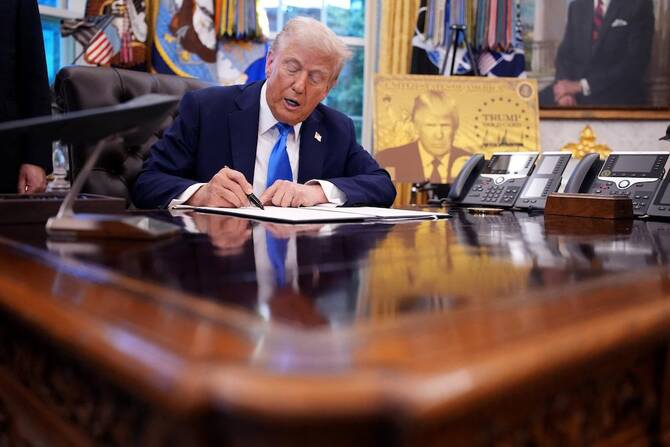
US President Trump raised the cost of new H-1B visa applications this month to $100,000, from an existing range of $2,000 to $5,000, adding pressure on US firms that relied on skilled foreign workers to bridge critical talent gaps.
On Monday, US senators reintroduced a bill to tighten rules on the H-1B and L-1 worker visa programs, targeting what they called loopholes and abuse by major employers.
If Trump’s visa curbs go unchallenged, industry experts expect US firms to shift high-end work tied to AI, product development, cybersecurity, and analytics to their India GCCs, choosing to keep strategic functions in-house over outsourcing.
Growing uncertainty fueled by the recent changes has given fresh impetus to discussions about shifting high-value work to GCCs that many firms were already engaged in.
“There is a sense of urgency,” said Lalit Ahuja, founder and CEO of ANSR, which helped FedEx, Bristol-Myers Squibb, Target and Lowe’s set up their GCCs.
Reassessing India strategies
Such a rush could lead to “extreme offshoring” in some cases, said Ramkumar Ramamoorthy, a former managing director of Cognizant India, adding that the COVID-19 pandemic had shown key tech tasks could be done from anywhere.
Big Tech, including Amazon, Microsoft, Apple and Google parent Alphabet, along with Wall Street bank JPMorgan Chase and retailer Walmart, were among the top sponsors of H-1B visas, US government data showed.
All have major operations in India but did not want to comment as the issue is a politically sensitive one.
“Either more roles will move to India, or corporations will near-shore them to Mexico or Colombia. Canada could also take advantage,” said the India head of a retail GCC.
Even before Trump’s hefty fee on new H1-B visa applications and plan for a new selection process to favor the better-paid, India was projected to host the GCCs of more than 2,200 companies by 2030, with a market size nearing $100 billion.
“This whole ‘gold rush’ will only get accelerated,” Ahuja said.
Implications for India
Others were more skeptical, preferring a “wait and watch” approach, especially as US firms could face a 25 percent tax for outsourcing work overseas if the proposed HIRE Act is passed, bringing significant disruption in India’s exports of services.
“For now, we are observing and studying, and being ready for outcomes,” said the India head of a US drugmaker’s GCC.
India-US trade tension has spilled into services from goods, with visa curbs and the proposed HIRE Act threatening to reduce India’s lower-cost edge and choke cross-border flows of services.
While the $283-billion IT industry that contributes nearly 8 percent of India’s GDP may feel the strain, surging demand for GCC services could cushion such a blow, however.
“Lost revenues from H-1B visa reliant businesses could be somewhat supplanted by higher services exports through GCCs, as US-based firms look to bypass immigration restrictions to outsource talent,” Nomura analysts said in a research note last week.


![]()

Trump visa curbs push US firms to consider shifting more work to India
Short Url
https://arab.news/zntb7
Trump visa curbs push US firms to consider shifting more work to India
- Visa curbs force US firms to rethink labor strategies
- Work tied to AI, cybersecurity could shift to India


Latest updates


© 2026 SAUDI RESEARCH & PUBLISHING COMPANY, All Rights Reserved And subject to Terms of Use Agreement.