

UN Security Council meets on Palestine as Trump, Netanyahu hold talks

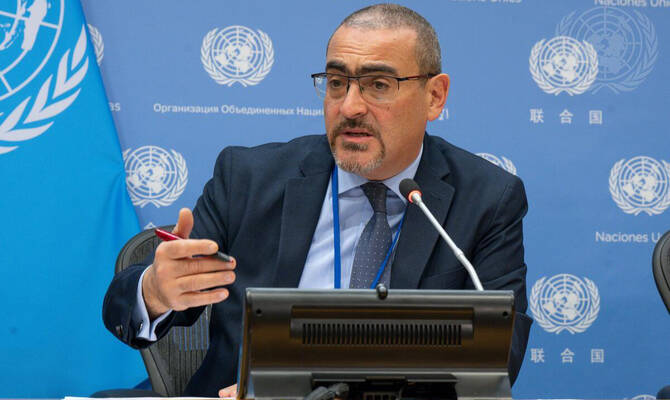
Ramiz Alakbarov, the UN’s deputy special coordinator for the Middle East peace process. (UNSCO)
Short Url
Updated 29 September 2025
Follow

UN Security Council meets on Palestine as Trump, Netanyahu hold talks

  • US Ambassador Mike Waltz stands as lone voice in support of Israel
  • UN official: ‘Alarming’ violence in West Bank while Gaza ‘beyond breaking point’

NEW YORK: The US ambassador to the UN stood as a lone voice in support of Israel on Monday, as he repeated accusations that the countries that recognized Palestine last week had “rewarded Hamas.”

Mike Waltz was addressing a UN Security Council meeting on the situation in the Middle East as US President Donald Trump was set to meet Israeli Prime Minister Benjamin Netanyahu at the White House.

Waltz accused the UNSC of having an “obsessive focus” on Israel. “The US continues to work tirelessly to free all 48 hostages and end the war … If we want to end the war, we need to place accountability where it belongs, with the terrorist organization known as Hamas,” he said.

“Members of this body rewarded Hamas for its horrible atrocities, including Oct. 7, by unilaterally recognizing a Palestinian state.”

Hamas “sees actions like that as winning and as a win for them,” Waltz said, calling on the council and UN member states to “pressure Hamas to end the bloodshed.”

A stable West Bank “keeps Israel secure, and is in line with this administration’s goal to achieve peace in the region,” Waltz said.

Last week, Trump reportedly promised Arab and Muslim leaders at a closed-door UN meeting that the US will not allow Israel to annex the West Bank.

In Monday’s meeting, Ramiz Alakbarov, the UN’s deputy special coordinator for the Middle East peace process, outlined the status of Resolution 2334, adopted in 2016, which calls for an end to Israeli settlement building in the Occupied Territories, among other stipulations.

This year, from June 18 to Sept. 19, Israeli planning authorities advanced or approved about 20,810 housing units in the West Bank, including in East Jerusalem, he said.

“Demolitions and seizures of Palestinian-owned structures also accelerated … Israeli authorities demolished, seized or forced people to demolish 455 structures in the occupied West Bank, including East Jerusalem, displacing 420 people, including 175 children and 118 women,” he added.

During the same period, Gaza’s Health Ministry reported the deaths of at least 7,579 Palestinians and at least 37,201 injured, mostly women and children, Alakbarov said.

Despite the world’s focus on events in Gaza, violence in the West Bank is continuing “at an alarming rate,” he added.

Alakbarov described a series of incidents across cities in the West Bank, notably Tulkarem and Jenin, in which large-scale operations by Israeli forces killed Palestinian children.

“After 23 months of fighting, the humanitarian situation in Gaza is beyond breaking point,” he added.

Alakbarov shared the views of UN Secretary-General Antonio Guterres on the implementation of Resolution 2334.

“Israeli settlement expansion continues to accelerate alongside the proliferation of outposts and steps in the Israeli Knesset (parliament) promoting the annexation of the West Bank,” Guterres said.

“Israeli settlements have no legal validity and constitute a flagrant violation of international law and UN resolutions.

“They’re systematically shrinking the territory of the Palestinian state and further entrenching Israel’s unlawful occupation.

“I’m appalled at the horrific humanitarian situation in Gaza, with unbearable levels of suffering and untenable living conditions. Famine in Gaza is a man-made disaster.”

The UNSC meeting included remarks from permanent and non-permanent states, including Russia, France, China and Slovenia.

The latter, which recognized Palestine last year, is serving as a non-permanent member of the council for 2024–2025.

Samuel Zbogar, Slovenia’s ambassador to the UN, said “the horrors of Gaza dominated all discussions” at the UN General Assembly over the past week, highlighting the almost unanimous message that “the suffering in Gaza must end.”

He said Slovenia supports the Palestinian Authority and the UN Relief and Works Agency as crucial bodies in any postwar governance of Gaza.

Zbogar described UNRWA as an “indispensable part of the fiber of Palestinian society that “must be protected.”

Each national recognition of Palestine over the past week — which included France, the UK, Canada and Australia — strengthens the “legitimacy of Palestine and moves us closer to a just settlement,” he said.

“I want to underline that we also hear voices for peace in Israel … We hear families of hostages calling for ceasefire,” Zbogar added.

“We hear voices of so many Israelis understanding that their safety and future is intertwined with the safety and future of Palestinians … We hear Jewish voices around the globe emphasizing that peace can’t be achieved through war.”

Asim Iftikhar Ahmad, Pakistan’s ambassador to the UN, told the council meeting that Israel continues to violate Resolution 2334 “with impunity.”

Israel’s use of “systematic military operations, illegal settlements and forced displacement” are aimed at “extinguishing the very prospect of a two-state solution,” he said.

“The people of Palestine can’t wait. The cause of peace, and the credibility of this council, depend on what we do in this moment.”


Volatile security blocks UN from Syria Daesh-linked camp

Updated 6 sec ago
Follow

Volatile security blocks UN from Syria Daesh-linked camp

  • Schmitt said: “UNHCR was able to reach Al-Hol for the past three days but has not yet been able to enter inside the camp due to the volatile security situation“
  • A former employee said most associations withdrew on Tuesday “due to the deteriorating security situation“

RAQQA, Syria: Poor security at a camp in Syria housing thousands of suspected relatives of Daesh group militants has prevented UN agency staff from entering, days after Kurdish forces withdrew and the army deployed at the site.
Two former employees at the Al-Hol desert camp told AFP on Friday that some of its residents had escaped during an hours-long security vacuum.
Thousands of suspected militants and their families, including foreigners, have been held in prisons and camps in northeast Syria since 2019, when the Kurdish-led Syrian Democratic Forces (SDF) defeated Daesh with the support of a US-led coalition.
This year, the SDF had to relinquish to Syrian government control swathes of territory they had seized during their fight against Daesh, and on Tuesday withdrew from Al-Hol.
In Raqqa province, Kurdish forces who formerly controlled a prison housing Daesh detainees were bussed out on Friday under a deal with the government, as a four-day truce neared expiry.

- Returning today -

Celine Schmitt, the UN refugee agency’s spokesperson in Syria, told AFP that “UNHCR was able to reach Al-Hol for the past three days but has not yet been able to enter inside the camp due to the volatile security situation.”
“UNHCR is returning to Al-Hol today, with the hope of resuming the bread delivery that had stopped for the past three days,” she said.
On Sunday, Syrian President Ahmed Al-Sharaa announced a deal with SDF chief Mazloum Abdi that included a ceasefire and the integration of the Kurds’ administration into the state, which will take responsibility for Daesh prisoners.
A former employee of a local humanitarian organization that operated in Al-Hol told AFP on condition of anonymity that most associations withdrew on Tuesday “due to the deteriorating security situation.”
Some camp residents fled during the “security vacuum” between when the SDF withdrew and the army took control, they said, without providing a number.
A former employee at another organization working there said “escapes were reported, but the exact number is unknown.”
“The camp is fenced, but without security, anyone can easily cross it and flee,” they said, also requesting anonymity.
Both ex-employees said camp residents torched centers belonging to aid organizations operating in the camp, where humanitarian conditions are dire.
Before the turmoil, the camp housed some 23,000 people — mostly Syrians but also including around 2,200 Iraqis and 6,200 other foreign women and children of various nationalities, the camp’s former administration told AFP.
Roj, a smaller camp in the northeast still under Kurdish control, holds some 2,300 people, mostly foreigners.
The Kurds and the United States have repeatedly urged countries to repatriate their citizens but foreign governments have generally allowed home only a trickle.

- Al-Aqtan prison -

The SDF has withdrawn to parts of Hasakah province, its stronghold in northeast Syria.
A fresh four-day ceasefire was announced on Tuesday, while the following day the United States said it had launched an operation that could see 7,000 Daesh militant detainees moved from Syria to Iraq, with 150 transferred so far.
US envoy Tom Barrack, who has said the purpose of Washington’s alliance with SDF has now largely expired, held talks this week with Abdi and senior Kurdish official Elham Ahmad.
On Friday, Syria transferred Kurdish fighters away from the Al-Aqtan prison on the outskirts of Raqqa city.
An AFP correspondent in Raqqa saw buses and cars heading away from the Al-Aqtan prison, escorted by government vehicles.
Syrian state television reported the transfer came “after five days of negotiations” and that the fighters would go to the Kurdish-held city of Ain Al-Arab, also known as Kobani, on the northern border with Turkiye.
The SDF later said that with coalition support, all the fighters had been transferred “to safe locations,” while the interior ministry said authorities had taken control of the facility.
A government source told state television that around 800 SDF fighters were to leave, while Daesh detainees would be managed “according to Syrian law.”
The army said the Al-Aqtan transfer was “the first step in implementing the January 18 agreement.”