

Djibouti calls for urgent action on Gaza and Sudan, highlights need for UN reform

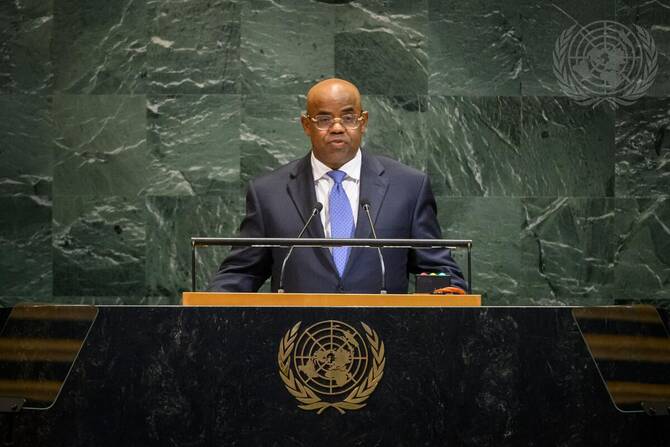
In a speech to the UN General Assembly, Djibouti’s ambassador and permanent representative described the situation in Gaza as “unspeakable horror” where “children are killed daily with impunity” and famine is being used as a weapon of war. (UN)
Short Url
Updated 29 September 2025
Follow

Djibouti calls for urgent action on Gaza and Sudan, highlights need for UN reform

  • ‘The Palestinian people are resilient and courageous,’ envoy tells General Assembly
  • Mohamed Siad Doualeh: ‘The Security Council is paralyzed by the systematic use of the veto’

NEW YORK: Djibouti on Monday called for immediate international action to address the humanitarian crisis in Gaza and stressed the importance of supporting a viable Palestinian state, while also highlighting the need for reform at the UN and its Security Council.

In a speech to the UN General Assembly, Djibouti’s ambassador and permanent representative described the situation in Gaza as “unspeakable horror” where “children are killed daily with impunity” and famine is being used as a weapon of war. 

Mohamed Siad Doualeh also condemned the repeated violations of laws governing the use of force, citing Israeli bombings, raids and extraterritorial killings.

He reaffirmed Djibouti’s solidarity with Palestine, noting that while the international community works to revive the two-state solution, “Israel is busy burying not only the idea of two states but also the possibility of a future viable and sovereign Palestinian state.” 

He added: “The Palestinian people are resilient and courageous. The international community is equally determined.

“The two-state solution is the only one capable of meeting the legitimate aspirations of the Palestinian people and achieving lasting peace.”

Doualeh condemned Israeli aggression against Qatar and reaffirmed its support for the Gulf state, while warning of the broader dangers of geopolitical fragmentation in the region, from Sudan to the Sahel. 

He described the conflict in Sudan as a “fratricidal war” causing massive civilian casualties, widespread destruction and displacement. He called for an immediate ceasefire and coordinated international response.

Doualeh stressed that the UN remains a critical platform for collective action, but warned that its effectiveness is becoming increasingly undermined. 

“The Security Council is paralyzed by the systematic use of the veto,” he said, adding that international law and long-established norms are being “dangerously challenged.” 

He called for a renewed commitment to multilateralism, saying the UN must not remain “a symbolic theater, vigilant over its image but deaf to the requirements for reform.” 

Doualeh urged stronger representation for Africa in the Security Council, and a broader effort to strengthen international cooperation so that all nations can participate effectively in global decision-making. 

“The UN remains more essential than ever,” he said. “We must work together to give multilateralism renewed meaning and reinforce cooperation in the interest of all states.”


Tourism on hold as Middle East war casts uncertainty

Updated 58 min 39 sec ago
Follow

Tourism on hold as Middle East war casts uncertainty

  • Cancelled flights, postponed trips and a great deal of uncertainty: the war in the Middle East is casting a long shadow over the tourism outlook for the region

PARIS: Cancelled flights, postponed trips and a great deal of uncertainty: the war in the Middle East is casting a long shadow over the tourism outlook for a region that has become a prized destination for travelers worldwide.
“My last group of tourists left three days ago, and all the other groups planned for March have been canceled,” said Nazih Rawashdeh, a tour guide near Irbid, in northern Jordan.
“This is the start of the high season here. It’s catastrophic,” he told AFP.
“And yet there’s no problem in Jordan. It’s perfectly safe.”
Across the world, tour operators are scrambling to find solutions for clients stranded in the region or who had trips planned there.
“The priority is getting those already there back home,” said Alain Capestan, president of the French tour operator Comptoir des Voyages.
He said however that the war was also affecting customers who have traveled to other parts of the world, as the Gulf region is home to several major aviation hubs — Dubai, Abu Dhabi and Doha.
Like other companies, the German tour operators surveyed by AFP — Alltours, Dertour, Schauinsland-Reisen — announced they would cover the cost of extra nights for clients stranded in the Middle East. They also canceled trips to the UAE and Oman until at least March 7.
Swiss operator MSC Cruises, which has a ship stranded in Dubai, told AFP on Thursday it was sending five charter flights to airlift nearly 1,000 passengers.
The firm said it expected the passengers to be out of the region by Saturday, without specifying the destinations of the flights or the nationalities of the holidaymakers.
The British travel industry association ABTA said agencies “would not be sending customers to the region for as long as the British Foreign Office advises against all non-essential travel.”
Customers whose holidays were canceled in recent days will be able to rebook or receive a refund, it said.
- Economic impact -
The war is disrupting a sector that had been booming in the region.
According to UN Tourism, in 2025 around 100 million tourists visited the Middle East — nearly seven percent of all international tourists recorded worldwide. That figure had grown three percent year-on-year and 39 percent compared to the pre-pandemic period.
Depending on the destination, Europeans make up a large share of visitors, followed by tourists from South Asia, the Americas, and other Middle Eastern countries.
For example, nearby markets accounted for 26 percent of total visitors to Dubai in 2025, according to its Ministry of Tourism and Economy.
Against this backdrop analysts Oxford Economics warns that “a decline in tourist flows to the region will deal a more severe economic blow than in the past, as tourism’s share of GDP has grown, as has employment in the sector.”
“We estimate inbound arrivals to the Middle East could decline 11-27 percent year-on-year in 2026 due to the conflict, compared to our December forecast that projected 13 percent growth,” said Director of Global Forecasting Helen McDermott.
That would translate, according to the firm, to between 23 and 38 million fewer international visitors compared to the prior scenario, and a loss of $34 to $56 billion in tourist spending.
After Covid and then the conflict in Gaza, tourists had been coming back, said Rawashdeh, the Jordanian tour guide.
“For the past six months, people working in tourism here had hope. And now there’s a war. This is going to be terrible for the economy,” he said.
“We’ve definitely noticed an understandable slowdown in new bookings from our partners right now, but we fully expect that to bounce back as soon as things settle down and travelers feel more confident,” said Ibrahim Mohamed, marketing director of Middle East Travel Alliance, which offers direct tours to American and British operators.
He remains optimistic: “The Middle East has always been an incredibly resilient market, and demand always bounces back fast once stability returns.”