

Pakistan to direct bulk of $2 billion annual World Bank funds to population challenge

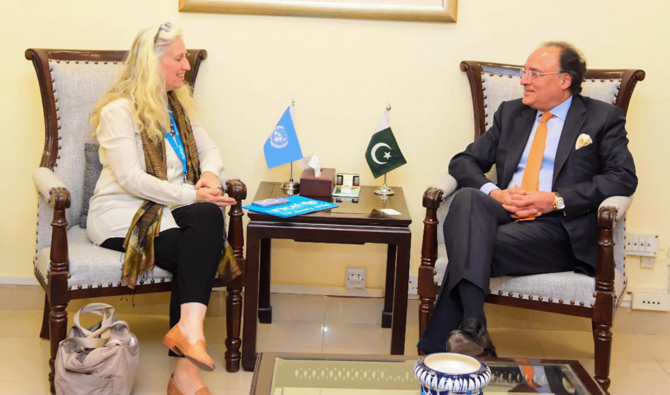
Pakistan's Finance Minister, Muhammad Aurangzeb (right) in conversation with Ms. Pernille Ironside, UNICEF Representative in Pakistan, in Islamabad on September 29, 2025. (Pakistan's Ministry of Finance)
Short Url
Updated 29 September 2025
Follow

Pakistan to direct bulk of $2 billion annual World Bank funds to population challenge

  • Pakistan, World Bank have signed $20 billion decade-long partnership to support climate and growth
  • UNICEF, Pakistan discuss collaboration on climate resilience, education and child stunting

ISLAMABAD: Pakistan will channel nearly two-thirds of the $2 billion expected annually from a new World Bank partnership into tackling population growth and its impact on children, Finance Minister Muhammad Aurangzeb told UNICEF’s representative during a meeting in Islamabad on Monday.

Earlier this year, Pakistan and the World Bank signed a Country Partnership Framework (CPF) for $20 billion in lending to the cash-strapped nation over the coming decade on development issues like the impact of climate change as well as boosting private-sector growth.

Officials say directing most of the funds to population-related interventions will help relieve strain on education, health care, and food systems, as well as improve long-term human capital outcomes.

“The Finance Minister highlighted the two existential challenges facing the country — climate change and population growth — particularly their impact on child stunting and learning poverty,” the Finance Division said in a statement. 

“He discussed the Country Partnership Framework signed with the World Bank, noting that nearly two-thirds of the USD 2 billion expected every year under the program over the next year would be directed toward addressing population-related challenges.”

Pakistan has one of the highest rates of child stunting in South Asia, while more than three-quarters of children cannot read or understand a simple text by age 10, according to UNICEF. These vulnerabilities are compounded by climate shocks, including devastating floods that have displaced millions and destroyed infrastructure.

Aurangzeb stressed the importance of making the best use of available resources and called for greater coordination among federal and provincial governments, UNICEF, and key ministries to identify priority areas and strengthen technical capacity. He said collaboration with partners such as UNICEF and ministries including Climate Change, Population Welfare, and National Health Services was essential for effective project delivery.

According to the statement, UNICEF Representative Pernille Ironside reaffirmed the agency’s commitment to Pakistan, saying UNICEF is “actively working with relevant ministries and stakeholders across a broad range of sectors, with a particular focus on child care and girls’ education.” 

She said the agency was following “a multi-sectoral approach to community welfare, prioritizing projects in education, health, and climate resilience,” and was exploring ways to further strengthen its role in Pakistan.

Both sides reiterated their resolve to work together to address the challenges facing children and communities and to deepen cooperation for sustainable development.


Pakistan condemns Sudan attack that killed Bangladeshi UN peacekeepers, calls it war crime

Updated 14 December 2025
Follow

Pakistan condemns Sudan attack that killed Bangladeshi UN peacekeepers, calls it war crime

  • Six peacekeepers were killed in a drone strike in Kadugli as fighting between Sudan’s army and the RSF grinds on
  • Pakistan, a major troop contributor to the UN, says perpetrators of the attack must be identified, brought to justice

ISLAMABAD: Pakistan on Sunday extended condolences to the government and people of Bangladesh after six United Nations peacekeepers from the country were killed in a drone strike in southern Sudan, condemning the attack and describing it as a war crime.

The attack took place amid a full-scale internal conflict that erupted in April 2023 between the Sudanese Armed Forces (SAF) and the Rapid Support Forces (RSF), a powerful paramilitary group, following a power struggle after the collapse of Sudan’s post-Bashir political transition.

Omar Al-Bashir, who ruled Sudan for nearly three decades, was ousted by the military in 2019 after months of mass protests, but efforts to transition to civilian rule later faltered, plunging the country back into violence that has since spread nationwide.

The drone strike hit a logistics base of the United Nations Interim Security Force for Abyei (UNISFA) in Kadugli, the capital of South Kordofan state, on Saturday, killing the Bangladeshi peacekeepers. Sudan’s army blamed the RSF for the attack, though there was no immediate public claim of responsibility.

“Pakistan strongly condemns the attack on @UNISFA in Kadugli, resulting in the tragic loss of 6 Bangladeshi peacekeepers & injuries to several others,” the country’s permanent mission to the UN said in a social media message. “We honor their supreme sacrifice in the service of peace, and express our deepest condolences to the government and people of #Bangladesh.”

“Such heinous attacks on UN peacekeepers amount to war crimes,” it added. “Perpetrators of this horrific attack must be identified and brought to justice. As a major troop-contributing country, we stand in complete solidarity with all Blue Helmets serving the cause of peace in the perilous conditions worldwide.”

According to Pakistan’s UN mission in July, the country has deployed more than 235,000 peacekeepers to 48 UN missions across four continents over the past eight decades.

Pakistan also hosts one of the UN’s oldest peacekeeping operations, the United Nations Military Observer Group in India and Pakistan (UNMOGIP), and is a founding member of the UN Peacebuilding Commission.

More than 180 Pakistani peacekeepers have lost their lives while serving under the UN flag.

Pakistan and Bangladesh have also been working in recent months to ease decades of strained ties rooted in the events of 1971, when Bangladesh — formerly part of Pakistan — became independent following a bloody war.

Relations have begun to shift following the ouster of former Bangladeshi prime minister Sheikh Hasina last year amid mass protests.

Hasina later fled to India, Pakistan’s neighbor and arch-rival, creating space for Islamabad and Dhaka to rebuild their relationship.