

Myanmar army razed Rohingya villages to build security outposts, UN backed report says

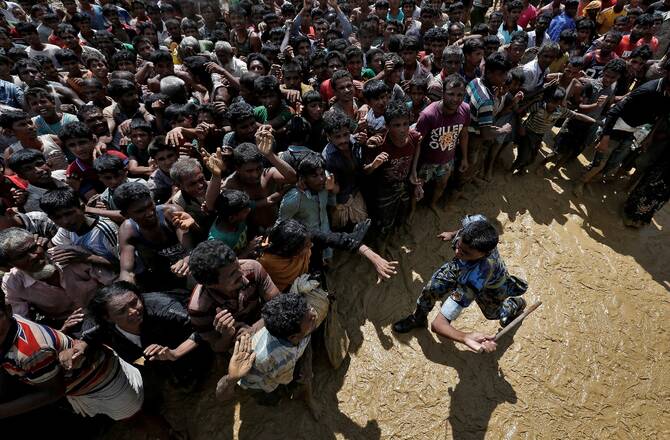
A security officer attempts to control Rohingya refugees waiting to receive aid in Cox's Bazar, Bangladesh. (Reuters)
Short Url
Updated 29 September 2025
Follow

Myanmar army razed Rohingya villages to build security outposts, UN backed report says

  • The report came a day ahead of a UN high level meeting in New York focused on the Rohingya crisis, where officials will discuss the worsening conditions in Bangladesh’s refugee camps and the stalled repatriation efforts
  • Some 1.3 million Rohingya refugees now live in densely packed camps in Bangladesh, following the military operation that the United Nations later described as a “textbook example of ethnic cleansing”

After the 2017 expulsion of the Muslim minority Rohingya from Myanmar’s Rakhine state, the military destroyed villages and mosques and repurposed their lands for security outposts, according to a UN-backed investigation released on Monday.
Violence against the Rohingya escalated dramatically in August 2017 when Myanmar’s military launched an operation in response to militant attacks, driving out hundreds of thousands from their homes in the coastal state.
Some 1.3 million Rohingya refugees now live in densely packed camps in Bangladesh, following the military operation that the United Nations later described as a “textbook example of ethnic cleansing.”
“Myanmar authorities systematically destroyed Rohingya villages, mosques, cemeteries and farmland. They had knowledge of Rohingya land rights and tenure through official records,” said the report by the Independent Investigative Mechanism for Myanmar.

REPORT USED FIRST-HAND ACCOUNTS, SATELLITE IMAGES
A Myanmar military spokesperson did not respond to calls from Reuters seeking comment on the report, which IIMM said is based on first-hand accounts of witnesses, geospatial imagery, video footage, official records and documentation.
Myanmar’s military has previously said it did not commit genocide against the Rohingya during the 2017 operations, but crimes may have been committed on an individual level.
The report came a day ahead of a UN high-level meeting in New York focused on the Rohingya crisis, where officials will discuss the worsening conditions in Bangladesh’s refugee camps and the stalled repatriation efforts.
“Private companies and associated individuals played a direct role by providing machinery and labor to bulldoze villages and build infrastructure under state contracts,” according to the investigation.
For instance, in the village tract of Inn Din, where Reuters reported in 2018 on the killing of 10 Rohingya men, the military destroyed settlements to build a new facility, according to IIMM.
“The base was built directly over the remains of Inn Din (East and Rakhine) villages, with cleared land replaced by new roads, permanent buildings, fortified compounds and two helipads,” the report said.

INVESTIGATORS FACE FUNDING CUTS
Myanmar has been in political turmoil since the military staged a coup in February 2021, ousting a civilian government led by Nobel laureate Aung San Suu Kyi and triggering a civil war.
The IIMM was established by the UN Human Rights Council in 2018 to investigate serious international crimes committed in Myanmar since 2011 to facilitate prosecutions. But it is grappling with deep funding cuts that it says could affect its ability to gather evidence.
An IIMM spokesperson said its open-source investigations team is directly affected and does not currently have funding to continue its work beyond year-end.
The Rohingya now face renewed threats of violence and displacement as fighting rages in Rakhine state, with some members of the minority community taking up arms.
“There is widespread agreement in the international community that Rohingya must be allowed to return home to Myanmar once conditions exist that allow for their safe, voluntary, dignified and sustainable repatriation,” said IIMM chief Nicholas Koumjian.
“However, in many cases their homes, even their villages, no longer exist.”


Afghanistan says it thwarted Pakistani airstrike on Bagram Air Base as fighting enters fourth day

Updated 01 March 2026
Follow

Afghanistan says it thwarted Pakistani airstrike on Bagram Air Base as fighting enters fourth day

  • The fighting has been the most severe between the neighbors for years
  • Pakistan accuses Taliban government of harboring militant groups that stage attacks against it

KABUL: Afghanistan thwarted attempted airstrikes on Bagram Air Base, the former US military base north of Kabul, authorities said Sunday, while cross-border fighting between Pakistan and Afghanistan stretched into a fourth day.
The fighting has been the most severe between the neighbors for years, with Pakistan declaring that it’s in “open war” with Afghanistan.
The conflict has alarmed the international community, particularly as the area is one where other militant organizations, including Al-Qaeda and the Daesh group, still have a presence and have been trying to resurface.
Pakistan accuses Afghanistan’s Taliban government of harboring militant groups that stage attacks against it and also of allying with its archrival India.
Border clashes in October killed dozens of soldiers, civilians and suspected militants until a Qatari-mediated ceasefire ended the intense fighting. But several rounds of peace talks in Turkiye in November failed to produce a lasting agreement, and the two sides have occasionally traded fire since then.
On Sunday, the police headquarters of Parwan province, where Bagram is located, said in a statement that several Pakistani military jets had entered Afghan airspace “and attempted to bomb Bagram Air Base” at around 5 a.m.
The statement said Afghan forces responded with “anti-aircraft and missile defense systems” and had managed to thwart the attack.
There was no immediate response from Pakistan’s military or government regarding Kabul’s claim of attempted airstrikes on Bagram or the ongoing fighting.
Bagram was the United States’ largest military base in Afghanistan. It was taken over by the Taliban as they swept across the country and took control in the wake of the chaotic US withdrawal from the country in 2021. Last year, US President Donald Trump suggested he wanted to reestablish a US presence at the base.
The current fighting began when Afghanistan launched a broad cross-border attack on Thursday night, saying it was in retaliation for Pakistani airstrikes the previous Sunday.
Pakistan had said its airstrike had targeted the outlawed Pakistani Taliban, also known as Tehreek-e-Taliban Pakistan, or TTP. Afghanistan had said only civilians were killed.
The TTP militant group, which is separate but closely allied with Afghanistan’s ruling Taliban, operates inside Pakistan, where it has been blamed for hundreds of deaths in bombings and other attacks over the years.
Pakistan accuses Afghanistan’s Taliban government of providing a safe haven within Afghanistan for the TTP, an accusation that Afghanistan denies.
After Thursday’s Afghan attack, Pakistani Defense Minister Khawaja Mohammad Asif declared that “our patience has now run out. Now it is open war between us.”
In the ongoing fighting, each side claims to have killed hundreds of the other side’s forces — and both governments put their own casualties at drastically lower numbers.
Two Pakistani security officials said that Pakistani ground forces were still in control on Sunday of a key Afghan post and a 32-square-kilometer area in the southern Zhob sector near Kandahar province, after having seized it during fighting Friday. The captured post and surrounding area remain under Pakistani control, they added. The officials spoke on condition of anonymity, because they weren’t authorized to speak publicly.
In Kabul, the Afghan government rejected Pakistan’s claims. Deputy government spokesman Hamdullah Fitrat called the reports “baseless.”
Afghan officials said that fighting had continued overnight and into Sunday in the border areas.
The police command spokesman for Nangarhar province, Said Tayyeb Hammad, said that anti-aircraft missiles were used from the provincial capital, Jalalabad, and surrounding areas on Pakistani fighter jets flying overhead Sunday morning.
Defense Ministry spokesman Enayatulah Khowarazmi said that Afghan forces had launched counterattacks with snipers across the border from Nangarhar, Paktia, Khost and Kandahar provinces overnight. He said that two Pakistani drones had been shot down and dozens of Pakistani soldiers had been killed.
Fitrat said that Pakistani drone attacks hit civilian homes in Nangarhar province late Saturday, killing a woman and a child, while mortar fire killed another civilian when it hit a home in Paktia province.
There was no immediate response to the claims from Pakistani officials.