

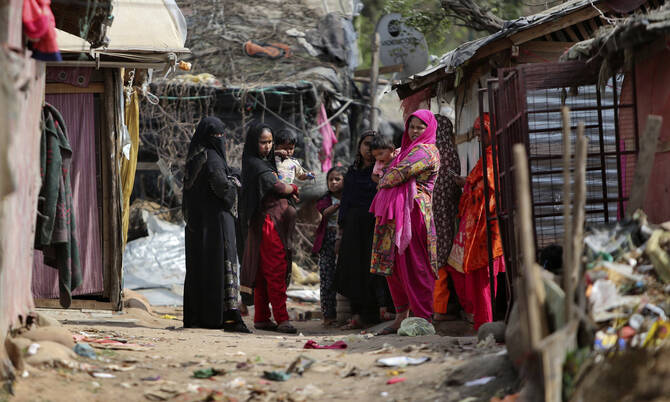

NEW DELHI: After more than a decade of living in India as a refugee, 55-year-old Nobel Hussain — whose real name has not been used due to concerns over his safety — was among dozens of Rohingya who were forced off an Indian naval vessel into the Andaman Sea in May, amid a crackdown on “illegal immigrants” that has seen hundreds being unlawfully forced out of India.
Hussain said he and his wife were detained in New Delhi along with at least 40 other Rohingya refugees. After being forced onto a military plane and flown to another location, they were forced onto a naval vessel and cast into the sea near Myanmar.
“It was 4 a.m., we were asked to put on life jackets, our legs and hands were tied, and we were put (into) boats,” he told Arab News. ”After some time, they untied us and threw us in the sea. We had to swim for 30 minutes before we saw land and were rescued by the locals.”
Hussain and his wife, who are both registered with the United Nations High Commissioner for Refugees, have been living in hiding ever since and face an uncertain future in Myanmar — a country they fled years ago in fear for their lives.
“We don’t have any documents. Myanmar is always attacking our area. My wife, who has cancer, has sleepless nights. We live in constant fear and don’t know what will happen to us when we are caught,” he said.
“What the Indian government did to us is inhumane … We thought that we had escaped the danger when we landed in India in 2013, but the Indian government has brought us back to the same predators we thought we escaped.”
India’s Ministry of Home Affairs did not respond to Arab News’ request for comment.
Tom Andrews, UN Special Rapporteur on the situation of human rights in Myanmar, started a probe in May into what it called “unconscionable, unacceptable acts,” following “credible reports” of Indian authorities rounding up Rohingya refugees and expelling them, which included the case of the Rohingya refugee group of which Hussain was a part.
A report by Human Rights Watch published on Friday stated that Indian authorities have deported more than 200 ethnic Rohingya refugees to Bangladesh and Myanmar since May 2025, while hundreds of others have been arbitrarily detained.
India does not have a national policy or a law on the status and treatment of refugees. It is also not a signatory to the 1951 Refugee Convention, which outlines the rights of refugees and the legal obligations of states to protect them.
Most Rohingya refugees fled Myanmar in 2017, when its military launched a brutal crackdown — widely regarded as ethnic cleansing — on Rohingya Muslims in western Rakhine State.
While most of them sought safety in neighboring Bangladesh, many also escaped to Hindu-majority India, where an estimated 40,000 now live, more than 20,000 of whom are registered with the UNHCR.
The increasing crackdown against Rohingya in India appears to be part of a broader campaign led by Prime Minister Narendra Modi’s Bharatiya Janata Party, which has been expelling the persecuted minority and Bengali-speaking Muslims for being “illegal immigrants,” HRW said.
One Rohingya refugee living in Delhi, who asked not to be identified, said his brother was in the same group as Hussain. In early May, he and others were taken to the local police station under the guise of collecting biometric data, but were later detained by authorities.
Since then, he has only managed a single brief call with his brother, who is also registered with the UNHCR and had lived in Delhi since 2017.
“My brother and others escaped the brutal Myanmar army to save their lives. The Indian government has pushed them into the hands of the same predator … What is our crime? We don’t want to live in India but we are persecuted in our country. Such arbitrary detention breaks the family, it brings the unimaginable pain of separation and utter helplessness,” the man told Arab News. ”We want India to show some humanity. We are not illegal. We are registered with the UNHCR and want to live like refugees with respect.”
Sabber Kyaw Min, founder of Delhi-based NGO Rohingya Human Rights Initiative, said the deportations of Rohingya are a “violation” of the Indian constitution.
“Myanmar is not safe for Rohingya. To send refugees back to the same place where they are under attack is not on par with humanitarian law and human values. There are so many other refugees, like Afghans, Africans and others, who are living in India,” he told Arab News. “Why is India targeting Rohingya?
“We don’t want to criticize India. India should show humanity towards the women, children and unfortunate people of Rohingya,” he continued.
While Indian policy has historically been in favor of refugees, activist Priyali Suri of the Azadi Project, an NGO that works for refugees, said the government’s approach to refugees has changed in the last decade.
“India has never been a signatory of the Refugee Convention, but we have welcomed refugees in our land. We have welcomed Sri Lankan refugees, we’ve welcomed Tibetan refugees, we’ve welcomed Afghan refugees, refugees who’ve made this their home,” she told Arab News.
“It is very sad, and rather infuriating, that human beings who are already persecuted, who are fearing for their lives, have been deported in such a merciless manner. These deportations are clearly a political message that this current establishment stands for a certain kind of political ideology that does not support human rights, does not support refugee rights, and does not adhere to international conventions.”


