

Myanmar army razed Rohingya villages to build security outposts, UN backed report says

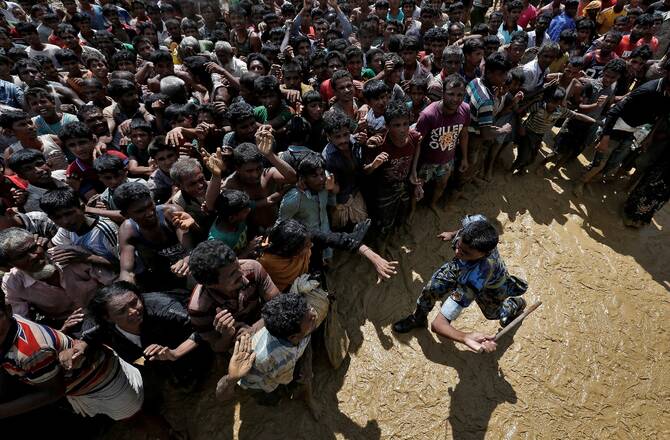
A security officer attempts to control Rohingya refugees waiting to receive aid in Cox's Bazar, Bangladesh. (Reuters)
Short Url
Updated 29 September 2025
Follow

Myanmar army razed Rohingya villages to build security outposts, UN backed report says

  • The report came a day ahead of a UN high level meeting in New York focused on the Rohingya crisis, where officials will discuss the worsening conditions in Bangladesh’s refugee camps and the stalled repatriation efforts
  • Some 1.3 million Rohingya refugees now live in densely packed camps in Bangladesh, following the military operation that the United Nations later described as a “textbook example of ethnic cleansing”

After the 2017 expulsion of the Muslim minority Rohingya from Myanmar’s Rakhine state, the military destroyed villages and mosques and repurposed their lands for security outposts, according to a UN-backed investigation released on Monday.
Violence against the Rohingya escalated dramatically in August 2017 when Myanmar’s military launched an operation in response to militant attacks, driving out hundreds of thousands from their homes in the coastal state.
Some 1.3 million Rohingya refugees now live in densely packed camps in Bangladesh, following the military operation that the United Nations later described as a “textbook example of ethnic cleansing.”
“Myanmar authorities systematically destroyed Rohingya villages, mosques, cemeteries and farmland. They had knowledge of Rohingya land rights and tenure through official records,” said the report by the Independent Investigative Mechanism for Myanmar.

REPORT USED FIRST-HAND ACCOUNTS, SATELLITE IMAGES
A Myanmar military spokesperson did not respond to calls from Reuters seeking comment on the report, which IIMM said is based on first-hand accounts of witnesses, geospatial imagery, video footage, official records and documentation.
Myanmar’s military has previously said it did not commit genocide against the Rohingya during the 2017 operations, but crimes may have been committed on an individual level.
The report came a day ahead of a UN high-level meeting in New York focused on the Rohingya crisis, where officials will discuss the worsening conditions in Bangladesh’s refugee camps and the stalled repatriation efforts.
“Private companies and associated individuals played a direct role by providing machinery and labor to bulldoze villages and build infrastructure under state contracts,” according to the investigation.
For instance, in the village tract of Inn Din, where Reuters reported in 2018 on the killing of 10 Rohingya men, the military destroyed settlements to build a new facility, according to IIMM.
“The base was built directly over the remains of Inn Din (East and Rakhine) villages, with cleared land replaced by new roads, permanent buildings, fortified compounds and two helipads,” the report said.

INVESTIGATORS FACE FUNDING CUTS
Myanmar has been in political turmoil since the military staged a coup in February 2021, ousting a civilian government led by Nobel laureate Aung San Suu Kyi and triggering a civil war.
The IIMM was established by the UN Human Rights Council in 2018 to investigate serious international crimes committed in Myanmar since 2011 to facilitate prosecutions. But it is grappling with deep funding cuts that it says could affect its ability to gather evidence.
An IIMM spokesperson said its open-source investigations team is directly affected and does not currently have funding to continue its work beyond year-end.
The Rohingya now face renewed threats of violence and displacement as fighting rages in Rakhine state, with some members of the minority community taking up arms.
“There is widespread agreement in the international community that Rohingya must be allowed to return home to Myanmar once conditions exist that allow for their safe, voluntary, dignified and sustainable repatriation,” said IIMM chief Nicholas Koumjian.
“However, in many cases their homes, even their villages, no longer exist.”


Why Somali migrants may still aim for US despite travel restrictions

Updated 2 sec ago
Follow

Why Somali migrants may still aim for US despite travel restrictions

MOGADISHU: Somali migrant Mohamed Abdi Awale endured horrors on an ill-fated journey across Africa to seek a better life in the West — but he’s determined to try again one day, even aiming for the US despite increasing restrictions.
Awale is one of 165 Somali migrants recently repatriated after being detained in Libya, where the International Organization for Migration says those caught on journeys to Europe face “unacceptable and inhumane conditions.”
Awale undertook a more than 5,000-kilometer (3,100-mile) journey, leaving Somali capital Mogadishu to cross Kenya, Uganda, South Sudan and Sudan.
He was captured by smugglers near the Sudan-Libyan border and taken to the Sahara oasis town of Kufra, where captors filmed him being tortured in a bid to extract a ransom from his family.
“Torture became normal,” Awale said. “If you failed to pay, they beat you until you fainted. Some people lost their minds. Others didn’t survive.”
Unable to afford the ransom, his mother, Hawo Elmo Rage, turned to social media, pleading with Somalis at home and abroad to help her save her son.
“They told me to send the money or they would take his life,” Rage said. She ultimately raised $17,000, enough to free him.
Awale was released from Kufra and put in a car bound for the Mediterranean coast with other migrants. After their vehicle broke down, the group trekked for more than two weeks, facing starvation and dehydration.
“I thought we would die there,” Awale said.
The group was then detained outside of Tripoli, and Awale spent a month in prison in the coastal town of Sirte and another two months in detention in Tripoli before his repatriation to Somalia in November.
Awale became one of hundreds of thousands of Somalis that have fled the country in more than three decades of civil war, according to UNHCR, the UN refugee agency, which estimates that another 3.5 million people are displaced within Somalia itself.
While most Somali refugees live in neighboring countries like Kenya, according to UNHCR, many like Awale have been inspired to seek a future in the West. Awale said that he dreamed of moving to the US since he was a child.
“I want him to stay,” his mother said. “But I know he wishes for a better life. I pray God gives him a safe future— not the dangerous one he found.”
Changes to immigration policy this year under Trump administration changed the calculus of migrants like Awale. US President Donald Trump banned travel to the US by citizens of Somalia and 11 other countries in June — so Awale set his sights on Europe.
Awale remains hopeful that he will reach the US one day, despite anti-Somali sentiment from the White House and a further tightening of immigration restrictions for Somalis.
The White House also announced this week that it was pausing all immigration applications for people from 19 countries, including Somalia.
“My dream was America, but I felt like Trump closed that door,” Awale said. “Maybe after Trump’s term ends.”