Saudi cultural sector attracts $500m in FDI, 1,700 foreign investors, says Al-Falih
Saudi cultural sector attracts $500m in FDI, 1,700 foreign investors, says Al-Falih /node/2617139/business-economy
Saudi cultural sector attracts $500m in FDI, 1,700 foreign investors, says Al-Falih
Arab News’ Editor-in-Chief Faisal J. Abbas with Minister of Investment Khalid Al-Falih, Faisal Alibrahim, Saudi Arabia’s minister of economy and planning. AN
Saudi cultural sector attracts $500m in FDI, 1,700 foreign investors, says Al-Falih
Updated 29 September 2025
Miguel Hadchity
RIYADH: Saudi Arabia’s cultural sector has attracted $500 million in foreign investment and 1,700 non-Saudi investors, one of the Kingdom’s leading ministers has revealed.
Speaking at the inaugural Cultural Investment Conference in Riyadh, Minister of Investment Khalid Al-Falih explained how Saudi Arabia’s push to become a global cultural hub is accelerating.
“We have today over 50,000 investors in the Kingdom of Saudi Arabia — Saudi and international — that are categorized as investors in culture and creative categories,” he said.
During the conference’s first panel, which was moderated by Arab News’ Editor-in-Chief Faisal J. Abbas, the minister detailed the rapid growth of the cultural economy.
“I can tell you from nothing six, seven years ago we have today over $500 million ... in foreign investments in culture as of last year, so it is accelerating as we go, growing at double digit,” he stated.
He further specified that a significant portion of this investment is coming from abroad, noting: “I’m happy to say that we have 1,700 international investors that are investing in culture, creative, arts, events, entertainment, and all of the things that we classify under this very broad definition of culture.”
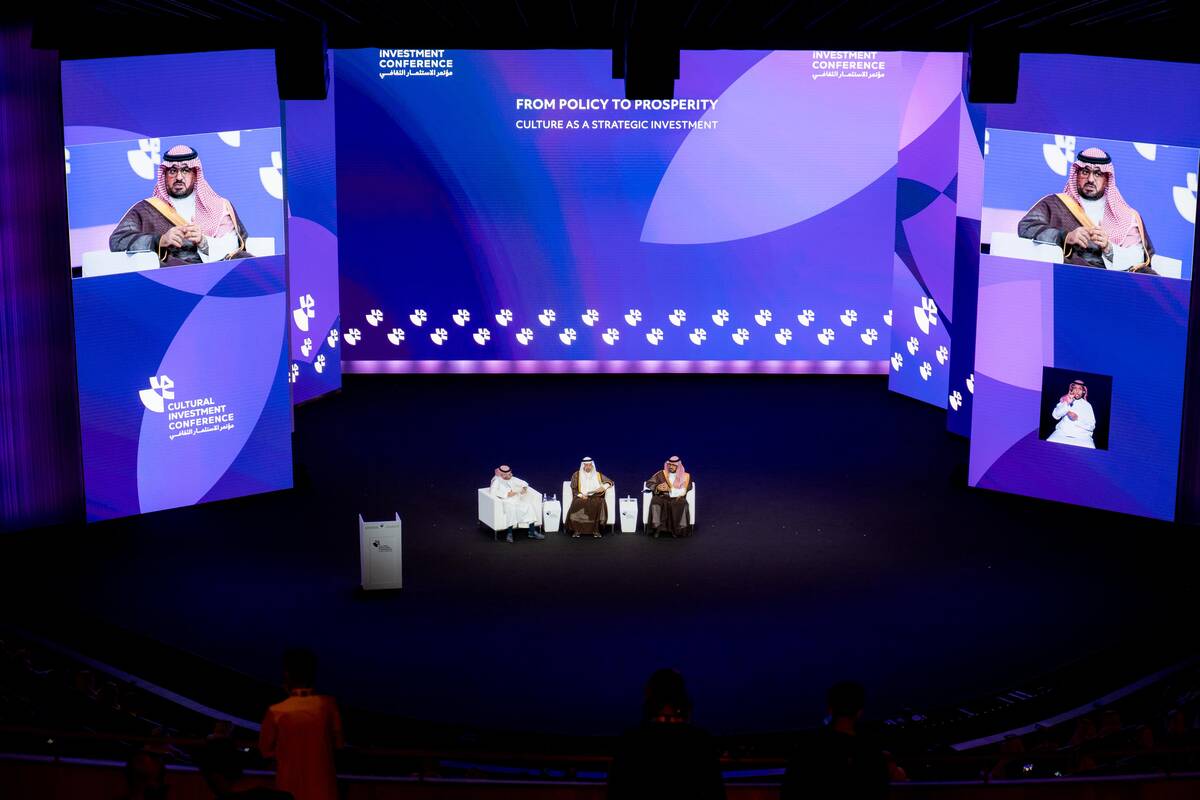
The two-day Cultural Investment Conference will feature over 38 panel discussions. AN
The conference, organized by the Ministry of Culture and held at the King Fahd Cultural Center, drew a global audience of investors, cultural leaders, and decision-makers. The event aims to position the Kingdom as a leading destination for cultural investment, a key pillar of its Saudi Vision 2030 economic diversification plan.
Minister Al-Falih framed the cultural investment as essential to the nation’s identity and appeal. “If you don’t have a soul as a country and as a society, you’re a no country. Nobody will want to come and visit,” he said, adding that “Riyadh and the Kingdom has become a cultural hub,” with the upcoming Riyadh Season event as a prime example.
This drive is a core component of Saudi Vision 2030’s Quality of Life Program, which aims to enhance cultural offerings, entertainment, and overall livability for citizens and residents.
“This is serious business” - Minister of Economy and Planning @falibrahim on the importance of the culture sector and its pivotal role in economic diversification during a panel session titled ‘From Policy to Prosperity – Culture as a Strategic Investment’ during the… pic.twitter.com/Uz96XabOIU
Echoing this sentiment, Faisal Alibrahim, Saudi Arabia’s minister of economy and planning, emphasized the strategic priority of the sector.
“For the Kingdom of Saudi Arabia, this is pivotal for the first wave of economic diversification that we witnessed,” Alibrahim said.
He revealed that the cultural sector already employs approximately 235,000 people, with the target being to triple the sector’s contribution to the economy by 2030, driven significantly by exports.
Both ministers outlined a collaborative model for growth. Al-Falih described a focused approach to creating a triangle between investment by investors, government support, and government direct investment in the sector, along with the third category, civil society.
He noted that the Ministry of Investment has already developed 40 specific investment opportunities in the sector, which are listed on the Invest Saudi platform.
Minister Alibrahim highlighted that in the formative years of Vision 2030, spending on culture was “equally as important as, and maybe even more important than” traditional budget items.
He went on to link cultural development to the Kingdom’s global reputation, saying: “People remember generosity, and today are seeing an increase in the quality of the user experience when you interact with the Kingdom.”
The minister highlighted the culture sector’s need for entrepreneurs, not only large corporations. Using South Korea as a model, he explained how its rapid diversification led to a boom in cultural exports, a form of soft power that even inspired Saudis to learn the language.
Bank of Korea data shows that the country’s intellectual property exports, which includes music, films, and games, more than tripled over the last decade to reach $9.85 billion in 2024.
The two-day Cultural Investment Conference, featuring over 38 panel discussions, marks a significant step in Saudi Arabia’s strategy to empower its cultural sector as a dynamic economic engine and strengthen its cultural presence on the world stage.
Saudi-US business ties in ‘position of strength,’ US Chamber of Commerce official tells Arab News
Steve Lutes says Saudi-US ties are resilient and rapidly shifting toward technology, innovation and next-generation economic cooperation
Saudi Vision 2030 reforms are driving a surge in US corporate interest across sectors like AI, cloud services, biotech and advanced manufacturing
Updated 18 November 2025
Arab News
RIYADH: Business and investment ties between Saudi Arabia and the US are in a “position of strength,” a US Chamber of Commerce official told Arab News ahead of Crown Prince Mohammed bin Salman’s visit to the country.
Steve Lutes, vice president for Middle East affairs at the organization, described the state of bilateral relations between Riyadh and Washington as “durable and resilient,” adding that such visits are “important milestones, they’re momentous.”
The timing of the crown prince’s visit is noteworthy. It comes as Saudi Arabia’s Vision 2030 reform program nears its 10-year mark, and as American companies recalibrate their global strategies to tap into rapidly growing markets.
HUMAIN and Qualcomm Technologies, Inc. announced a collaboration to deploy advanced AI infrastructure in Saudi Arabia. (Supplied)
Washington has consistently ranked among the Kingdom’s top trading partners, with total trade in goods and services surpassing $35 billion in 2023, according to official US data.
Energy remains a major pillar, but a new generation of partnerships has emerged in areas such as cloud computing, biotechnology and renewable infrastructure — reflecting the profound shift underway in the Kingdom’s economic model.
US companies have played a vital role as economic, commercial and investment partners to the Kingdom’s diversification journey under Vision 2030, Lutes said, adding that the visit comes as an opportunity to gain momentum.
“It’s really important that everyone understand that in the current day we have very strong commercial and economic ties,” he said. “They’re deep and they’re growing with our strategic partner, the Kingdom of Saudi Arabia.”
Lutes said US businesses are eager to use the visit to deepen ties in emerging sectors where Saudi Arabia is advancing rapidly, especially digital transformation, advanced manufacturing, data infrastructure and artificial intelligence.
Beyond the traditional oil and defense nexus that has long defined US-Saudi commerce, a wave of new agreements is reshaping the economic map.
American firms such as Google Cloud, Oracle and Amazon Web Services have established operations in the Kingdom, supporting its push to become a regional hub for digital services.
Saudi Arabia will host the FIFA World Cup 2034. (Supplied)
Meanwhile, Lucid Motors, the California-based electric vehicle manufacturer in which the Saudi Public Investment Fund holds a majority stake, is ramping up local production at its $3.4 billion plant in King Abdullah Economic City, one of the flagship industrial projects under Vision 2030.
Regarding the scope of collaboration, Lutes highlighted the importance of AI being at the forefront of emerging deals and partnerships.
“So, for this visit, I think we’re very keen to see — whether it’s in AI or in other innovative technologies — that we see more partnerships, new investments,” he said.
He added that AI and technology fall under “knowledge-based sectors” that the US and Saudi governments continuously work together on, including the space sector.
This emphasis reflects growing momentum behind Saudi investment in digital infrastructure.
The Kingdom has pledged more than $6 billion toward AI and tech-related projects, including the creation of sovereign computing capacity and partnerships with American developers focused on natural language modeling and cloud-based analytics.
Microsoft shares strong progress on datacenter region in Saudi Arabia; construction complete on three sites, with availability expected in 2026. (Microsoft)
For Washington, this growing ecosystem represents a vital entry point for US innovation into the Gulf’s future-oriented industries.
Adding to the discussion surrounding AI, the recent deal between HUMAIN and Qualcomm was brought up as an example of what Lutes called “the art of the possible.”
Such deals are “going to very much be at the heart of our bilateral economic relationship going forward and that’s exciting, that’s energizing and, again, I think deals like that are going to only accelerate that trend,” he said.
The HUMAIN-Qualcomm collaboration, announced earlier this year, is only one of several such partnerships linking cutting-edge US chip design and AI technology with Saudi entities.
It follows announcements by IBM, Nvidia, and Microsoft to explore joint AI research and data management projects with Saudi institutions.
Lucid Motors, the California-based electric vehicle manufacturer in which the Saudi Public Investment Fund holds a majority stake, is ramping up local production at its $3.4 billion plant. (Supplied)
Taken together, these projects highlight the evolution of a once oil-dominated alliance into one centered on data, innovation and advanced manufacturing.
Lutes said energy is also an important point of discussion, specifically in relation to data centers.
“I would actually put energy into the mix when it comes specifically to the opportunity to develop data centers there in other energy intensive types of industries, perhaps in advanced manufacturing or other aspects,” he said.
Energy continues to serve as both the foundation and the enabler of this evolving partnership.
The Kingdom’s growing renewable portfolio — including the landmark NEOM Green Hydrogen Project, an $8.4 billion venture involving US engineering firms — illustrates how Riyadh’s energy ambitions now extend well beyond hydrocarbons.
With its abundant solar and wind resources, Saudi Arabia aims to become a top-10 exporter of hydrogen by 2030, with US firms such as Air Products helping to deliver the infrastructure.
Haitham Abdulrahman Al-Ohali, Vice Minister of Communications and Information Technology, Saudi Arabia inaugurated Oracle’s first innovation hub in the Kingdom. (Oracle)
Lutes said that energy and defense are core pillars of the bilateral agenda that will continue for decades onward and evolve in “more innovative and strategic ways.”
While major defense contracts such as those with Lockheed Martin and Raytheon remain central to the relationship, the diversification into renewables, cybersecurity and supply-chain security signals how both governments are repositioning for a multipolar world economy.
Lutes went on to recognize that the strength of bilateral business relations has been deeply rooted in the Kingdom’s Vision 2030 agenda and the commitment of its leadership and institutions.
He said that “big credit is owed to a range of Saudi ministries, ministers, decision makers, those that are even behind the scenes working with organizations like the chamber and our US government to have a very deliberative and consultative process on policy regulations.”
The US-Saudi Business Council reports that American direct investment stock in Saudi Arabia has more than doubled since 2018, reaching almost $14 billion by 2023.
The interaction of different sectors has created a strong foundation for Riyadh and Washington’s partnership and Lutes made sure to note that the visit aims to build on that in more ways than one.
“We’re looking at announcing around the crown prince’s visit the idea of specifically looking at our bilateral relationship — the US-Saudi economic relationship — and what we need to do between now and 2035 to transform it in a way that’s future-built,” he said.
Lutes’ comments come as both governments explore new frameworks for commercial cooperation beyond traditional bilateral agreements.
Washington has been encouraging deeper private sector collaboration, including through the US-Saudi Strategic Dialogue and the Chamber’s US-Saudi Business Program, which convenes CEOs and policymakers from both countries to align on industrial policy, research collaboration and capital flows.
With the Kingdom preparing to host global events such as Expo 2030 and the FIFA World Cup 2034, US companies see opportunities to play a major role in infrastructure, innovation, tourism and technology.
“The Kingdom has major marquee global events coming up,” Lutes said. “We want to think creatively about how US companies can support those global events as well.”
That includes not only construction and logistics, but also the broader “experience economy” — from smart mobility to digital ticketing and hospitality technologies, areas in which American firms have proven expertise.
The Saudi Tourism Development Fund has already signaled interest in partnerships with US entertainment and real estate investors ahead of Expo 2030, which Riyadh hopes will showcase its transformation to tens of millions of visitors.
Qualcomm Technologies, Inc. and Aramco Digital announced their intent to enter into a strategic collaboration to develop, deploy and commercialize state-of-the-art edge AI industrial IoT technologies and solutions. (Qualcomm)
Lutes said that the US wants to be the “partner of choice” for the Kingdom as it continues to diversify and transform its economy, and as both nations advance into a new era of collaboration with the upcoming visit.
For Washington and Riyadh alike, the visit is expected to underscore a message of continuity — that behind the politics, the business relationship remains a cornerstone of stability.