

Popular Egyptian ‘strong man’ goes for another jaw-dropping challenge: Pulling a ship with his teeth

1 / 3
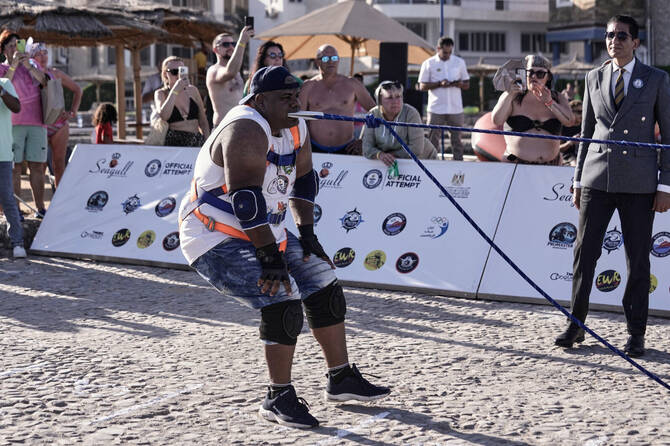
Egyptian wrestler Ashraf Mahrous pulling a 700-ton ship across the water with a rope held only by his teeth, at the marina in the Red Sea resort of Hurghada, Egypt, on Sept. 27, 2025. (AP Photo/Amr Nabil)
2 / 3
Egyptian wrestler Ashraf Mahrous pulls a 700-ton ship across the water with a rope held only by his teeth at the marina of the Red Sea resort of Hurghada, Egypt, on Sept. 27, 2025. (AP Photo/Amr Nabil)
3 / 3
Egyptian wrestler Ashraf Mahrous celebrates after he manages to pull a 700-ton ship across the water with a rope held only by his teeth at the marina of the Red Sea resort of Hurghada, Egypt, on Sept. 27, 2025. (AP Photo/Amr Nabil)
Short Url
Updated 29 September 2025
Follow

Popular Egyptian ‘strong man’ goes for another jaw-dropping challenge: Pulling a ship with his teeth

  • Ashraf Mahrous, also known by his nickname Kabonga, was recognized by Guinness in June 2021, for pulling a 15,730-kg truck with his teeth
  • In February 2024, the international franchise also recognized him for cracking and eating 11 raw eggs in 30 seconds
  • Mahrous, 6 feet 3 inches tall and weighing 155 kilograms (341 pounds), hopes someday to pull a plane using only his eyelid muscles

HURGHADA, Egypt: With nothing but grit, muscle and an iron jaw, a hugely popular Egyptian wrestler geared up for an extraordinary challenge Saturday: pulling a 700-ton ship across the water with a rope held only by his teeth.
“Today, I have come to break the world record,” Ashraf Mahrous said in an interview in Egypt’s Red Sea resort of Hurghada after the challenge.
It was no easy task but Ashraf Mahrous, also known by his nickname Kabonga, has dazzled before with his astonishing strength. Earlier this year, he pulled a train. He has also singlehandedly pulled a locomotive and four years ago, a truck.
With each achievement, his popularity has soared — children run after him in the streets, where he’s known simply as “strong man.”
With the ship pull, Mahrous, a 44-year-old native of the port city of Ismalia, hopes to get yet another recognition from the Guinness World Records.


A triumph by the Red Sea
The scene was set Saturday at the shore in Hurghada. Mahrous first pulled a 700-ton ship, and to affirm his challenge he pulled two ships weighing approximately 1,150 tons together.
“I pulled them both, thanks to God, to prove to my friends and the whole world that God blessed me by being the strongest man in the world,” Mahrous said.
He said the current Guinness World Record is a 614-ton ship set in 2018.
Mahrous said he will send videos and photos of his attempt to Guinness World Records to be evaluated.
In preparation for the feat, Mahrous followed a protein- and iron-rich diet, consuming at least a dozen eggs, two whole chickens, and 5 kilograms (11 pounds) of fish every day — all while training for two hours, three times a day.
It wasn’t his first ship pull. Six years ago, he tried for two hours before he managed to pull a 4,000-ton ship in the water, a rope strapped to his shoulders, for about 30 meters. The event was caught on video.
″I grunted and yelled as I pulled the ship, and I spoke to it, saying ‘It’s either me or you today,’” he told The Associated Press recently at his local gym in Cairo, where he trains daily.
Mahrous believes that speaking with the object he pulls beforehand helps him establish a connection and is key to his success. “It’s important for me to treat the object that I will pull as part of my body that moves along with my heart beat,” he said.


Egyptian wrestler Ashraf Mahrous pulls a 700-ton ship across the water with a rope held only by his teeth at the marina of the Red Sea resort of Hurghada, Egypt, on Sept. 27, 2025. (AP Photo/Amr Nabil)

An extraordinary child
Mahrous, 190 centimeters (6 feet 3 inches) tall and weighing 155 kilograms (341 pounds), said his strength emerged early.
As a child, he would carry his friends for fun and haul heavy loads, several gas cylinders at once on a wheelbarrow. He was 9 when his father lost his job as a contractor in Iraq and after that, Mahrous began knocking on doors, offering to lift heavy items for some cash.
Once, he accidentally broke a friend’s arm when he tried to pull him as they played. He helped people move bricks, sandbags and other heavy materials — and he was fast. He loved sports and trained in kung fu, kickboxing and even established a wrestling team in Cairo.
It was only when his friends saw him easily flip giant tires 10 times in a row in a deserted courtyard at their gym and push a car using only a finger that they encouraged him to go for a world record.
“I was inspired by people who broke records and felt like they are no better than me,” he said. Now he’s less fearful of injuries and more concerned about failing to accomplish a pull.


Egyptian wrestler Ashraf Mahrous celebrates after he manages to pull a 700-ton ship across the water with a rope held only by his teeth at the marina of the Red Sea resort of Hurghada, Egypt, on Sept. 27, 2025. (AP Photo/Amr Nabil)

Past recognitions
In March, he was formally recognized by Guinness World Records for the heaviest rail pull: He pulled a train weighing 279 tons with a rope held by his teeth for a distance of nearly 10 meters (33 feet). At the time, he received two other certificates, for the heaviest locomotive pull and for the fastest 100-meter road vehicle pull.
Mahrous, who is also president of the Egyptian Federation for Professional Wrestlers, was previously recognized by Guinness in June 2021, for pulling a 15,730-kilogram truck with his teeth. And in February 2024, the international franchise recognized him for cracking and eating 11 raw eggs in 30 seconds.
He wears a mouthguard during pulling events but says he has no concerns about his teeth. Instead of going to a dentist, he uses a miswak — a traditional teeth-cleaning twig rich in anti-bacterial compounds that help prevent decay.
He says he takes no supplements but eats, sleeps and works out at least twice every day.
His ambitions are far from over. Next, he plans to send a request to the Egyptian presidency for permission to pull a 263,000-ton submarine.
He also hopes someday to pull a plane using only his eyelid muscles.


Egypt reveals restored colossal statues of pharaoh in Luxor

Updated 14 December 2025
Follow

Egypt reveals restored colossal statues of pharaoh in Luxor

  • Amenhotep III, one of the most prominent pharaohs, ruled during the 500 years of the New Kingdom, which was the most prosperous time for ancient Egypt

LUXOR: Egypt on Sunday revealed the revamp of two colossal statues of a prominent pharaoh in the southern city of Luxor, the latest in the government’s archeological events that aim at drawing more tourists to the country.
The giant alabaster statues, known as the Colossi of Memnon, were reassembled in a renovation project that lasted about two decades. They represent Amenhotep III, who ruled ancient Egypt about 3,400 years ago.
“Today we are celebrating, actually, the finishing and the erecting of these two colossal statues,” Mohamed Ismail, secretary-general of the Supreme Council of Antiquities, said ahead of the ceremony.
Ismail said the colossi are of great significance to Luxor, a city known for its ancient temples and other antiquities. They’re also an attempt to “revive how this funerary temple of King Amenhotep III looked like a long time ago,” Ismail said.
Amenhotep III, one of the most prominent pharaohs, ruled during the 500 years of the New Kingdom, which was the most prosperous time for ancient Egypt. The pharaoh, whose mummy is showcased at a Cairo museum, ruled between 1390–1353 BC, a peaceful period known for its prosperity and great construction, including his mortuary temple, where the Colossi of Memnon are located, and another temple, Soleb, in Nubia.
The colossi were toppled by a strong earthquake in about 1200 BC that also destroyed Amenhotep III’s funerary temple, said Ismail.
They were fragmented and partly quarried away, with their pedestals dispersed. Some of their blocks were reused in the Karnak temple, but archeologists brought them back to rebuild the colossi, according to the Antiquities Ministry.
In late 1990s, an Egyptian German mission, chaired by German Egyptologist Hourig Sourouzian, began working in the temple area, including the assembly and renovation of the colossi.
“This project has in mind … to save the last remains of a once-prestigious temple,” she said.
The statues show Amenhotep III seated with hands resting on his thighs, with their faces looking eastward toward the Nile and the rising sun. They wear the nemes headdress surmounted by the double crowns and the pleated royal kilt, which symbolizes the pharaoh’s rule.
Two other small statues on the pharaoh’s feet depict his wife, Tiye.
The colossi — 14.5 meters and 13.6 meters respectively — preside over the entrance of the king’s temple on the western bank of the Nile. The 35-hectare complex is believed to be the largest and richest temple in Egypt and is usually compared to the temple of Karnak, also in Luxor.
The colossi were hewn in Egyptian alabaster from the quarries of Hatnub, in Middle Egypt. They were fixed on large pedestals with inscriptions showing the name of the temple, as well as the quarry.
Unlike other monumental sculptures of ancient Egypt, the colossi were partly compiled with pieces sculpted separately, which were fixed into each statue’s main monolithic alabaster core, the ministry said.
Sunday’s unveiling in Luxor came just six weeks after the inauguration of the long-delayed Grand Egyptian Museum, the centerpiece of the government’s bid to boost the country’s tourism industry. The mega project is located near the famed Giza Pyramids and the Sphinx.
In recent years, the sector has started to recover after the coronavirus pandemic and amid Russia’s war on Ukraine — both countries are major sources of tourists visiting Egypt.
“This site is going to be a point of interest for years to come,” said Tourism and Antiquities Minister Sherif Fathy, who attended the unveiling ceremony. “There are always new things happening in Luxor.”
A record number of about 15.7 million tourists visited Egypt in 2024, contributing about 8 percent of the country’s GDP, according to official figures.
Fathy, the minister, has said about 18 million tourists are expected to visit the country this year, with authorities hoping for 30 million visitors annually by 2032.