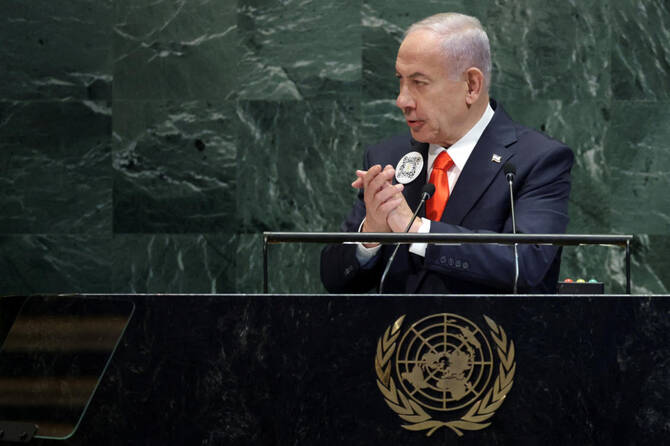
JERUSALEM: Facing increasing isolation abroad and mounting pressure at home, Israeli Prime Minister Benjamin Netanyahu will defend his intention to “finish the job” in Gaza when he meets US President Donald Trump on Monday.
The meeting comes days after Trump unveiled a 21-point plan aimed at ending the war in the Palestinian territory during discussions with Arab and Muslim leaders on the sidelines of the UN General Assembly.
On Sunday, Trump hinted at “something special” to come in Middle East talks, adding in a post on his Truth Social platform: “WE WILL GET IT DONE!!!“
On Friday, Trump had told reporters in Washington “I think we have a deal” on Gaza, even as Netanyahu, speaking at the UN, vowed to “finish the job” in Israel’s war against Hamas.
But experts told AFP that Netanyahu appeared to be cornered, facing growing international and domestic calls to end the war.
“He has no other choice but to accept” Trump’s plan for a ceasefire, said Eytan Gilboa, an expert on US-Israel relations at Israel’s Bar-Ilan University.
“Simply because the United States and Trump have remained almost his only ally in the international community.”
“Comprehensive agreement”
In Israel, tens of thousands of protesters have pressured Netanyahu to agree to a ceasefire, and on Saturday they urged Trump to use his influence.
“The only thing that can stop the slide into the abyss is a full, comprehensive agreement that ends the war and brings all the hostages and the soldiers home,” said Lishay Miran-Lavi, wife of Omri Miran, who remains captive in Gaza.
Directly addressing Trump, she urged: “Use your influence with Prime Minister Netanyahu.”
Israel’s international isolation has deepened in recent days, with countries including the UK, France, Canada and Australia officially recognizing Palestinian statehood, breaking with longstanding US-led diplomatic protocols.
Trump’s 21-point plan, according to a diplomatic source, envisions a permanent ceasefire, the release of hostages, an Israeli withdrawal from Gaza and a major influx of humanitarian aid.
Hamas political bureau member Hossam Badran said Sunday evening that the group “had not received any official proposal from Qatari or Egyptian mediators.”
Arab and Muslim leaders have welcomed the proposal, but have also called for an immediate halt to Israel’s military operations and any occupation of Gaza.
Some elements of the plan will prove hard for Netanyahu to swallow, and could even lead to the collapse of his right-wing government coalition.
Among the most controversial is the involvement of the Ramallah-based Palestinian Authority (PA) in the future governance of Gaza.
The PA ruled the territory until Hamas seized control in 2007, and its potential restoration represents a red line for Netanyahu’s hard-line coalition partners.
While the US proposal conditions the PA’s return on implementing reform programs, these changes “could take years” to materialize, Gilboa warned.
“Broad consensus”
Several far-right ministers in Netanyahu’s coalition have threatened to collapse the government if he agrees to the PA’s return, or if he ends the war without defeating Hamas.
However, opposition leader Yair Lapid has offered a parliamentary “safety net,” promising his centrist Yesh Atid party would support a ceasefire and hostage-release deal — but it is not clear whether other opposition parties would follow suit.
“This kind of broad plan would need a broad consensus,” said Ksenia Svetlova, a former Knesset member who now heads the regional cooperation NGO ROPES.
Svetlova predicted Netanyahu would only accept parts of the deal, while trying to negotiate or postpone decisions on other elements “seem difficult in this moment.”
Another contentious point in the US proposal is who would guarantee security in the Gaza Strip once the Israeli army pulls out and Hamas is disarmed.
The proposal envisions an international security force comprising Palestinian personnel alongside troops from Arab and Muslim nations.
However, critical details about command structure and operational control remain unclear.
“This plan is internationalizing the Gaza conflict in an unprecedented way,” Svetlova said, “but without a clear plan on who will be the guiding star, what the end goals are, who will see it through.”
“The unpredictability factor runs wild here, really.”


![]()

Netanyahu to meet Trump as Israel faces isolation over Gaza war
Short Url
https://arab.news/nunhk
Netanyahu to meet Trump as Israel faces isolation over Gaza war
- Israel’s international isolation has deepened in recent days, with countries including the UK, France, Canada and Australia officially recognizing Palestinian statehood


Latest updates


© 2026 SAUDI RESEARCH & PUBLISHING COMPANY, All Rights Reserved And subject to Terms of Use Agreement.