

UK foreign secretary says ‘no military solution’ in Gaza as Trump backs peace plan

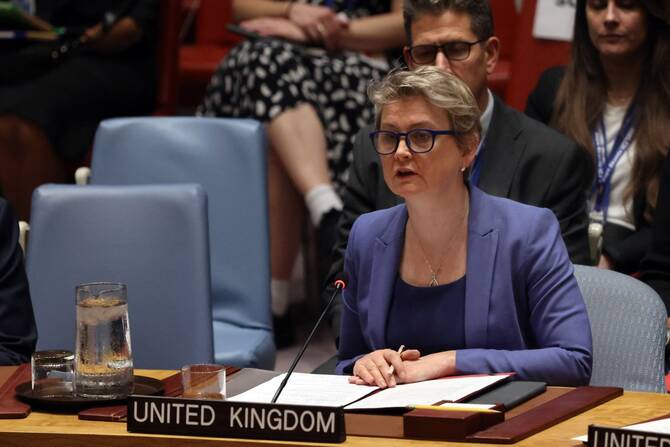
British Foreign Secretary Yvette Cooper attends a Security Council meeting on the situation in the Middle East, Sept. 23, 2025. (AFP)
Short Url
Updated 28 September 2025
Follow

UK foreign secretary says ‘no military solution’ in Gaza as Trump backs peace plan

  • Yvette Cooper says Israeli government ‘urgently needs to change course’ after it pushed forces to occupy Gaza City
  • Cooper has not yet met the Israeli prime minister, although she was in New York when he made his remarks at the UN

LONDON: UK Foreign Secretary Yvette Cooper said that there is “no military solution” in Gaza and called for an end to the war, noting that the international community is making progress toward a peace deal for the Palestinian coastal enclave, backed by the US administration.

Cooper, who reaffirmed the British government’s decision to recognize the state of Palestine during her speech at the UN General Assembly last week, told The Guardian that the international community has “reached a moment where the world wants to end this war.”

Israeli actions in the Gaza Strip since late 2023, which have resulted in the killing of more than 65,000 people in a span of two years, have been labeled as genocide by several EU and UN officials.

Cooper, believed to be one of the cabinet ministers who urged Prime Minister Keir Starmer to recognize Palestinian statehood, refrained from declaring that Israel is committing genocide in Gaza. She said that it is up to the government’s legal expert to make that determination, according to The Guardian.

“For security for Israelis, as well as security for Palestinians and as well as dealing with this devastating humanitarian crisis, I think the Israeli government urgently needs to change course,” she said.

US President Donald Trump announced that a peace deal was attainable in Gaza after several meetings during the general assembly with leaders from Arab and majority-Muslim countries, who urged him to push for an immediate ceasefire in the territory.

The White House is reportedly supporting a plan for a temporary technocratic administration in Gaza, led by Tony Blair, the former UK prime minister and a controversial figure in the Middle East because of his involvement in the 2003 Iraq war. Cooper declined to say if Blair was suitable to lead the Gaza transitional authority, The Guardian added.

“I feel like there is a consensus, a real, huge consensus building, and there was real energy and determination (at the UN) around peace. I think we’ve reached a moment where the world wants to end this war,” Cooper said.

However, Israeli Prime Minister Benjamin Netanyahu, from the UN, vowed to “finish the job.” Since August, Israeli forces have been advancing into Gaza City, the enclave’s main metropolis and home to major government, financial, medical, and educational institutions. It was home to one million Palestinians before the mass displacement since late 2023.

“There is no military solution to this that works, there is no way that the security of Israel is remotely strengthened by this further Gaza City offensive,” Cooper said.

The British diplomat has not yet met Netanyahu, although she was in New York when he made his remarks at the UN. Mahmoud Abbas, the Palestinian president, was the last world leader Cooper met as shadow foreign secretary in 2011 and the first she met after becoming UK foreign secretary this month, according to The Guardian.

“We can’t pretend this isn’t incredibly hard, and how long the crisis has been going on makes it challenging. But there was no doubt that there is a real sense of determination and energy behind trying to get an end to the war and to try and get not just an immediate ceasefire, but a proper plan for the future,” she said.

The 21-point White House peace plan for Gaza is clear that there will be no mass displacement of Palestinians, it excludes Hamas from any future government and prohibits Israel from annexing the West Bank. It remains to be confirmed whether Blair, who served as the Middle East envoy, will head it.

“Everybody can see the horror of what has happened and the fact that it feels like nothing’s being done. It feels like nothing is changing. It feels like everything is just getting worse.

“The challenge for us now is that there is a moment, and we have to make sure that that moment, through international action, is turned into a peace process.”


India accelerates free trade agreements against backdrop of US tariffs

Updated 21 December 2025
Follow

India accelerates free trade agreements against backdrop of US tariffs

  • India signed a CEPA with Oman on Thursday and a CETA with the UK in July 
  • Delhi is also in advanced talks for trade pacts with the EU, New Zealand, Chile 

NEW DELHI: India has accelerated discussions to finalize free trade agreements with several nations, as New Delhi seeks to offset the impact of steep US import tariffs and widen export destinations amid uncertainties in global trade. 

India signed a Comprehensive Economic Partnership Agreement with Oman on Thursday, which allows India to export most of its goods without paying tariffs, covering 98 percent of the total value of India’s exports to the Gulf nation. 

The deal comes less than five months after a multibillion-dollar trade agreement with the UK, which cut tariffs on goods from cars to alcohol, and as Indian trade negotiators are in advanced talks with New Zealand, the EU and Chile for similar partnerships. 

They are part of India’s “ongoing efforts to expand its trade network and liberalize its trade,” said Anupam Manur, professor of economics at the Takshashila Institution. 

“The renewed efforts to sign bilateral FTAs are partly an after-effect of New Delhi realizing the importance of diversifying trade partners, especially after India’s biggest export market, the US, levied tariff rates of up to 50 percent on India.” 

Indian exporters have been hit hard by the hefty tariffs that went into effect in August. 

Months of negotiations with Washington have not clarified when a trade deal to bring down the tariffs would be signed, while the levies have weighed on sectors such as textiles, auto components, metals and labor-intensive manufacturing. 

The FTAs with other nations will “help partially in mitigating the effects of US tariffs,” Manur said. 

In particular, Oman can “act as a gateway to other Gulf countries and even parts of Eastern Europe, Central Asia, and Africa,” and the free trade deal will most likely benefit “labor-intensive sectors in India,” he added. 

The chances of concluding a deal with Washington “will prove to be difficult,” said Arun Kumar, a retired economics professor at the Jawaharlal Nehru University.

“With the US, the chances of coming to (an agreement) are a bit difficult, because they want to get our agriculture market open, which we cannot do. They want us to reduce trade with Russia. That’s also difficult for India to do,” he told Arab News.  

US President Donald Trump has threatened sanctions over India’s historic ties with Moscow and its imports of Russian oil, which Washington says help fund Moscow’s ongoing war with Ukraine.

“President Trump is constantly creating new problems, like with H-1B visa and so on now. So some difficulty or the other is expected. That’s why India is trying to build relationships with other nations,” Kumar said, referring to increased vetting and delays under the Trump administration for foreign workers, who include a large number of Indian nationals. 

“Substituting for the US market is going to be tough. So certainly, I think India should do what it can do in terms of promoting trade with other countries.” 

India has free trade agreements with more than 10 countries, including comprehensive economic partnership agreements with South Korea, Japan, and the UAE.

It is in talks with the EU to conclude an FTA, amid new negotiations launched this year for trade agreements, including with New Zealand and Chile.  

India’s approach to trade partnerships has been “totally transformed,” Commerce and Industry Minister Piyush Goyal said in a press briefing following the signing of the CEPA with Oman, which Indian officials aim to enter into force in three months. 

“Now we don’t do FTAs with other developing nations; our focus is on the developed world, with whom we don’t compete,” he said. “We complement and therefore open up huge opportunities for our industry, for our manufactured goods, for our services.”