Uproar as Pakistan says researcher with Israel-friendly posts not part of UNGA delegation

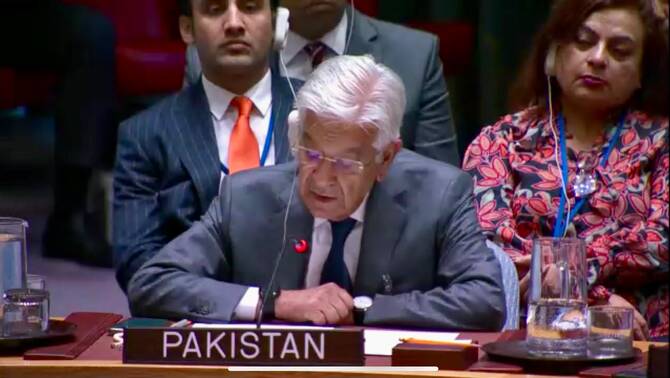
This handout photo, released by Pakistani mission at UN, shows Defense Minister Khawaja Asif and Pakistani researcher Shama Junejo (R) during a Security Council debate at the UN Headquarters in New York on September 24, 2025. (Photo courtesy: X/@PakistanUN_NY)
Short Url
Updated 27 September 2025
Follow

Uproar as Pakistan says researcher with Israel-friendly posts not part of UNGA delegation

  • London-based Dr. Shama Junejo has previously drawn criticism for her social media posts in support of Israel
  • A video showing her seated behind the defense minister at the UNSC has gone viral, sparking the controversy

ISLAMABAD: The Pakistani Foreign Office has denied that researcher Dr. Shama Junejo is part of the country’s delegation to the United Nations General Assembly (UNGA) that is currently led by Prime Minister Shehbaz Sharif, after she was seen sitting behind Defense Minister Khawaja Asif during a Security Council debate this week.

Junejo, a researcher based in London, has previously drawn criticism for her social media posts in support of Israel. A video clip showing Junejo sitting behind Defense Minister Asif at the UNSC on Sept. 25 has gone viral and since caused uproar in Pakistan.

On Friday, Asif said he did not know the woman sitting behind him in the video and it was entirely the prerogative of the Foreign Office to choose analysts and researchers for the Pakistani delegation. The minister said his views on Gaza and Israel have always been clear and only the Foreign Office could answer queries about the said woman.

“To clarify, the individual in question was not listed in the official letter of credence for the Pakistan delegation to the 80th UNGA Session, signed by the Deputy Prime Minister and Foreign Minister,” the Pakistani Foreign Office said on Saturday, responding to queries.

“As such, her seating behind the Defense Minister did not have the approval of the Deputy Prime Minister/Foreign Minister.”

Pakistan does not recognize Israel and has steadfastly supported an independent Palestinian state with pre-1967 borders. PM Sharif also resonated Islamabad’s stance in his address with the UNGA on Friday.

“My emotional attachment and commitment to Palestine spans 60 years,” Defense Minister Asif wrote on X. “My views on Gaza are clear, and I express them openly. My thoughts on Israel and Zionism are nothing but hatred. Who this woman is, why she was with us in the delegation, and why she was seated behind me — only the Foreign Office can answer.”

In a now-deleted Sept. 21 post on X, Junejo, who has been criticized by many Pakistanis for her support of Israel, claimed that she has been working as an adviser to PM Sharif since May 2025. The researcher has also been photographed in the past with PM Sharif, his elder brother and three-time former PM Nawaz Sharif, Punjab Chief Minister Maryam Nawaz and Defense Minister Asif.

In an August 2022 post on X, then Twitter, she said meeting Israeli PM Benjamin Netanyahu “would have been an honor” and that she would have used a photo with him as her profile picture. She has also previously praised Israeli technology, including drip irrigation, suggesting it could benefit Sindh and southern Punjab.

But the researcher said she joined others in leaving the UN General Assembly during Netanyahu’s speech on Friday. “We walked out from UNGA when the war criminal Netanyahu entered,” Junejo said on X.

Asad Qaiser, a former speaker of the lower house of Pakistan parliament, said the defense minister and the Foreign Office were “lying,” asking who allowed Junejo to reportedly travel in a Pakistani plane from London to New York, who allowed her an official Pakistani government seat behind Asif at the UNSC, and who prepared her passes that enabled her to regularly attend UN sessions.

“These questions are extremely important,” Qaiser said. “Most importantly she has been meeting Israeli diplomats and is known for her support to recognize Israel.”

“This is an extremely grave situation that the PM himself must explain,” he added.


Return of millions of Afghans from Pakistan and Iran pushes Afghanistan to the brink, UN warns

Updated 14 February 2026
Follow

Return of millions of Afghans from Pakistan and Iran pushes Afghanistan to the brink, UN warns

  • Afghan authorities provide care packages for those returning that include food aid, cash, a telephone SIM card and transportation
  • But the returns have strained resources in a country struggling with a weak economy, severe drought and two devastating earthquakes

GENEVA: The return of millions of Afghans from neighboring Pakistan and Iran is pushing Afghanistan to the brink, the U.N. refugee agency said on Friday, describing an unprecedented scale of returns.

A total of 5.4 million people have returned to Afghanistan since October 2023, mostly from the two neighboring countries, UNHCR’s Afghanistan representative Arafat Jamal said, speaking to a U.N. briefing in Geneva via video link from Kabul, the Afghan capital.

“This is massive, and the speed and scale of these returns has pushed Afghanistan nearly to the brink,” Jamal said.

Pakistan launched a sweeping crackdown in Oct. 2023 to expel migrants without documents, urging those in the country to leave of their own accord to avoid arrest and forcible deportation and forcibly expelling others. Iran also began a crackdown on migrants at around the same time.

Since then, millions have streamed across the border into Afghanistan, including people who were born in Pakistan decades ago and had built lives and created businesses there.

Last year alone, 2.9 million people returned to Afghanistan, Jamal said, noting it was “the largest number of returns that we have witnessed to any single country.”

Afghanistan’s Taliban rulers have criticized the mass expulsions.

Afghanistan was already struggling with a dire humanitarian situation and a poor human rights record, particularly relating to women and girls, and the massive influx of people amounting to 12% of the population has put the country under severe strain, Jamal said.

Already in just the month and a half since the start of this year, about 150,000 people had returned to Afghanistan, he added.

Afghan authorities provide care packages for those returning that include some food aid, cash, a telephone SIM card and transportation to parts of the country where they might have family. But the returns have strained resources in a country that was already struggling to cope with a weak economy and the effects of a severe drought and two devastating earthquakes.

In November, the U.N. development program said nine out of 10 families in areas of Afghanistan with high rates of return were resorting to what are known as negative coping mechanisms — either skipping meals, falling into debt or selling their belongings to survive.

“We are deeply concerned about the sustainability of these returns,” Jamal said, noting that while 5% of those who return say they will leave Afghanistan again, more than 10% say they know of someone who has already left.

“These decisions, I would underscore, to undertake dangerous journeys, are not driven by a lack of a desire to remain in the country, on the contrary, but the reality that many are unable to rebuild their viable and dignified lives,” he said.