DEIR AL-BALAH: Israeli strikes and gunfire killed at least 38 people across Gaza, health officials said, as international pressure grows for a ceasefire but Israel’s leader remains defiant about continuing the war.
Strikes in central and northern Gaza killed people in their homes in the early hours of Saturday morning, including nine from the same family in a house in the Nuseirat refugee camp, according to health staff at the Al-Awda hospital where the bodies were brought.
The attacks came hours after a defiant Israeli Prime Minister Benjamin Netanyahu told fellow world leaders at the UN General Assembly Friday that his nation “must finish the job” against Hamas in Gaza.
Netanyahu’s words, aimed as much at his increasingly divided domestic audience as the global one, began after dozens of delegates from multiple nations walked out of the UN General Assembly hall en masse Friday morning as he began speaking.
International pressure on Israel to end the war is increasing, as is Israel’s isolation, with a growing list of countries deciding recently to recognize Palestinian statehood — something Israel rejects.
Countries have been lobbying US President Donald Trump to press Israel for a ceasefire. On Friday, Trump told reporters on the White House lawn that he believes the US is close to achieving a deal on easing fighting in Gaza that “will get the hostages back” and “end the war.”
Trump and Netanyahu are scheduled to meet Monday, and Trump said on social media Friday that “very inspired and productive discussions” and “intense negotiations” about Gaza are ongoing with countries in the region.
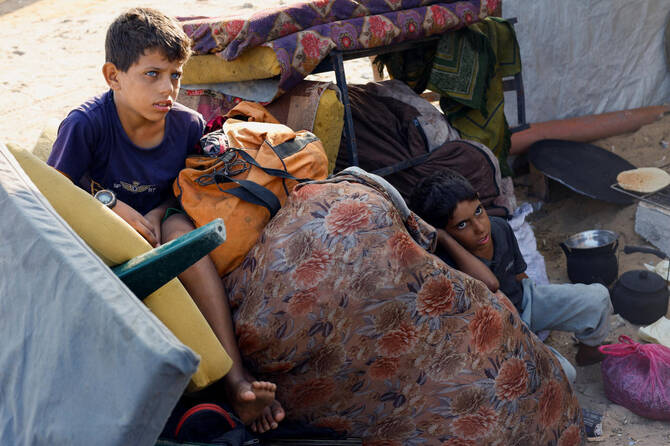
Yet, Israel is pressing ahead with another major ground operation in Gaza City, which experts say is experiencing famine. More than 300,000 people have fled, but up to 700,000 are still there, many because they can’t afford to relocate.
The strikes Saturday morning demolished a house in Gaza City’s Tufah neighborhood, killing at least 11 people, more than half of them women and children, according to the Al-Ahly Hospital where the bodies were brought. Four other people were killed when an airstrike hit their homes in the Shati refugee camp, according to Shifa hospital.
Six other Palestinians were killed by Israeli gunfire while seeking aid in southern and central Gaza, according to Nasser and Al Awda hospitals where the bodies were brought.
Israel’s army did not immediately respond about the airstrikes or the gunfire.
Hospitals and health clinics in Gaza City are on the brink of collapse. Nearly two weeks into the offensive, two clinics have been destroyed by airstrikes, two hospitals shut down after being damaged and others are barely functioning, with medicine, equipment, food and fuel in short supply.
Many patients and staff have been forced to flee hospitals, leaving behind only a few doctors and nurses to tend to children in incubators or other patients too ill to move.
On Friday, aid group Doctors Without Borders said it was forced to suspend activities in Gaza City amid an intensified Israeli offensive. The group said Israeli tanks were less than half a mile from its health care facilities and the escalating attacks have created an “unacceptable level of risk” for its staff.
Meanwhile, the food situation in the north has also worsened, as Israel has halted aid deliveries through its crossing into northern Gaza since Sept. 12 and has increasingly rejected UN requests to bring supplies from southern Gaza into the north, the UN Office for the Coordination of Humanitarian Affairs said.
Israel’s campaign in Gaza has killed more than 65,000 people and wounded more than 167,000 others, according to the Gaza Health Ministry. It doesn’t distinguish between civilians and combatants, but says women and children make up around half the fatalities. The ministry is part of the Hamas-run government, but UN agencies and many independent experts consider its figures to be the most reliable estimate of wartime casualties.


![]()

Airstrikes and shooting kill at least 38 people in Gaza as Israel ignores demands for a ceasefire
Short Url
https://arab.news/vvdyr
Airstrikes and shooting kill at least 38 people in Gaza as Israel ignores demands for a ceasefire
- On Friday, Netanyahu told the UN General Assembly that Israel “must finish the job” against Hamas
- This comes as international pressure mounts for a ceasefire, but Israeli Prime Minister Benjamin Netanyahu remains defiant


Latest updates


© 2026 SAUDI RESEARCH & PUBLISHING COMPANY, All Rights Reserved And subject to Terms of Use Agreement.