

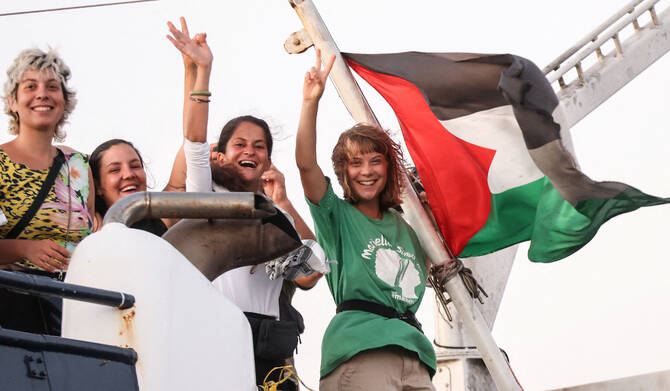

ATHENS, Greece: Spain and Italy say they are sending navy ships to where a flotilla of boats carrying activists seeking to break Israel’s blockade of Gaza is sailing, after the activists said they were attacked by drones near Greece.
The Global Sumud Flotilla said on Friday it was preparing to set sail on the final leg to Gaza after being targeted by drones and communications jamming, with several explosions occurring on or near some of the boats. Some of the vessels were damaged, but no injuries were reported.
Here’s what to know about the flotilla.
The flotilla’s goal
Organizers say the flotilla includes 52 mostly small vessels carrying activists from dozens of countries. They are carrying a symbolic amount of humanitarian aid, mainly food and medicine, for Palestinians in the besieged enclave of Gaza.
The 23-month war has led to a humanitarian catastrophe in the territory that has seen much of it reduced to rubble. The world’s leading authority on the food crisis has declared famine in Gaza’s largest city.
Activists hope their actions will focus attention on the plight of Palestinians. They say the flotilla is the largest attempt to date to break Israel’s maritime blockade of the Gaza Strip, which has now lasted 18 years, long predating the current war in Gaza.
Israel says the blockade is needed to prevent Hamas from importing arms, while critics consider it collective punishment.
The boats’ journey
The core vessels set sail from Spain on Sept. 1, heading east across the Mediterranean Sea, and have been joined by boats from other countries along the way.
The flotilla includes larger vessels that are providing support and provisions for smaller boats.
Participants include high-profile activists such as Swedish climate activist Greta Thunberg and former Barcelona Mayor Ada Colau, as well as members of Italy’s parliament and the European Parliament. Organizers say delegates from 46 countries had committed to participating, with activists including military veterans, doctors, clergy and lawyers.
The bulk of the flotilla was sailing south of the Greek island of Crete on Thursday, heading eastwards. Organizers said they expected to reach the Gaza area within a week.
Drone attacks
Organizers have reported at least three separate instances of participating boats being targeted by drones: twice in Tunisia on Sept. 8 and 9, and once while sailing south of Greece in the early hours of Wednesday.
In the latest attack, the flotilla said it was targeted during the night by “unidentified drones and communications jamming.” Activists said “at least 13 explosions” were heard on and around several flotilla boats, while drones or aircraft dropped “unidentified objects” on at least 10 boats.
No casualties were reported but there was damage to the vessels and “widespread obstruction in communications,” it added.
Thunberg said Thursday that she expects the attacks to intensify in the coming days, adding in an online post: “But we continue undeterred. And the closer we are to Gaza, the bigger grows the risk of escalation toward us.”
Israel vows to block the boats
Israel said Thursday it had no problem with Italy and Spain’s plan to send rescue ships to accompany the flotilla but renewed strong criticism of the aid initiative — warning that the boats would not be allowed to reach Gaza.
“The real purpose of this flotilla is provocation and serving Hamas, certainly not humanitarian effort,” Israeli Foreign Ministry official Eden Bar Tal said. “Israel will not allow any vessel to enter the active combat zone.”
Bar Tal warned the activists against attempting to reach Gaza. “Any further refusal will put the responsibility on the flotilla organizers,” he said, without elaborating.
The Israeli military did not immediately respond to questions regarding Wednesday’s drone attack.
Spain and Italy ready navy ships
Italy and Spain said they were sending military ships to provide assistance and possible rescues if needed.
Spanish officials said a navy offshore patrol vessel, the Furor, was being prepared to sail from the Mediterranean port of Cartagena.
As Premier Giorgia Meloni delivered one of her toughest criticisms of Israel’s actions in Gaza at the UN General Assembly, Italy was also sending an Italian navy ship ready to assist the flotilla if needed.
Defense Minister Guido Crosetto urged the flotilla to offload aid instead in Cyprus, suggesting Italy and the Catholic Church could deliver it safely to Palestinians. He emphasized that Italy couldn’t guarantee the flotilla’s security once it entered another country’s waters, noting Israel might view it as a “hostile act.”
Flotilla organizers rejected the Cyprus proposal and vowed to continue on to Gaza.
The Cyprus proposal is an initiative of Italian Cardinal Matteo Zuppi, who has said the Latin Patriarchate of Jerusalem could get the aid into Gaza. The head of the Latin church in Jerusalem is Italian Cardinal Pierbattista Pizzaballa, who has visited Gaza on a few occasions since the war.
On Friday, Italian President Sergio Mattarella urged the flotilla organizers to reconsider the Cyprus-Pizzaballa option, saying the goal was to get the aid to the people of Gaza and that Pizzaballa’s office could get it there.
“Allow me to address — with genuine intensity — an appeal to the women and men aboard the Flotilla to accept the offer of the Latin Patriarchate of Jerusalem — which is also firmly and courageously committed to supporting the people in Gaza — to carry out the safe delivery of the supplies that this effort of solidarity has collected for the children, women and men in Gaza,” Mattarella said in a statement in English and Italian.
Cypriot deputy government spokesman Yiannis Antoniou said Israel had stated its willingness to accept the aid from Cyprus. “Cyprus is ready to assist if any request for help is made,” he said.
EU warns against use of force
In Athens, activists staged a protest outside the foreign ministry, urging the government to condemn the drone attacks, provide naval protection to the flotilla, and join other European nations in formally recognizing Palestinian statehood.
“I think (recognition) is the very least they could do,” protest organizer Mariketi Stasinou told The Associated Press. “But beyond that, more immediate measures are needed to have real impact and show meaningful solidarity with the Palestinian people.”
UN Human Rights Office spokesperson Thameen Al-Kheetan called for an investigation, while the European Union also warned against the use of any force. “The freedom of navigation under international law must be upheld,” said Eva Hrncirova, a European Commission spokesperson.
Past attempts to break Israel’s blockade of Gaza
It is not the first time activists trying to break Israel’s Gaza blockade have come under attack.
Another vessel said it was attacked by drones in May in international waters off Malta. An overland convoy traveling across North Africa also attempted to reach the border but was blocked by security forces aligned with Egypt in eastern Libya.
In 2010, Israeli commandos raided the Mavi Marmara, a boat participating in an aid flotilla attempting to breach the maritime blockade of Gaza. Nine Turkish citizens and one Turkish-American on board were killed.
The current war
The war began on Oct. 7, 2023, when Hamas-led militants stormed into Israel and killed 1,200 people, mostly civilians, and took 251 others hostage. Israel says its offensive is aimed at pressuring Hamas to surrender and return the remaining 48 hostages, about 20 of whom Israel believes are still alive. Most of the rest were released in ceasefires or other deals.
The Israeli offensive has killed more than 65,000 Palestinians, according to the Gaza Health Ministry. It does not say how many were civilians or combatants, but says around half were women and children.


