ACCRA: The United States has reversed its visa restrictions on Ghana, its foreign minister said Friday, as the west African nation emerges as a key deportation hub in President Donald Trump’s immigration crackdown.
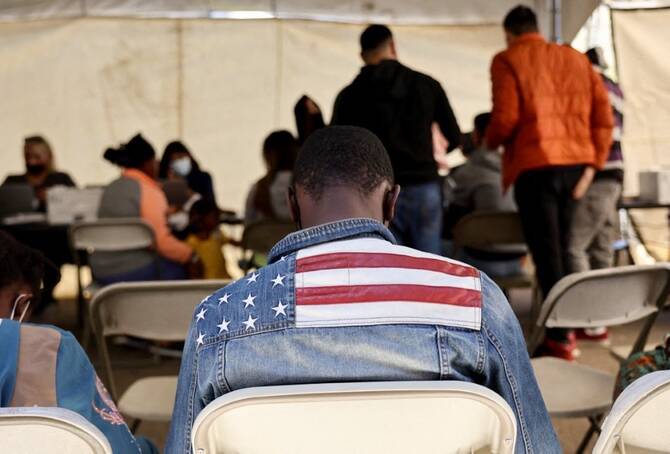
Earlier this month, Ghanaian President John Mahama revealed that the country was accepting west Africans deported by the United States.
US President Donald Trump has made so-called “third-country” deportations a hallmark of his anti-immigration crackdown, sending people to countries where they have no ties or family.
Accra has insisted it has received nothing in return for taking in the deportees, though Mahama acknowledged that the deal was struck as relations were “tightening,” with Washington imposing tariffs as well as visa restrictions in recent months.
“The US visa restrictions imposed on Ghana” have been “reversed,” Ghanaian Foreign Minister Samuel Okudzeto Ablakwa said.
In a post on X, Ablakwa said the “good news” was delivered by US officials on the sidelines of the United Nations General Assembly.
The reversal was the result of “months of high-level diplomatic negotiations,” Ablakwa said.
In June, the United States announced restrictions on most visas for nationals from Cameroon, Ethiopia, Ghana and Nigeria, restricting them to three months and a single entry.
“Ghanaians can now be eligible for five-year multiple entry visas and other enhanced consular privileges,” Ablakwa said.
At least 14 west Africans have been sent to Ghana since the beginning of September, though neither Accra nor Washington has made details of the arrangement public.
They all had won protection from US immigration courts against being deported to their home nations, their lawyers said, even as Ghana has forwarded on at least four to their country of origin, according to an AFP tally.
After weeks of detention in Ghana, allegedly under military guard and in poor conditions, eight to 10 of the deportees were abruptly sent to Togo last weekend and left to fend for themselves, US-based lawyer Meredyth Yoon told AFP.
Another plane able to carry 14 people has since arrived in Ghana, Yoon said, though it was unclear how many people were on it.
Ghana has said it is accepting west Africans on humanitarian grounds and that the deal is not an “endorsement” of US immigration policy.


US reverses Ghana visa curbs as country becomes deportation hub
https://arab.news/4ktzq
US reverses Ghana visa curbs as country becomes deportation hub

- Ghanaians can now be eligible for five-year multiple entry visas


US lawmaker Fine criticized by rights advocates, Democrats after anti-Muslim remarks
- Fine’s past comments include calling for the mass expulsion of all Muslims from the US, labeling of Muslims as “terrorists” and the mocking of the starvation and killing of Palestinians in Gaza, among others
WASHINGTON: Rights advocates and multiple Democrats on Tuesday condemned anti-Muslim comments by Republican US Representative Randy Fine who said on Sunday that “the choice between dogs and Muslims is not a difficult one.”
Fine, whose comments against Muslims have often sparked outrage, has dismissed the criticism and since doubled down on his remarks on social media. The Council on American-Islamic Relations designated the Republican US lawmaker from Florida as an anti-Muslim extremist last year.
“If they force us to choose, the choice between dogs and Muslims is not a difficult one,” Fine said on X on Sunday in a post that had over 40 million views as of Tuesday afternoon.
Some high-profile Democrats including California Governor Gavin Newsom called for him to resign while House of Representatives Minority Leader Hakeem Jeffries called Fine an “Islamophobic, disgusting and unrepentant bigot.”
Jeffries also called for Republicans — who hold a majority in both chambers of Congress — to hold Fine accountable.
“To ignore this is to accept and normalize it,” Democratic US Representative Alexandria Ocasio-Cortez said. Fine’s past comments include calling for the mass expulsion of all Muslims from the US, labeling of Muslims as “terrorists” and the mocking of the starvation and killing of Palestinians in Gaza, among others. Rights advocates have noted a rise in Islamophobia in the US in recent years due to a range of factors including hard-line immigration policies and white-supremacist rhetoric, as well as the fallout of Israel’s war in Gaza on American society.


