

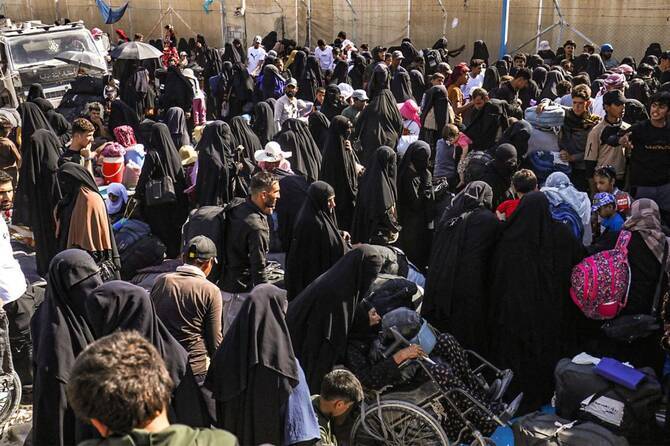

NEW YORK: The international community must take decisive action on the Al-Hol detainment camp in Syria or risk further regional instability, senior UN officials have warned.
The camp, located close to the Iraqi border in northern Syria, is used to detain Daesh militants and their families after the terror group lost swathes of territory in 2019.
Al-Hol houses more than 10,000 foreign militants, Iraqi President Abdul Latif Rashid said on Friday at an event held on the sidelines of the UN General Assembly in New York.
The camp has become a long-term cause of concern for regional governments and international authorities, with questions looming over the future of its inhabitants.
Rashid told the high-level international conference that 34 countries, including his own, have repatriated their nationals from the camp, but citizens of six countries remain.
He said at least 4,915 families, including 18,880 people, have returned to Iraq from Al-Hol since the launch of his country’s repatriation program.
The New York event, supported by the UN Office of Counterterrorism, was attended by 400 officials from 60 countries, as well as 31 high-level officials from leading humanitarian and multilateral organizations, said Iraq’s Foreign Minister Fuad Hussein.
Rashid said Iraq aims to “reintegrate them (former militants) into their communities and their places of origin,” adding: “We cooperate with international organizations to achieve this objective. Our aim is to ensure them a safe future and a dignified life in their country.”
Most of Al-Hol’s inhabitants are women, and reports estimate that 60 percent of its population is younger than 18.
UN acting undersecretary-general for counterterrorism, Alexandre Zouev, warned that conditions in Al-Hol and surrounding camps are “dire and very alarming.”
He added: “With Daesh attacks and assorted humanitarian actors limiting services, the camps threaten to turn into incubators of terrorist radicalization and future recruitment.”
But the fall of the Assad regime in Syria last year presents the international community with a window to take decisive action on the camp, Guy Ryder, undersecretary-general for policy, told the meeting.
“Whilst the situation in northeast Syria grows more complex with increasing volatility, Daesh attacks and limited humanitarian access, member states have new avenues now to engage directly with different stakeholders and to advance solutions,” he said.
“But that window can quickly narrow, and inaction would carry serious consequences for regional stability and for international peace and security.”
Dr. Mohammed Al-Hassan, UN special representative for Iraq and head of the UN Assistance Mission in the country, said camps such as Al-Hol “shouldn’t exist at all.”
The “prolonged presence” of the camp without any foreseeable resolution is “unacceptable,” he added.
Al-Hassan called for the international community to stand behind Syria and support its extension of sovereignty over all its territory.
“The best service the international community can offer Syria and the Syrian people at this particular stage is for every state to repatriate its citizens and nationals from Syria. Syria has borne more than enough,” he said.
Rashid pledged to share his country’s expertise on repatriating former militants, and called on the international community to “turn the page on this inhumane chapter.” Al-Hol must be emptied of people by the end of the year, he added.
Zouev warned that repatriation is just the first step on a “long journey to break the cycle of violence.”
Countries and communities that repatriate Al-Hol’s detainees must provide extensive rehabilitation and reintegration services, he said.
“In this regard, it’s absolutely crucial not to lose sight of the imperative of justice for victims and survivors of terrorism.”


