

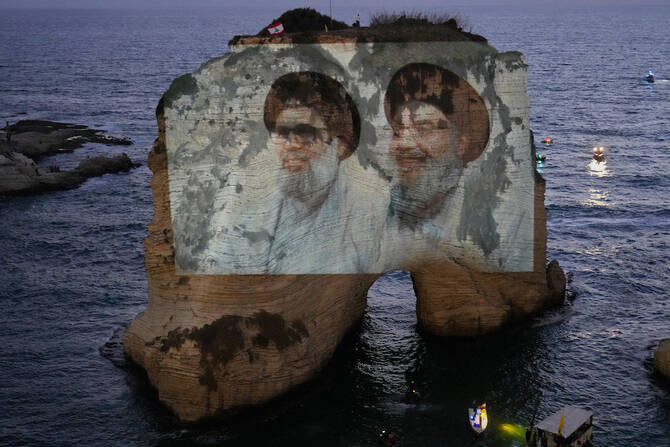

BEIRUT: The Lebanese government pledged swift legal action after Hezbollah brazenly defied an official ban, projecting images of its late leaders onto Beirut’s landmark Raouche Rock, a public display that has reignited fierce debate over state authority and deepened political tensions across the country.
The expanded consultative ministerial council, led by Lebanese Prime Minister Nawaf Salam at the Grand Serail, condemned Thursday’s event as “a clear breach of the permit” granted for the gathering, and pledged to take necessary measures to protect the prestige of the state and its decisions.
Ministers stressed the government’s commitment to Lebanon’s stability and social cohesion, vowing to counter divisive rhetoric and halt hate campaigns that threaten national integrity.
“The policy the government committed to in its ministerial statement calls for extending the sovereignty of the Lebanese state with its own forces across all its territories, and … enforcing the laws on all citizens without exception,” it said, adding that this places “great responsibility” on security services to deliver on this mandate.
“The Lebanese are equal before the law, and the state does not discriminate between one citizen and another, or between one group of citizens and another.”
The ministers of defense, interior, and justice attended the Grand Serail at Salam’s request for an emergency meeting, which later expanded to include Minister of Labor Mohammed Haidar (Hezbollah’s representative in the government) and Minister of Finance Yassin Jaber (representing the Amal Movement), along with a number of other ministers.
Discourse intensified Friday morning regarding Hezbollah’s violation of the official ban on using national monuments for “propaganda purposes and to hold activities in which partisan and political slogans are raised” by lighting the Raouche Rock with images of Hassan Nasrallah and Hashem Safieddine. Hezbollah party supporters launched a campaign of insults on social media against the prime minister, openly challenging his decision.
Salam canceled all his appointments on Friday, a move initially perceived by the media as a retreat. However, he quickly informed his ministerial and parliamentary visitors that he “wanted to devote himself to following up on the Raouche Rock issue,” emphasizing the necessity of holding accountable those who violated the Lebanese state’s decision.
In a firm statement issued Thursday night in response to Hezbollah’s defiance, Salam condemned the event as “a clear violation” of the prohibition on illuminating Raouche Rock and projecting images on it.
Salam described Hezbollah’s actions as a breach of “the explicit commitments of the organizing party and its supporters, and is considered a new lapse on their part, negatively impacting their credibility.” He asserted that “this reprehensible behavior will not deter us from the decision to rebuild a state of law and institutions, but rather increases our determination to fulfill this national duty.”
Salam directed the interior, justice, and defense ministers to “take appropriate measures,” including arresting those responsible and subjecting them to investigation and prosecution under applicable laws.
Minister of Justice Adel Nassar confirmed that the Public Prosecution is working with security services to identify those involved, regardless of political considerations. He said that “the law applies to everyone without discrimination.”
In response to Hezbollah’s defiance, Kataeb Party leader MP Sami Gemayel, after meeting with Salam, said: “The question today is: Is there a state or not? Will Hezbollah accept the state’s conditions, or does it want to remain above them? Our battle is to restrict weapons, not to light the Rock of Raouche.”
Lebanese Forces leader Samir Geagea praised Salam’s “ongoing efforts to establish the desired state,” adding that “Hezbollah has learned nothing from everything that has happened. What happened at the Raouche Rock constitutes an additional black mark on Hezbollah’s record.”
MP Melhem Khalaf also weighed in, saying: “Hezbollah cannot participate in a government while violating its decisions.”
Sami Abi Al-Mona, Sheikh Aql of the Druze community, emphasized the importance of “strengthening the state’s role, preserving its prestige, and developing the work of its institutions in accordance with the Taif Agreement.”
MP Michel Moawad described what happened at Raouche Rock as “a political May 7 against the state, its institutions, and the people of Beirut,” noting that “Hezbollah’s weapons are not directed against Israel,” and highlighting ongoing disputes over arms control, which Hezbollah appears to reject.
In parallel, the Israeli army carried out a series of raids on Friday on the eastern mountain range at border sites straddling Lebanon and Syria.
Israeli army spokesman Avichay Adraee stated that Israeli forces “attacked a Hezbollah precision missile production site in the Bekaa Valley, and that the presence of this targeted site constitutes a violation of the understandings between Israel and Lebanon. The army will continue to work to eliminate any threat to the state of Israel.”


