

Pakistan vaccinates 9 million girls against cervical cancer despite online backlash

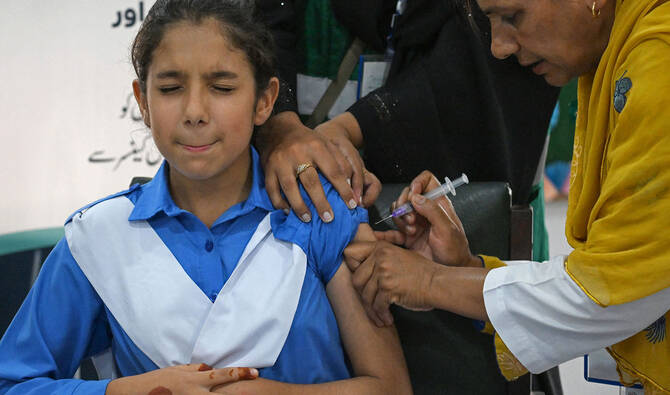
A health worker (R) injects human papillomavirus (HPV) vaccine to a school student in Islamabad on September 24, 2025, during a vaccination drive held to protect adolescent girls from cervical cancer. (AFP)
Short Url
Updated 26 September 2025
Follow

Pakistan vaccinates 9 million girls against cervical cancer despite online backlash

  • The 13 million girls targeted in the initial campaign were in Punjab and Sindh provinces and in Azad Kashmir
  • Pakistan plans to expand the coverage to additional areas by 2027, hoping to eliminate cervical cancer by 2030

KARACHI: Pakistan has vaccinated about 9 million adolescent girls against the virus that causes cervical cancer, as part of a continuing national campaign that has overcome early setbacks fueled by skeptics online, the health minister said Friday.

Health Minister Mustafa Kamal said the campaign that began Sept. 15 is aiming to vaccinate 13 million girls aged 9 to 14 against the human papillomavirus, or HPV, which causes most cervical cancers. He said the program so far achieved 70 percent of its goal.

The program has overcome what Kamal said were baseless rumors spread by some parents that the vaccine could cause infertility. He gave the vaccine to his own daughter live on stage at an event in Karachi this week to build confidence.

“By the grace of God, administering the vaccine to my daughter publicly had a huge impact,” Kamal told The Associated Press. “From the fifth day of the campaign, refusal rates began dropping and acceptance climbed to 70–80 percent in some districts.”

However, many parents are still reluctant.

“I have heard that the vaccination is being used to make women infertile and reduce the population of Muslims,” said a mother of two in Karachi, the capital of Sindh province.

She said that “social media is full of such claims,” and that she was advised by relatives not to allow health workers to vaccinate her daughters.

Health worker Shamim Anwar, 52, said the job of administering the vaccines has been exhausting.

“It is very difficult work. Many parents refuse because of rumors and hesitate to let us vaccinate their daughters,” she said.

“Sometimes we even face humiliation, but we tolerate it because we have to complete the vaccination target,” she said, as she went door-to-door for the campaign in Karachi.

Cervical cancer is the third most common cancer among Pakistani women after breast and ovarian cancers. Globally, it is the fourth most common. Each year, between 18,000 and 20,000 women in Pakistan die of the disease, according to health authorities.

Experts promoted the campaign under the slogan “one jab will do the job.” Authorities set up vaccination centers and deployed teams to schools nationwide to reach as many girls as possible.

Kamal acknowledged that during the first days of the drive, refusals outnumbered acceptances, fueled by false claims that the vaccine campaign is a Western plot to cause infertility.

Officials say the vaccine, offered free of charge, typically causes only minor side effects.

The 13 million girls targeted in the initial campaign were in Punjab and Sindh provinces and in Azad Kashmir. The country plans to expand the coverage to additional areas by 2027, hoping to eliminate cervical cancer as a public health problem by 2030. It became the 149th country to add the HPV vaccine to its immunization schedule.


Pakistan cuts diesel prices, keeps petrol unchanged for next fortnight

Updated 4 sec ago
Follow

Pakistan cuts diesel prices, keeps petrol unchanged for next fortnight

  • Diesel reduction expected to ease transport and food costs
  • Fuel pricing remains tightly regulated amid IMF-backed reforms

KARACHI: Pakistan on Tuesday lowered the retail price of high-speed diesel while keeping petrol prices unchanged for the next two weeks, offering limited relief to transporters and businesses as the country navigates inflation pressures and economic reforms.

Fuel prices are closely watched in Pakistan because diesel is widely used in freight transport, agriculture and power generation, meaning changes can quickly feed into food prices and overall inflation. Petrol, meanwhile, primarily affects private motorists and urban consumers. The government revises fuel prices every fortnight, based largely on global oil prices, exchange rates and taxes.

The move comes as Pakistan seeks to balance inflation control with fiscal discipline under an International Monetary Fund loan program, which limits the government’s ability to offer broad fuel subsidies. Energy pricing has been a sensitive political issue in the country, where fuel costs directly affect household budgets and business expenses.

“The government has revised the prices of the petroleum products based on recommendations of OGRA,” the petroleum division said in a notification issued late Monday, referring to the regulator. 

According to the notification, the price of high-speed diesel was reduced by 14 rupees per liter, bringing it down to 265.65 rupees per liter, effective from today, Dec. 16. The price of petrol, officially termed motor spirit, was left unchanged at 263.45 rupees per liter for the same period.

Diesel accounts for a large share of fuel consumption in Pakistan and is critical for trucking, farming machinery and inter-city transport. Analysts say even modest reductions can help contain transport costs, though the impact depends on whether savings are passed on to consumers.

Pakistan has been adjusting fuel prices regularly since removing blanket subsidies in recent years as part of wider economic reforms aimed at reducing budget deficits and stabilizing the economy. The government has repeatedly said that energy pricing decisions must reflect market conditions while protecting public finances.