

A British court throws out a terror-related charge against a member of the Irish rap group Kneecap

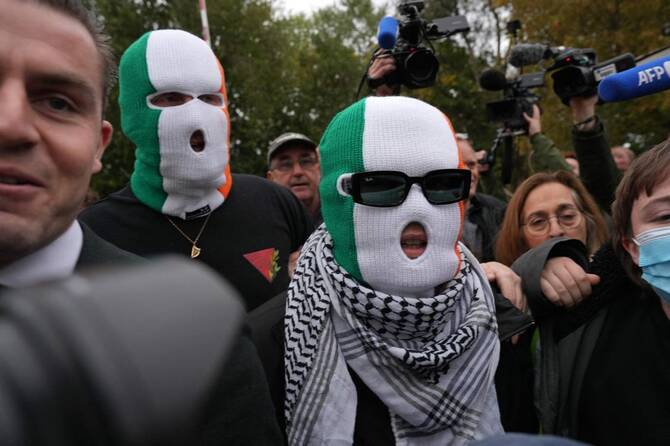
Members of the band Kneecap, including singer Liam O'Hanna who performs under the stage name Mo Chara, wear Irish flag-themed balaclavas as they arrive at Woolwich Crown Court in south east London on Sept. 26, 2025. (AFP)
Short Url
Updated 26 September 2025
Follow

A British court throws out a terror-related charge against a member of the Irish rap group Kneecap

  • Chief magistrate Paul Goldspring sitting at Woolwich Crown Court said: “These proceedings were instituted unlawfully and are null”
  • The Belfast trio has faced criticism for political statements seeming to glorify militant groups including Hamas and Hezbollah

LONDON: A London court on Friday threw out a terror-related charge against a member of the controversial Irish rap group Kneecap, basing its decision on a technical error in the way the charge was brought forward.
Liam Óg Ó hAnnaidh, who is also referred to by his anglicized name Liam O’Hanna and performs under the name Mo Chara, had been charged after waving a flag of the Lebanese militant group Hezbollah, which is banned in Britain as a terrorist organization, during a London concert last year.
Chief magistrate Paul Goldspring sitting at Woolwich Crown Court said the case should be thrown out, agreeing with O’Hanna’s lawyers that the prosecutors had missed the deadline for the charge by a day.
“These proceedings were instituted unlawfully and are null,” he said.

There were huge cheers from the public gallery as the chief magistrate handed down his decision, while O’Hanna smiled and gave a thumbs up to his supporters.
The Belfast trio, who rap in English and Irish about drugs, working-class life and the reunification of Ireland, has faced criticism for political statements seeming to glorify militant groups including Hamas and Hezbollah. Canada and Hungary have previously banned the group.
Kneecap has accused critics of trying to silence the band because of its support for the Palestinian cause throughout the war in Gaza. The band says it doesn’t support Hezbollah and Hamas, nor condone violence.
O’Hanna, 27, had claimed the prosecution was a politically motivated effort to silence the band’s support for Palestinians.
“We will not be silent,” the rapper told supporters outside the court after the charges against him were thrown out. “As people from Ireland, we know oppression, colonialism, famine and genocide.”
Northern Ireland’s First Minister Michelle O’Neill welcomed the move, saying the charges were part of “a calculated attempt to silence those who stand up and speak out against the Israeli genocide in Gaza.”
“Kneecap have used their platform on stages across the world to expose this genocide, and it is the responsibility of all of us to continue speaking out and standing against injustice in Palestine,” she added.
The Crown Prosecution Service said it was “reviewing the decision of the court carefully” and pointed out that it can be appealed.
London’s Metropolitan Police said it was working with the prosecutors to “understand the potential implications of this ruling for us and how that might impact on the processing of such cases in the future.”
Kneecap has been the center of controversy in Britain since last year, when the previous government sought to block an arts grant for the band, citing its anti-British politics. That decision was overturned after the Labour Party won last year’s parliamentary election and Prime Minister Keir Starmer took office.
The group’s members played themselves in “Kneecap,” which won an audience award when it was screened at the 2024 Sundance Film Festival. It was shortlisted for best foreign-language film and best original song at this year’s Academy Awards, though it did not make the final cut.


India rolls out strictest anti-pollution curbs as toxic smog engulfs Delhi

Demonstrator wearing an oxygen mask and holding oxygen tanks takes part in protest.
Updated 14 December 2025
Follow

India rolls out strictest anti-pollution curbs as toxic smog engulfs Delhi

  • Private monitors in several parts of northern Delhi recorded AQI spikes between 550 and 700s
  • Authorities invoked stage four of the capital region’s emergency pollution-control framework

NEW DELHI: India’s capital choked under a thick blanket of smog on Sunday, with the government imposing anti-pollution curbs after monitoring stations in some areas recorded extremely hazardous air quality.

Home to 30 million people, Delhi has not recorded a single “clean air” day in 2025, with Air Quality Index readings hitting high above the 50 score throughout the year.

On the AQI scale from 0 to 500, good air quality is represented by levels below 50, while levels above 300 are dangerous.

Worsening since late October, official records over the weekend were in the severe to severe-plus range of 400–500, but as 24-hour averages, they did not capture the peaks. Private monitors in several parts of North and North West Delhi recorded AQI spikes above 550 and even into the 700s in real-time.

On Saturday evening, the Ministry of Environment’s Commission for Air Quality Management invoked stage four — the highest level — of the Graded Response Action Plan for Delhi and surrounding areas.

To “prevent further deterioration of air quality in the region,” the commission suspended all non-essential construction, shut stone crushers and mining operations, stopped entry of trucks into the capital region, and ordered schools to shift to hybrid classes or online, where possible.

While authorities blamed the pollution on “adverse meteorological conditions,” residents have been demanding more government action.

“The situation is so bad in Delhi that we don’t have any option but to force kids to do online classes. The government has failed us; it has not done anything to address the issue,” said Nabanita Nayak, who decided for her teenage children to attend school online only, despite concerns over their screen addiction.

“If the kids are too much in front of laptops, that’s also an issue. As a mother, I am worried.” 

Delhi’s pollution has been worsening since Diwali in late October, when the average AQI has been above 370, or “very poor.” Since mid-November, it has been over 400, which means “severe” air quality, with certain areas recording 500 and above, which is classified as a “hazardous” level.

“I don’t feel proud living in Delhi. It’s the capital city of the country … We talk about being a developed nation by 2047 — we have deadlines,” said Jagriti Arora, who is keeping her 7-year-old daughter at home to prevent allergy flare-ups caused by air pollution.

“The government has to do something … China had a big problem with pollution, but now they’ve managed to bring it down.”

Delhi’s air quality deteriorates in winter due to local emissions and seasonal weather conditions. Cold temperatures and low wind speeds result in a temperature inversion, which traps pollutants close to the ground instead of letting them disperse. This allows emissions from millions of vehicles, ongoing construction, and nearby industrial activity to accumulate in the air. Urban waste burning and dust from construction sites further add to it.

“This is not a new thing. This has been happening now for over 10 years,” Arora said. “You can see it. You don’t need to actually look at an AQI meter to see how bad the pollution is these days.”