- Head of KSrelief Abdullah Al-Rabeeah calls for action against tragedy of ‘man-made crises’
- He was joined at UN by leading humanitarian figures who sounded alarm over scale of suffering in Middle East
NEW YORK: Saudi Arabia’s aid chief has issued an impassioned plea to transform “despair to hope” through humanitarian action amid mounting suffering in Gaza, Sudan and across the Middle East.
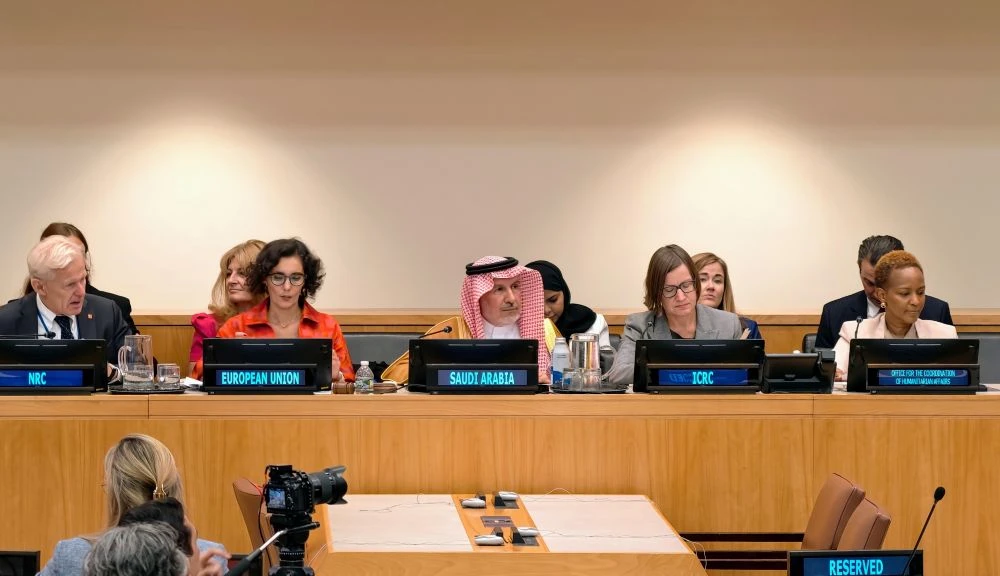
Dr. Abdullah Al-Rabeeah was speaking at the UN General Assembly in New York during a Saudi-organized meeting attended by some of the world’s foremost humanitarian leaders.
The world is witnessing “unprecedented challenges such as conflicts, displacements, mass migration and human rights violations in many parts of the world, especially in the Middle East and Africa,” he warned.
The prominent physician and surgeon, and head of Saudi aid agency KSrelief, was joined by representatives from the EU, the World Food Programme, the International Committee of the Red Cross, the Norwegian Refugee Council and the UN Office for the Coordination of Humanitarian Affairs.
“In Sudan and Gaza alone, more than 20 million people have been displaced, 60,000 Palestinians have been killed and hundreds of thousands have been injured, as well as 300 humanitarian workers killed,” he added.
“These tragedies and many other man-made crises raise the importance of humanitarian diplomacy as a vital tool toward achieving peace and stability.”
Though “such an approach may be difficult,” Al-Rabeeah said, meaningful efforts from the UN and its member states can “transform conflicts to peace, and despair to hope.”
He highlighted the Kingdom’s work in the Syrian Arab Republic, which was ravaged by more than a decade of civil war.
“Saudi Arabia has shown a leading example in Syria, where diplomacy supported by humanitarian aid managed to bring peace, stability and hope,” he said.
“Similar efforts by Saudi Arabia may bring a better outcome and hope for Sudan, Yemen and Palestine.”
Amid straining national aid budgets and questions about the US commitment to multilateralism, “it’s now more than ever that the world is at most need of a collaborative and impactful response from all stakeholders in the humanitarian, political and development sectors,” Al-Rabeeah said.
Despite the world facing “an alarming rise in conflict and crisis,” the UN and its member states can grasp a “golden opportunity” to reduce human suffering through “conflict prevention, crisis solution by positive dialogue, negotiation, and the removal of any barriers that will deprive civilians, women and children from their basic right of having a decent life with hope and dignity for a better future,” he added.
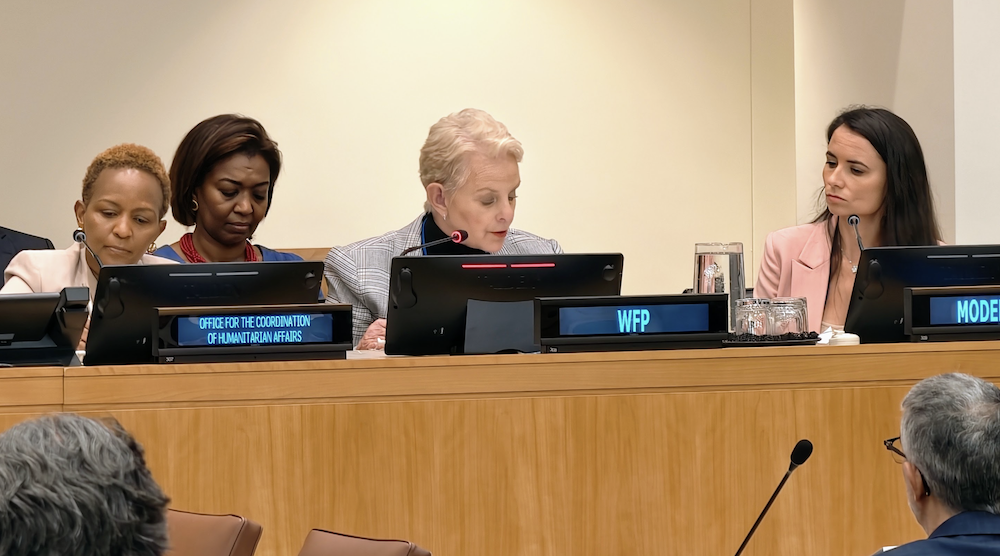
Al-Rabeeah’s appeal was echoed by senior humanitarian figures: Cindy McCain, executive director of the WFP; NRC chief Jan Egeland; ICRC President Mirjana Spoljaric Egger; and Hadja Lahbib, European commissioner for equality, preparedness and crisis management.
Representatives from dozens of UN member states voiced their support for Al-Rabeeah’s remarks during a later statement session.
The chairs of the event focused extensively on the humanitarian crises in the Arab world, including Palestine, Sudan, Yemen and Syria.
McCain told the meeting that national and multilateral commitments to humanitarian action, “the engine to effective operations,” are “too often not being upheld.”
The result is a “litany of suffering” around the world, she warned, highlighting crises in Gaza, Sudan and Yemen.
“In Sudan, famine has been confirmed in at least five places, with further areas at very grave risk. Across the country, 25 million people — half the population — face severe hunger,” she said.
“In Gaza, over half a million people are trapped in famine, and the entire civilian population requires urgent food aid, along with other life-saving humanitarian support.
“In Yemen, 5.5 million people are severely hungry.”
Yet humanitarian actors mobilizing support to these conflict zones face their staff being killed or injured amid a wider erosion of respect for humanitarian law, she said.
Humanitarians are “under attack like never before” and there is “little accountability where lines are crossed,” McCain warned.
“There’s no getting around this statistic: Last year was the deadliest year ever for humanitarian aid workers on record, with 379 killed. Many were from the UN family. This year is on track to be just as bad.”
She condemned Yemen’s Houthi militia for arbitrarily detaining humanitarian workers, a move that was widely criticized across the UN system and by Secretary-General Antonio Guterres.
“These are unacceptable dangers, and are posing unprecedented challenges to how aid agencies operate, and reducing the space for effective and principled humanitarian action,” McCain said.
Organizations and agencies are working to “strengthen the use of humanitarian diplomacy as a strategic operational tool,” she added.
But this will fail to make an impact in a “more fractured and polarized global landscape” unless world leaders “reassert and uphold the right to safety and protection for all aid workers,” she said. “When those obligations aren’t met, those priorities need to be held to account.”
McCain condemned Israel’s actions in Gaza and the strategies employed by warring factions in Sudan’s civil war.
“The famines in Gaza and Sudan were entirely preventable; they can still be halted before yet more people die,” she said, concluding her remarks by warning: “If we fail to meet this moment, we’ll be living with the consequences of failure for many years to come.”
Egeland told the meeting that “we can’t overstate the gravity of this moment.” He warned that 2025 represents the “biggest gap in recorded history” between the necessary levels of humanitarian assistance and the rollout of resources.
The dire situation is compounded by a “cold war” between the world’s great powers, he said, adding that this is “creating a paralysis in international relations that we haven’t seen since 1989 and the fall of the Berlin Wall.”
Echoing McCain’s condemnation of widespread targeting of humanitarian workers in Gaza and elsewhere, Egeland warned: “We have attacks on principled humanitarian work … on a scale and in more places than I can remember in my 40 years as a humanitarian worker.”
A united push for humanitarian diplomacy by multilateral organizations and NGOs can only succeed if leverage is exerted on “the actors that deny our access,” he said.
“In my view, humanitarian diplomacy isn’t another resolution from New York or Geneva expressing concern over the abuse against civilians, or the sieges, or the lack of access, or the starvation. We have that.
“It’s that we get those who have leverage on the parties, the governments, the actors that deny our access, that they meet and provide the carrots and the sticks — the leverage that’s needed for us to be able to help people in their hour of greatest need.”
This leverage has been exerted in “some places and in some conflicts of late,” but humanitarian workers in most cases lack the help they need from UN member states, Egeland said.
“Too many countries attack those they see as their enemies for all of what they’re doing, and then they don’t put pressure on their allies, which may be doing equally grave things,” he said.
“In Gaza, the West Bank, Sudan, Afghanistan, Myanmar etc., it’s not tsunamis, it’s man-made from A to Z,” Egeland added. “The parties get arms from somewhere …They get economic support from somewhere.”
Addressing the suffering generated by great power rivalry requires those who have leverage to “sit together on humanitarian task forces” and “reach out to armed groups” so that humanitarians can “do their work and the civilians can get help,” he said.
Egeland cited the example of the Syrian civil war, during which the humanitarian crisis arising from the “Assad besiegement of towns and cities” was addressed by a multi-nation task force in Geneva.
“I co-chaired that on behalf of the UN with Russia and the US … At the table were all of those who had influence on the parties to the conflict, including the Gulf countries … Iran sat at the table etc.,” he said.
“We were able to negotiate access with up to eight armies and armed groups to the people in great need.
“They were dying from starvation when we started in 2016, and we were able to allow hundreds of convoys from the WFP and others into the place. It was humanitarian diplomacy at its finest.”
The NRC has consistently tried to move aid supplies into Gaza, but has accused Israel of paralyzing its work in the Palestinian enclave.
Egeland said national aid programs, such as those organized by Saudi Arabia and Jordan, can make up for the shortfall in NGO-supply runs being blocked by Israel.
“I think if the US and Europe provided convoys that would reach our warehouses inside of Gaza, we’d distribute,” he added.
“We’re unable to bring in principal aid trucks and supplies to Gaza. We have to find another way, and it’s easy to do that.”
Egeland called for “less seminars and resolutions, and more field action by those who can fight for us and create results.”
Lahbib also accused Israel of employing starvation as a weapon of war, and described the situation in the Middle East as a “test of our individual conscience and a test for our multilateral system.”
She added: “The EU has engaged openly with Israel. We reached an understanding, but it must now be put into action. Israel must lift the blockade on Gaza.
“Let us get food and other supplies in to save lives. The European Commission has proposed to suspend trade concessions with Israel and other measures. We want urgent actions.”
Lahbib highlighted the EU’s aid programs for war-ravaged Middle Eastern countries: €170 million ($198 million) for humanitarian assistance to Gaza and the West Bank this year; €80 million for Yemen, with an additional €40 million in the pipeline in 2025; and almost €700 million to Sudan since 2023.
She said: “Today, the Middle East is a call to conscience, our individual conscience and our collective conscience.
“It asks each of us the simple question: Do you believe that every human life has equal value no matter where on this planet?
“Let’s send a clear collective message: We’ll act together, guided by one simple yet powerful belief that every life … on this planet has equal value. This is how we’ll honor the people of the Middle East.”
Egger said the ICRC is “one of the few remaining organizations that still has international staff on the ground in Gaza.”
Its 350 staff there include surgeons who “operate in the field hospital around the clock” and “see mass casualties coming in every day,” she added.
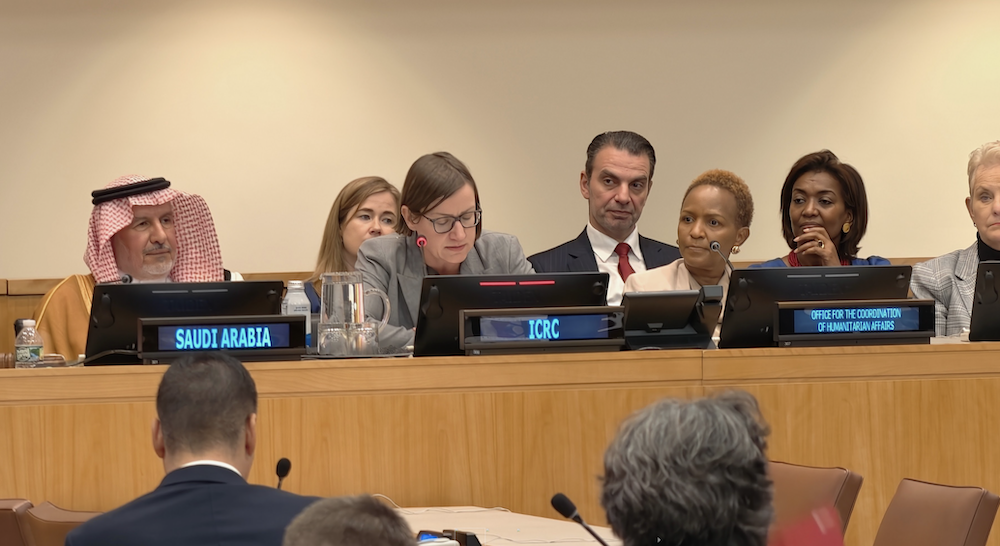
Egger delivered an overview of the state of suffering in Palestine, Sudan, Yemen and Syria. In the latter, “tens of thousands of people are living still under the unresolved trauma of not knowing what happened to their loved ones,” she said, referring to the forced disappearance of Syrians by the country’s former regime.
“The ICC (International Criminal Court) alone has registered over 36,000 cases of missing people in Syria. It’s an enormous task to manage for the authorities and everyone involved because we must assume that the real number is undoubtedly far higher,” she added.
“For many families, answers remain out of reach and will probably remain out of reach forever. It should teach us a lesson, and it should be a wake-up call for what it means to give the ICC systematic access to detention, especially when there’s a legal obligation for states to do so.”
In the West Bank, “relentless violence and expanding settlements” by Israel are “forcing Palestinians from their homes,” Egger said.
Palestinian lives in Gaza are being “sacrificed on the altar of might and military victory on both sides,” she added.
“Nothing will become better in the Middle East if we don’t show greater respect for the rules of war.
“Human dignity and humanity must be preserved because if we lose that, we’ll never be able to return on a path to peace.”