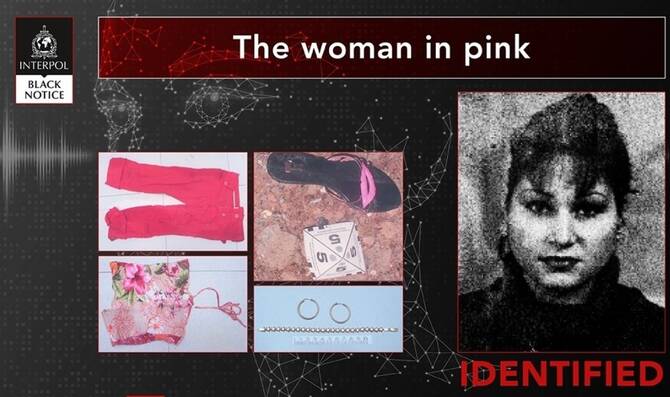
LYON: A woman nicknamed “The Woman in Pink” after her body was found in Spain two decades ago has finally been identified, Interpol said Thursday.
The case is the latest to be solved by the international police organization’s cold cases campaign “Identify Me,” created in 2023 and tasked with identifying women who were found dead across Europe in recent decades, murdered or in suspicious circumstances.
The woman was named as Liudmila Zavada, a Russian national, Interpol said.
She was found dead in 2005 by a road in Viladecans, Spain, close to Barcelona, dressed in a pink floral top, pink trousers, and pink shoes, and had been dead for less than 24 hours.
Police believed the body had been moved in the 12 hours prior to discovery, suggesting foul play. But her identity remained a mystery.
Last year Spanish police, having no new leads, handed the case to the Identify Me campaign, which Interpol coordinates in collaboration with Belgium, France, Germany, Italy, the Netherlands, and Spain.
A breakthrough in the recent case came this year when police in Turkiye ran the woman’s fingerprints through a national biometric database, resulting in a match with Zavada, aged 31 at the time of her death.
The match was subsequently confirmed through kinship DNA analysis using the DNA of one of her close relatives.
“After 20 years, an unknown woman has been given back her name,” said Interpol Secretary General Valdecy Urquiza in a statement.
The case is the third success for the Identify Me appeal.
In 2023 it led to the identification of Rita Roberts, a British woman who was found murdered in Antwerp in 1992, thanks to relatives recognizing her tattoo.
Earlier this year, 33-year-old Ainoha Izaga Ibieta Lima was identified when Paraguayan authorities matched fingerprints uploaded by Spain against their own national databases.
The Identify Me campaign is still trying to solve 44 cases of unidentified women.

Interpol identifies ‘Woman in Pink’ after 20 years
https://arab.news/8xxcy
Interpol identifies ‘Woman in Pink’ after 20 years
- The case is the latest to be solved by the international police organization’s cold cases campaign “Identify Me,” created in 2023
- The woman was named as Liudmila Zavada, a Russian national, Interpol said
Tug of war: how US presidents battle Congress for military powers
- The last official declaration of war by Congress was as far back as World War II
WASHINGTON, United States: Donald Trump’s unleashing of operation “Epic Fury” against Iran has once more underscored the long and bitter struggle between US presidents and Congress over who has the power to decide on foreign military action.
In his video address announcing “major combat” with the Islamic republic, Trump didn’t once mention any authorization or consultation with the US House of Representatives or Senate.
In doing so he sidelined not only Democrats, who called for an urgent war powers vote, but also his own Republican party as he asserts his dominance over a largely cowed legislature.
A US official said Secretary of State Marco Rubio had called top congressional leaders known as the “Gang of Eight” to give them a heads up on the Iran attack — adding that one was unreachable.
Rubio also “laid out the situation” and consulted with the same leaders on Tuesday in an hour-long briefing, the US official said.
According to the US Constitution, only Congress can declare war.
But at the same time the founding document of the United States first signed in 1787 says that the president is the “commander in chief” of the military, a definition that US leaders have in recent years taken very broadly.
The last official declaration of war by Congress was as far back as World War II.
There was no such proclamation during the unpopular Vietnam War, and it was then that Congress sought to reassert its powers.
In 1973 it adopted the War Powers Resolution, passed over Richard Nixon’s veto, to become the only lasting limit on unilateral presidential military action abroad.
The act allows the president to carry out a limited military intervention to respond to an urgent situation created by an attack against the United States.
In his video address on Saturday, Trump evoked an “imminent” threat to justify strikes against Iran.
- Sixty days -
Yet under this law, the president must still inform Congress within 48 hours.
It also says that if the president deploys US troops for a military action for more than 60 days, the head of state must then obtain the authorization of Congress for continued action.
That falls short of an official declaration of war.
The US Congress notably authorized the use of force in such a way after the September 11, 2011 attacks on the United States by Al-Qaeda. Presidents have used it over the past two decades for not only the 2001 invasion of Afghanistan but a series of operations in several countries linked to the “War on Terror.”
Trump is far from the first US president to launch military operations without going through Congress.
Democrat Bill Clinton launched US air strikes against Kosovo in 1999 as part of a NATO campaign, despite the lack of a green light from skeptical lawmakers.
Barack Obama did the same for airstrikes in Libya in 2011.
Trump followed their example in his first term in 2018 when he launched airstrikes in Syria along with Britain and France.
But since his return to power the 79-year-old has sought to push presidential power to its limits, and that includes in the military sphere.
Trump has ordered strikes on alleged drug trafficking boats in Latin America without consulting Congress, and in June 2025 struck Iran’s nuclear facilities.
Perhaps the most controversial act was when he ordered the capture of Venezuelan president Nicolas Maduro in a lightning military raid on January 3.
Republicans however managed to knock down moves by Democrats for a rare war powers resolution that would have curbed his authority over Venezuela operations.
Trump has meanwhile sought to extend his powers over the home front. Democrats have slammed the Republican for deploying the National Guard in several US cities in what he calls a crackdown on crime and immigration.


