

More Afghans arrive in Germany after limbo in Pakistan

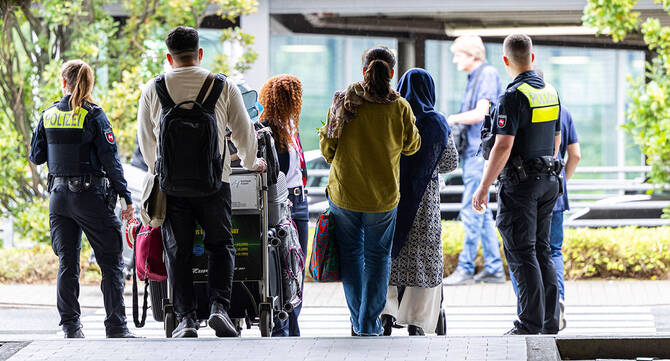
Afghan nationals walk past German policemen to board a bus after they landed at the airport in Hannover-Lenhagen, northwestern Germany, on September 1, 2025. (AFP)
Short Url
Updated 24 September 2025
Follow

More Afghans arrive in Germany after limbo in Pakistan

  • Afghans were accepted under refugee scheme set up by previous German government
  • Scheme, however, was frozen after conservative Chancellor Friedrich Merz took office in May

Berlin: A new group of Afghans who had been promised refuge in Germany arrived in the country on Wednesday, the latest to escape months of limbo in Pakistan.

An interior ministry spokesman told AFP that 28 Afghans landed at Hanover airport in the early afternoon.

The Afghans were accepted under a refugee scheme set up by the previous German government which was frozen after conservative Chancellor Friedrich Merz took office in May.

Since then around 2,000 Afghans have been stuck in Pakistan, where they have been threatened with deportation back to Afghanistan.

Some of those affected have mounted successful legal challenges against the German government, forcing the authorities to allow them entry.

A first group of 47 Afghans who won their cases arrived in Germany earlier this month, and those who came on Wednesday had also been successful in the courts.

According to the initiative Airbridge Kabul, set up to help those affected, the latest group — five men, 10 women and 13 children — arrived on a commercial flight from Islamabad.

However, around 250 Afghans who had been waiting to go to Germany have been deported from Pakistan in recent weeks.

A foreign ministry spokesman said on Wednesday that none of them has as yet been able to return to Pakistan.

The German scheme was aimed at Afghans who had worked with German forces in Afghanistan or who were deemed at particular risk from the Taliban, for example journalists, lawyers and human rights activists.

Since Merz’s conservative-led coalition government took power in May, it has put the process on ice as part of a wider push to toughen immigration policy.

Thousands of Afghans waiting in Pakistan to resettle in the United States and several other Western countries are facing a similar predicament as sentiment toward refugees hardens.

Pakistan has been mounting its own crackdown on Afghans without residence permits since 2023, with officials insisting the country cannot be a “transit camp” for those waiting to resettle in the West.


Pakistan deputy PM speaks with Iranian FM as Saudi Arabia intercepts missiles and drones

Updated 06 March 2026
Follow

Pakistan deputy PM speaks with Iranian FM as Saudi Arabia intercepts missiles and drones

  • Ishaq Dar expresses concern over evolving regional situation as both officials agree to remain in contact
  • Pakistan earlier reminded Tehran of its mutual defense pact with Saudi Arabia during diplomatic outreach

ISLAMABAD: Pakistan’s Deputy Prime Minister and Foreign Minister Ishaq Dar spoke with Iranian Foreign Minister Seyyed Abbas Araghchi on Friday amid escalating tensions in the Gulf, including recent missile and drone attacks targeting Saudi Arabia that were intercepted by the Kingdom’s air defenses.

The call comes as Islamabad remains in contact with both Tehran and Gulf states to prevent the widening Iran conflict from spilling further across the region, particularly after attempted strikes on Saudi territory, a sensitive development for Pakistan, which signed a mutual defense pact with the Kingdom last year.

Pakistan’s foreign ministry said Dar raised concerns about the evolving regional situation during the conversation.

“Deputy Prime Minister/Foreign Minister Senator Mohammad Ishaq Dar spoke this evening with the Foreign Minister of Iran, Seyyed Abbas Araghchi,” the ministry said in a statement.

“The DPM/FM expressed concern over the evolving regional situation. The two agreed to remain in touch on the developments,” it added.

The ministry did not share details of the conversation, though it came amid fast-moving developments in the region, with Saudi Arabia saying its air defenses intercepted multiple missiles and drones early on Friday.

Earlier this week, Prime Minister Shehbaz Sharif’s adviser on political affairs Rana Sanaullah said Pakistan was in contact with Iran to discourage attacks on Gulf countries and prevent misunderstandings.

“Such attacks should not be carried out from Iran’s side,” he told Geo TV.

Prior to that, the deputy prime minister told Pakistan’s Senate that Islamabad had engaged both Iran and Saudi Arabia at the outset of Iran’s retaliation in the region, reminding Tehran of its defense agreement with Saudi Arabia and conveying assurances from Riyadh that Saudi territory would not be used against Iran.

Pakistan says its administration is striving to end the conflict, though the United States-Israeli strikes on Iran, which triggered the war and led to its spillover, have only intensified.

Iranian President Masoud Pezeshkian said on Friday some countries had begun mediation efforts but insisted Tehran would defend its sovereignty.

Meanwhile, US President Donald Trump has called for Iran’s “unconditional surrender” on his Truth Social platform as the confrontation shows little sign of easing.