

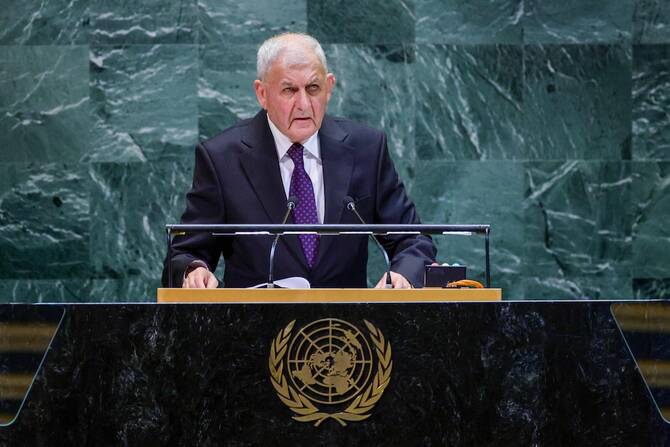

NEW YORK: Palestine is proof of the world’s “selectiveness” when it comes to human rights, justice and international law, Iraq’s president told the UN General Assembly on Tuesday.
Abdul Latif Rashid outlined his nation’s efforts to respect the rights of all citizens and to be a “good neighbor” in the region, but paid particular attention to Palestinian suffering.
“The Palestinian civilians are beset by killing, starvation, displacement, and the destruction of infrastructure and state institutions. This is inhumane. It’s a disgrace for humanity. Therefore, this must end,” he said, demanding that the UN apply the rule of law to end the suffering.
Rashid denounced Israel’s attacks against Qatar, Yemen, Iran, Syria, Palestine and Lebanon. “We reiterate our call for the international community to take urgent measures to ensure a just and comprehensive settlement to the Palestinian cause through the implementation of UN resolutions,” he said.
“This, and the establishment of an independent State of Palestine, is the only pathway to stability and security in the Middle East and the entire world.
“Decisive measures must be taken against the policy of settlement and annexation of land espoused by the occupying power against Palestinians to destroy their hope in a liveable state. We welcome the wide-scale international recognition of the State of Palestine.”
Rashid said more must be done to defeat terrorism across the board, citing Iraq as an example of a nation that “triumphed over the threat of terrorism” and is moving forward to empower its 46 million citizens.
“We rely on the unity of our people and the establishment of development plans to heal the wounds of the past and pave the way for a promising future, which relies on the steadfast national will of our people and the international community’s support,” he said.
“Terrorism is but one scourge, even if it takes on various slogans and manifestations. It therefore should be countered comprehensively without any distinction as to its forms.”
He added: “We underline the need to hold accountable those who support terrorism through funds, weapons, safe havens or media outlets, and those who allow the transfer of terrorists.”
Rashid described Iraq “as a beacon of hope” for the rest of the world, citing “the great sacrifices our people have conceded with great resolve to ensure coexistence and respect for pluralism, contrary to the repressive regime (of Saddam Hussein) that formally ruled Iraq.
“And as the guarantor of the constitution, I’m cooperating with the judiciary as the safety valve of the democratic system to hold free, fair and transparent elections to ensure neutrality and equal opportunities to candidacy and parliamentary representation.”
He emphasized the work that continues to strengthen its relations with other Arab nations, including Kuwait, which Saddam invaded in 1990.
“We’re not calling for sympathy but rather partnership, a partnership to heal our land, to secure our rivers, to safeguard our security, to empower our youth, and to ensure the unity of our region instead of its division,” Rashid said.
“The Middle East has witnessed enough war, tears, bloodshed and grief. Many opportunities for peace and dignified life have been lost. It’s high time to end this urgently and to forge a new path for peace, justice and cooperation.”
He continued to applause: “Iraq is willing to walk that path and to support those who will join it. The peoples of the world, namely the Middle East, look to the UN as the last remaining pathway for peace and they wonder, will it act or will it look the other way?
“Will we live in a world where international law, human rights and justice prevail? Or will we slip back into the law of the jungle, a disgrace to humanity, one that stokes the inferno of hatred, cruelty and chaos?”


