

Pakistan PM meets IMF, World Bank leaders in New York on reforms, recovery

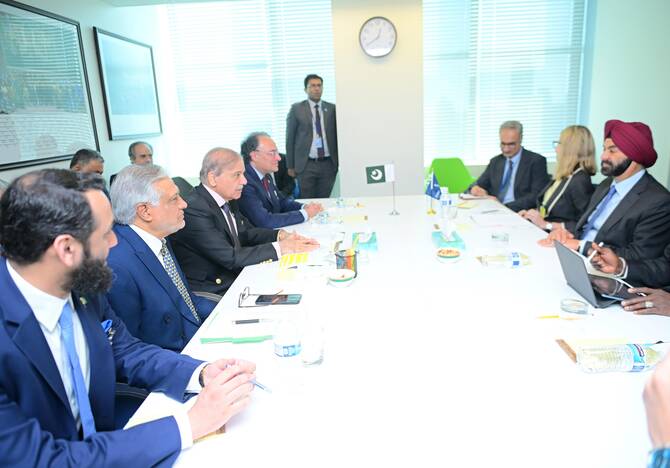
Pakistan Prime Minister Shehbaz Sharif meets President World Bank Ajay Banga on the sidelines of 80th Session of the United Nations General Assembly in New York on September 24, 2025. (Handout/PMO)
Short Url
Updated 24 September 2025
Follow

Pakistan PM meets IMF, World Bank leaders in New York on reforms, recovery

  • Sharif discusses $40 billion World Bank framework, ongoing IMF programs on UNGA sidelines
  • Pakistani statements highlight support for reform agenda, climate resilience and flood recovery

KARACHI: Prime Minister Shehbaz Sharif this week met the heads of the International Monetary Fund (IMF) and the World Bank on the sidelines of the 80th United Nations General Assembly in New York, where discussions focused on Pakistan’s economic reform program, long-term development agenda and recovery plan from recent floods, the premier’s office said on Wednesday.

The meetings build on Pakistan’s engagement with both institutions: the World Bank’s Country Partnership Framework (CPF) for 2026–2035, under which the Bank has committed $40 billion in financing, and the IMF’s $3 billion Stand By Arrangement, which has been concluded, and the ongoing $7 billion Extended Fund Facility (EFF) and $1.4 billion Resilience & Sustainability Facility (RSF).

Sharif briefed World Bank Group President Ajay Banga on reforms covering resource mobilization, energy sector restructuring, privatization and climate measures. His office said these policies had steered the economy toward stabilization, restored investor confidence and promoted inclusive growth.

“President World Bank appreciated the reform measures being undertaken by Pakistan and reaffirmed the Bank’s commitment to Pakistan’s development agenda,” Sharif’s office in Islamabad said in a statement.

“He emphasized the Bank’s readiness to extend continued support for advancing economic reforms and undertaking long-term initiatives on climate resilience under the new CPF.”

Sharif also praised Banga’s leadership in reshaping the World Bank into a faster and more effective development partner, highlighting its response during the COVID-19 pandemic and devastating 2022 floods in Pakistan that killed 1,700 people and caused over $30 billion in economic losses. Both sides reaffirmed their resolve to strengthen cooperation under the CPF.

Pakistan has received over $48.3 billion in World Bank assistance since joining the institution in 1950. Its current portfolio includes 54 projects with commitments totaling $15.7 billion.

In a separate meeting, Sharif thanked IMF Managing Director Kristalina Georgieva for what he described as the Fund’s longstanding partnership, citing its timely support under multiple facilities.


Pakistan Prime Minister Shehbaz Sharif meets IMF Managing Director Kristalina Georgieva on the sidelines of 80th Session of UNGA in New York on September 24, 2025.(Handout/PMO)

While emphasizing Pakistan’s progress toward IMF program targets, he stressed that “the impact of the recent floods on Pakistan’s economy must be factored into the IMF’s review.”

According to the Prime Minister’s Office, Georgieva “commended the Prime Minister’s commitment to pursuing sound macro-economic policies and reiterated the IMF’s continued support as Pakistan advances the necessary economic reforms to ensure sustainable long term economic growth.”

The IMF chief also expressed sympathy for flood-affected communities and underscored the importance of damage assessments to underpin recovery priorities.


World Bank president in Pakistan to discuss development projects, policy issues

Updated 01 February 2026
Follow

World Bank president in Pakistan to discuss development projects, policy issues

  • Pakistan, World Bank are currently gearing up to implement a 10-year partnership framework to grant $20 billion loans to the cash-strapped nation
  • World Bank President Ajay Banga will hold meetings with Pakistan Prime Minister Shehbaz Sharif and other senior officials during the high-level visit

ISLAMABAD: World Bank President Ajay Banga has arrived in Pakistan to hold talks with senior government officials on development projects and key policy issues, Pakistani state media reported on Sunday, as Islamabad seeks multilateral support to stabilize economy and accelerate growth.

The visit comes at a time when Pakistan and the World Bank are gearing up to implement a 10-year Country Partnership Framework (CPF) to grant $20 billion in loans to the cash-strapped nation.

The World Bank’s lending for Pakistan, due to start this year, will focus on education quality, child stunting, climate resilience, energy efficiency, inclusive development and private investment.

"World Bank President Ajay Banga arrives in Pakistan for a high-level visit," the state-run Pakistan TV Digital reported on Sunday. "During his stay, he will meet Prime Minister Shehbaz Sharif and other senior officials to discuss economic reforms, development projects, and key policy issues."

Pakistan, which nearly defaulted on its foreign debt obligations in 2023, is currently making efforts to stabilize its economy under a $7 billion International Monetary Fund (IMF) program.

Besides efforts to boost trade and foreign investment, Islamabad has been seeking support from multilateral financial institutions to ensure economic recovery.

“This partnership fosters a unified and focused vision for your county around six outcomes with clear, tangible and ambitious 10-year targets,” Martin Raiser, the World Bank vice president for South Asia, had said at the launch of the CPF in Jan. last year.

“We hope that the CPF will serve as an anchor for this engagement to keep us on the right track. Partnerships will equally be critical. More resources will be needed to have the impact at the scale that we wish to achieve and this will require close collaboration with all the development partners.”

In Dec., the World Bank said it had approved $700 million in ​financing for Pakistan under a multi-year initiative aimed at supporting the country's macroeconomic stability and service delivery.

It ‍followed a $47.9 ‍million World Bank grant ‍in August last year to improve primary education in Pakistan's most populous Punjab province.