

Lebanon facing triple crisis, president tells UN General Assembly

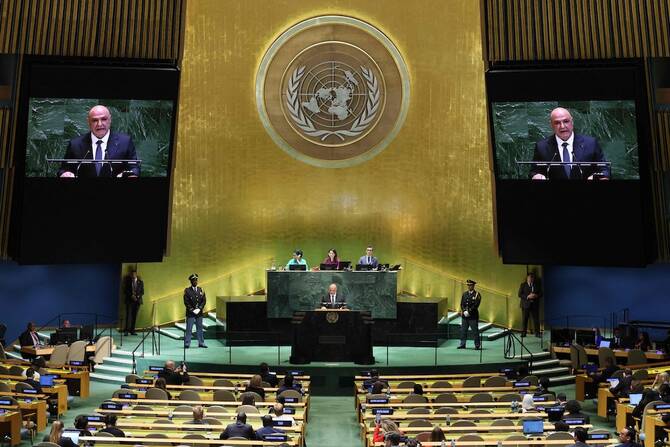
Above, President of Lebanon Joseph Aoun speaks during the United Nations General Assembly on Sept. 23, 2025 in New York City. (Getty Images via AFP)
Short Url
Updated 24 September 2025
Follow

Lebanon facing triple crisis, president tells UN General Assembly

  • Joseph Aoun cites Gaza war, Syrian refugee issue, reconstruction of south
  • Calls for Israel’s full withdrawal from his country’s territory, condemns continued attacks

NEW YORK: Lebanon is facing a triple crisis due to instability from the war in Gaza, the Syrian refugee issue and the reconstruction of the south, the country’s president told the UN General Assembly on Tuesday.

Joseph Aoun called for Israel’s full withdrawal from Lebanese territory, and condemned its continued use of drone strikes on the south of the country.

He also alluded to the disarmament of Hezbollah, by “securing the exclusive sovereignty of the Lebanese state,” which would be “enforced solely by … its legal armed forces.”

Lebanon is committed to an independent financial audit and a fair restructuring of the banking sector, Aoun said.

“We’ve also taken on the fight against corruption and organized crime to rebuild the trust of the Lebanese people in their state and the world’s confidence in Lebanon,” he added.

The president said his country “plays a unique role” in the world. “Amid the global clash over religious identities, Lebanon stands out as a nation where Christians and Muslims coexist as equals under a constitution that guarantees equitable representation to both communities in the parliament and the Council of Ministers with full citizenship for all individuals,” he added.

“I reiterate and emphasize a message of freedom and plurality. In a region where people are killed or kill over their religious belief or even for displaying a symbol of faith, in a wary world torn between those who want to impose religious attire and others intent on banning it, Lebanon offers a unique, unmatched and irreplaceable model.”

Aoun called for the protection of Lebanon’s religious traditions: “If Christians were to disappear from Lebanon, this delicate balance will fall and with it, justice.

“If the Muslim community in Lebanon no longer exists, this balance will also fall, and this will also undermine justice.”

He added: “It’s clear to me today that many of the underlying causes of the war on Lebanon, as well as the deeper, more insidious motivations behind it, have been aimed at dismantling Lebanon’s unique model.”

Aoun urged the UNGA to carry out its “moral, human and political obligation” and call for an end to the war in Gaza, which represents one of the “deep underlying causes” of the crises in Lebanon.

The country is burdened by the “unprecedented displacement situation taking place on its soil,” he added, describing the refugee crisis in Lebanon as “the largest in history” per capita.

“Through direct negotiations (with Syria) and with the support of the Kingdom of Saudi Arabia,” Lebanon hopes to bring about the “dignified and safe return of displaced Syrian citizens” as well as “the restoration of the special relations between Lebanon and Syria,” he said.

Israel’s destruction of border villages in south Lebanon will prevent stability in the country unless infrastructure “is rebuilt and its beauty restored,” Aoun said.

The Lebanese military must be given the means to “defend and safekeep our national integrity,” he added.

“We remain hopeful about the public initiatives to organize international conferences dedicated to that purpose.”


Washington presses Syria to shift from Chinese telecom systems

Updated 5 sec ago
Follow

Washington presses Syria to shift from Chinese telecom systems

  • Syria is exploring the possibility of procuring Chinese technology
  • It was unclear whether the United States ⁠pledged financial or logistical support to Syria to do so

DAMASCUS: The United States has warned Syria against relying on Chinese technology in its telecommunications sector, arguing it conflicts with US interests and threatens US national security, according to three sources familiar with the matter.
The message was conveyed during an unreported meeting between a US State Department team and Syrian Communications Minister Abdulsalam Haykal in San Francisco on Tuesday. Washington has been coordinating closely with Damascus since 2024, when Syria’s now President Ahmed Al-Sharaa ousted longtime leader Bashar Assad, who had a strategic partnership with China.
Syria is exploring the possibility of procuring Chinese technology to support its telecommunications towers and the infrastructure of local Internet service providers, according to a Syrian businessman involved in the procurement talks.
“The US side asked for clarity on the ministry’s plans regarding Chinese telecom equipment,” said ⁠another source briefed on ⁠the talks.
But Syrian officials said infrastructure development projects were time-critical and that Damascus was seeking greater vendor diversity, the source added.
SYRIAN OFFICIALS CITE US EXPORT CONTROLS AS TELECOMS BARRIER
Syria is open to partnering with US firms but the matter was urgent and export controls and “over-compliance” remained an issue, according to person familiar with the meeting in San Francisco.
A US diplomat familiar with the discussions told Reuters that the US State Department “clearly urged Syrians to use American technology or technology from allied countries in the telecoms sector.”
It was unclear whether the United States ⁠pledged financial or logistical support to Syria to do so.
Responding to Reuters questions, a US State Department spokesperson said: “We urge countries to prioritize national security and privacy over lower-priced equipment and services in all critical infrastructure procurement. If it seems too good to be true, it probably is.”
The spokesperson added that Chinese intelligence and security services “can legally compel Chinese citizens and companies to share sensitive data or grant unauthorized access to their customers’ systems” and promises by Chinese companies to protect customers’ privacy were “entirely inconsistent with China’s own laws and well-established practices.”
China has repeatedly rejected allegations of it using technology for spying purposes.
The Syrian Ministry of telecommunications told Reuters any decisions related to equipment and infrastructure are made “in accordance with national technical and security standards, ensuring data protection and service continuity.”
The ministry said it is also prioritizing the diversification of partnerships and technology sources to ⁠serve the national interest.
Syria’s telecom ⁠infrastructure has relied heavily on Chinese technology due to US sanctions imposed on successive Assad governments over the civil war that grew from a crackdown on anti-government protests in 2011.
Huawei technology accounts for more than 50 percent of the infrastructure of Syriatel and MTN, the country’s only telecom operators, according to a senior source at one of the companies and documents reviewed by Reuters. Huawei did not immediately respond to a request for comment.
Syria is seeking to develop its private telecommunications sector, devastated by 14 years of war, by attracting foreign investment.
In early February, Saudi Arabia’s largest telecom operator, STC, announced it would invest $800 million to “strengthen telecommunications infrastructure and connect Syria regionally and internationally through a fiber-optic network extending over 4,500 kilometers.”
The ministry of telecommunications says that US restrictions “hinder the availability of many American technologies and services in the Syrian market,” emphasizing that it welcomes expanding cooperation with US companies when these restrictions are lifted.
Syria has inadequate telecommunications infrastructure, with network coverage weak outside city centers and connection speeds in many areas barely exceeding a few kilobits per second.