Ecuador’s president claims narco gang behind fuel price protests

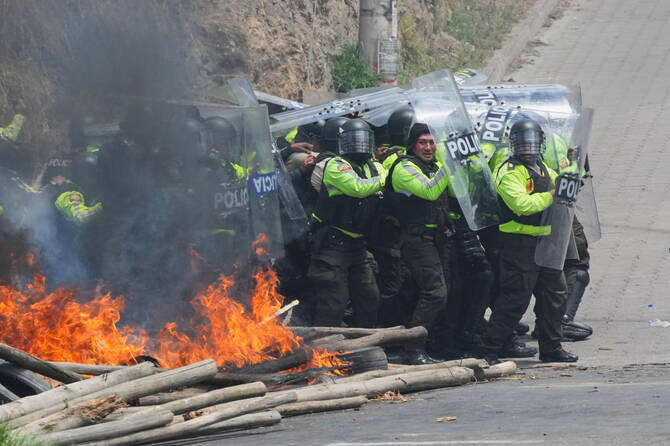
Police clear a roadblock set up by protesters rallying against President Daniel Noboa’s fuel subsidy cuts in Tabacundo, Ecuador, Sept. 23, 2025. (AP Photo/Dolores Ochoa)
Short Url
Updated 23 September 2025
Follow

Ecuador’s president claims narco gang behind fuel price protests

  • President Daniel Noboa earlier this month announced a cut in the fuel subsidy he said would save the state $1.1 billion
  • He claimed the fuel price protesters were “financed” by the Tren de Aragua narco cartel

QUITO: Ecuador’s president on Tuesday accused the Venezuelan drug gang Tren de Aragua of financing Indigenous fuel price protests that have rocked his country for days.
President Daniel Noboa earlier this month announced a cut in the fuel subsidy he said would save the state $1.1 billion.
The move saw the price of diesel soar from $1.80 to $2.80 per gallon (48 cents to 74 cents per liter) — a bitter pill in a country where nearly a third of the population is poor.
Hundreds of Indigenous Ecuadorans have come out in protest in defiance of a state of emergency declared by the president last week.
On Tuesday, Noboa claimed the protesters were “financed and surrounded by criminals from the Tren de Aragua.”
In a message on X, he posted photographs of several men behind bars, without clarifying who they were, why they were detained or what their link to the protests was.
“This is not a struggle, it’s not a protest... it’s the same mafias as always,” the president said.
Like the United States, Noboa has declared the Tren de Aragua a terrorist group for its links to skyrocketing cartel violence.
Last week, he imposed a state of emergency after protesters blockaded key roads, hindering food deliveries and hobbling critical sectors of the economy.
Noboa warned that protesters who defy the emergency would be “charged with terrorism and will serve 30 years in prison.”
Ecuador’s Minister of Government Zaida Rovira said Tuesday that 47 people had been arrested to date, including two foreigners for whom there were “indications” of ties with the Tren de Aragua.
The gang is at the center of rising tensions between Venezuela and the United States, which has deployed warships to the southern Caribbean in what it labeled an anti-drug operation.
Washington claims several people killed in US strikes on boats in the region were members of the Tren de Aragua.
Ecuador’s powerful Conaie Indigenous group, credited with unseating three presidents between 1997 and 2005, decried a “violent repression” of the fuel protests and urged its supporters Tuesday to “stand firm.”
Indigenous people represent nearly eight percent of Ecuador’s population of 17 million, according to the latest census.


Nowhere to pray as logs choke flood-hit Indonesian mosque

Updated 9 sec ago
Follow

Nowhere to pray as logs choke flood-hit Indonesian mosque

  • Before the disaster, the mosque bustled with worshippers — locals and students alike — attending daily and Friday prayers
  • Indonesia consistently ranks among the countries with the highest annual deforestation rates

ACEH TAMIANG, Indonesia: Almost two weeks on from devastating floods, Muslim worshippers in Indonesia’s Sumatra who gathered at their local mosque on Friday for prayers were blocked from entering by a huge pile of thousands of uprooted trees.
The deadly torrential rains had inundated vast tracts of rainforest nearby, leaving residents of the Darul Mukhlisin mosque and Islamic boarding school to search elsewhere for places of worship that had been less damaged.
“We have no idea where all this wood came from,” said Angga, 37, from the nearby village of Tanjung Karang.
Before the disaster, the mosque bustled with worshippers — locals and students alike — attending daily and Friday prayers.
“Now it’s impossible to use. The mosque used to stand near a river,” said Angga. “But the river is gone — it’s turned into dead land.”
Village residents told AFP the structure likely absorbed much of the impact of trees and logs carried by the torrents, preventing even greater destruction downstream.
When AFP visited the site, the mosque was still encircled by a massive heap of timber — a mix of uprooted trees and felled logs, likely from nearby forests.
By Friday, the death toll from one of northern Sumatra’s worst recent disasters — including in Aceh, where a tsunami wreaked havoc in 2004 — had reached 995 people, with 226 still missing and almost 890,000 displaced, according to the National Disaster Mitigation Agency.

- Uncontrolled logging -

Authorities have blamed the scale of devastation partly on uncontrolled logging.
Environmentalists say widespread forest loss has worsened floods and landslides, stripping the land of tree cover that normally stabilizes soil and absorbs rainfall.
Indonesia consistently ranks among the countries with the highest annual deforestation rates.
President Prabowo Subianto, visiting Aceh Tamiang district on Friday, assured victims the government was working to restore normalcy.
“We know conditions are difficult, but we will overcome them together,” he said, urging residents to “stay alert and be careful.”
“I apologize for any shortcomings (but) we are working hard,” he said.
Addressing environmental concerns, Prabowo called for better forest protection.
“Trees must not be cut down indiscriminately,” he said.
“I ask local governments to stay vigilant, to monitor and safeguard our nature as best as possible.”
But frustrations were growing, with flood victims complaining about the pace of relief efforts.
Costs to rebuild after the disaster could run up to 51.82 trillion rupiah ($3.1 billion) and the Indonesian government has so far shrugged off suggestions that it call for international assistance.
Back in nearby Babo Village, Khairi Ramadhan, 37, said he planned to seek out another mosque for prayers.
“I’ll find one that wasn’t hit by the flood,” he said. “Maybe some have already been cleaned. I don’t want to dwell on sorrow anymore.”