Pakistan floods batter fields, factories and fiscal plans

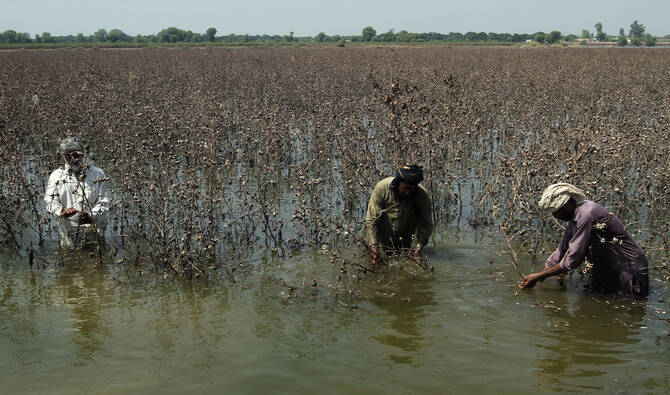
Farmers inspect damaged cotton crop, following monsoon rains and flooding, in Kabirwala, Pakistan, on September 18, 2025. (REUTERS)
Short Url
Updated 23 September 2025
Follow

Pakistan floods batter fields, factories and fiscal plans

  • Pakistan growth target hit as floods swamp farms, cities, Crop Monitor maps 220,000 hectares of rice fields flooded
  • Report flags risks to wheat sowing despite strong 2024 reserves, Cotton shortfall may ripple through textile sector

KARACHI/ ISLAMABAD: Massive floods in Pakistan have struck both the rural heartland and industrial centers for the first time in decades, causing billions of dollars in damage while straining food supplies, exports and a fragile economic recovery.

The government had been optimistic about 2026, penciling in 4.2 percent growth on the back of a rebound in farming and manufacturing after the economy was stabilized under a $7 billion International Monetary Fund bailout.

Instead, record monsoon rains since late June, amplified by dam releases from India, have submerged large swathes of Punjab and Sindh, the two most populous and economically vital provinces.

While waters have yet to recede in many districts, officials and analysts warn the hit could be deeper than in 2022, when a third of the country lay under water, due to dual shocks to agriculture and manufacturing.

Out on the plains, satellite images have traced the scale. A report from agricultural monitoring initiative GEOGLAM estimates at least 220,000 hectares of rice fields flooded between August 1 and September 16.

In Punjab, Pakistan’s rice, cotton and maize engine, 1.8 million acres of farmland have been inundated, according to the provincial disaster management agency.

“About 50 percent of rice, and 60 percent of cotton and maize crops have been damaged,” said Khalid Bath, chairman of the Pakistan Farmers Association.

He said losses could exceed 2.5 million acres, worth up to one trillion rupees ($3.53 billion).

“This is unlike anything we have seen in recent decades,” said Iqrar Ahmad Khan, former vice chancellor of the University of Agriculture Faisalabad.

He estimates at least a tenth of the country’s crops are destroyed, with vegetable losses topping 90 percent in some districts.

The timing is perilous: Pakistan is about to sow wheat, the crop that provides nearly half of the country’s caloric intake. National reserves remain comfortable after a strong 2024 harvest, according to Crop Monitor, but the sowing window is at risk in fields still slick with silt and mud.

“Food insecurity is coming, not just higher prices,” Khan warned.

UNDERPLAYING RISKS

Planning Minister Ahsan Iqbal acknowledged the floods would “set back” GDP growth and said a clearer damage tally would be ready in about two weeks.

Pakistan’s central bank said the deluge would cause a “temporary yet significant supply shock,” and it put growth near the lower end of its 3.25–4.25 percent range.

It argued the shock would be less severe than the $30 billion disaster in 2022, with stronger forex reserves and lower interest rates offering some resilience.

But prices for wheat, sugar, onions and tomatoes have jumped, pushing a sensitive price index to a 26‑month high.

IMF resident representative Mahir Binici said an upcoming review of the Extended Fund Facility this week will assess whether the 2026 fiscal year budget and emergency provisions can meet the nation’s needs. Iqbal called on the fund to “help us mitigate the damages.”

Some economists say policymakers are underplaying the risks.

“The floods will increase the current account deficit by $7 billion. They are worse than the previous floods,” former finance minister Hafeez Pasha said.

COUNTING LOSSES

In industrial cities such as Sialkot — a hub for the textiles, sporting goods and surgical equipment that underpin Pakistan’s exports — several workshops were marooned.

The hit to agriculture is also a blow for manufacturers. Industrialists say cotton shortfalls will ripple into the textile sector, the country’s top foreign exchange earner, while rice exporters warn Pakistan risks losing competitiveness to India as prices rise.

“We had 400 acres of cotton, but only 90 are left,” farmer Rab Nawaz said, near the historic city of Multan.

At least 1,006 people have been killed since June 26, the National Disaster Management Authority said, while over 2.5 million people have been evacuated in Punjab and Sindh.

In provincial capital Lahore, homes and small businesses were gutted.

Mohammad Arif, a 50‑year‑old rickshaw driver and father of five, said he moved his vehicle to higher ground as his home was inundated.

“We have been on the roads for three days,” he said.


Pakistan raises fuel prices by Rs55 per liter as Middle East conflict drives oil surge

Updated 06 March 2026
Follow

Pakistan raises fuel prices by Rs55 per liter as Middle East conflict drives oil surge

  • Government says adequate fuel stocks in place despite global energy shock
  • Oil prices jump from about $78 to over $106 per barrel amid regional conflict

ISLAMABAD: Pakistan on Friday increased petrol and diesel prices by Rs55 ($0.20) per liter each as escalating conflict in the Middle East sent global oil prices sharply higher and disrupted energy supply routes, officials said.

Global oil markets have been rattled since coordinated strikes by the United States and Israel against Iran began last week, triggering retaliatory attacks across the region, raising fears of disruption to key energy shipping routes and pushing petroleum prices sharply upward.

The price adjustment in Pakistan was announced after a joint press conference by Finance Minister Muhammad Aurangzeb, Deputy Prime Minister and Foreign Minister Ishaq Dar and Petroleum Minister Ali Pervaiz Malik, who said the government was monitoring international energy markets and domestic supply conditions amid the crisis.

“So, the decision we have made by changing the levy a little bit is that we are going ahead with increasing the price of both fuels, petrol and diesel, by Rs55 ($0.20),” Malik told reporters. 

“And as soon as this matter settles, we will revise the prices downward with the same speed and take steps on how to increase people’s income and purchasing power.”

He said Pakistan entered the crisis with “comfortable energy reserves” due to earlier planning but rising global prices had forced the government to adjust domestic fuel rates to maintain supply continuity.

He said international petrol prices had climbed from roughly $78 per barrel on March 1 to around $106.8 per barrel, while diesel prices had risen to about $150 per barrel.

Malik added that the government had taken steps to minimize the burden on consumers, noting diesel plays a critical role in agriculture, transportation and public mobility.

Malik also warned that authorities would take strict action against anyone attempting to hoard fuel or manipulate supply for profiteering.

The minister said Pakistan was working with international partners to secure additional energy supplies, including arrangements with Saudi Aramco and the use of Pakistan National Shipping Corporation vessels to transport crude oil imports.

Finance Minister Aurangzeb said a high-level government committee formed by Prime Minister Shehbaz Sharif had been meeting daily to review developments in global petroleum markets and their potential impact on Pakistan’s economy.

“Pakistan currently maintains adequate energy stocks and macroeconomic stability,” Aurangzeb said, adding that the government’s response was based on preparedness rather than panic.

He said the committee, which includes senior ministers, the governor of the State Bank of Pakistan and other officials, was assessing short-, medium- and long-term implications of the crisis for inflation, foreign exchange reserves and broader economic indicators.

Deputy PM Dar said the regional conflict had significantly disrupted global energy markets, with international petroleum prices rising by as much as 50–70 percent in recent days.

The deputy prime minister added that Pakistan was also engaged in diplomatic efforts aimed at de-escalating tensions and restoring stability in the region.

Petroleum prices will now be reviewed more frequently, potentially on a weekly basis, and any reduction in global oil prices would be passed on to consumers.

Pakistan, which relies heavily on imported fuel to meet its energy needs, is particularly vulnerable to global oil price shocks that can quickly feed into inflation and pressure the country’s external accounts.