CAIRO: Prominent British-Egyptian activist Alaa Abdel Fattah was released from prison in Cairo, his family said on Tuesday, prompting an emotional reunion with his loved ones after a pardon from President Abdel Fattah El-Sisi.
Abdel Fattah, 43, was a leading figure in Egypt’s 2011 uprising and an outspoken critic of the country’s authorities who had been jailed for the better part of the past decade.
His lawyer and a high-ranking Egyptian official confirmed on Monday that El-Sisi had granted him a presidential pardon and that he would soon walk free from Wadi Al-Natrun Prison, a major penitentiary on the outskirts of the capital Cairo.
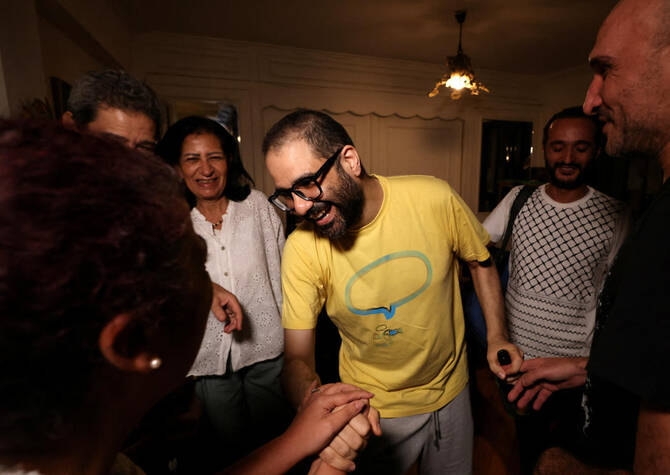
Social media posts by his family members early on Tuesday showed Abdel Fattah enjoying an emotional reunion with his loved ones following his release.
“Home,” read a post from an official X account that had advocated for his release, accompanied by a photograph of a smiling Abdel Fattah in a baggy yellow T-shirt embracing his mother, Laila Soueif.
Abdel Fattah’s sister Mona Seif, herself a well-known activist, hailed on X “an exceptionally kind day” and posted a photo of herself, apparently overwhelmed with emotion, with her arm around her beaming brother’s shoulders.
Over the past two decades, Abdel Fattah has been imprisoned under every Egyptian administration, from ousted president Hosni Mubarak to the current president El-Sisi.
He was last arrested in 2019 and sentenced in 2021 to five years in prison for “spreading false news” after sharing a Facebook post about alleged torture in Egyptian jails.
His sentence was due to end in September 2024, but authorities refused to count his remand period as part of it.
Soueif recently ended a 10-month hunger strike demanding her son’s release.
Abdel Fattah had escalated his own such strike, held in solidarity with her, at the start of September.
On Monday, the state-affiliated Al-Qahera News channel reported that El-Sisi had pardoned “a number of convicted persons, after taking the constitutional and legal procedures in this regard.”
“The pardon includes... Alaa Ahmed Seif El-Islam Abdel Fattah,” added the channel, which is linked to Egypt’s state intelligence service.
Tarek Al-Awady, a member of Egypt’s presidential pardons committee, later said all procedures for the pardon had been finalized and Abdel Fattah was awaiting his imminent release.
Abdel Fattah’s lawyer separately confirmed the pardon, which took place along with five other people.
Pardon petition
The move came after El-Sisi ordered relevant authorities earlier this month to study a petition submitted by the state-affiliated National Council for Human Rights to pardon a number of individuals, including Abdel Fattah.
It also followed a decision by a Cairo criminal court to remove Abdel Fattah from the country’s terrorism list, ruling that recent investigations showed no evidence linking him to the outlawed Muslim Brotherhood group.
Human Rights Watch (HRW) described the pardon as “long overdue good news,” calling for the release of other dissidents.
“Though we celebrate his pardon, thousands of people like Alaa are still languishing in Egyptian jails simply for exercising their rights to freedom of speech,” said Amr Magdi, HRW’s senior Middle East and North Africa researcher.
“Hopefully his release will act as a watershed moment and provide an opportunity for El-Sisi’s government to end the wrongful detention of thousands of peaceful critics.”
The British government had consistently raised Abdel Fattah’s case with Egyptian authorities, including during talks between Prime Minister Keir Starmer and El-Sisi.
British Foreign Secretary Yvette Cooper welcomed the pardon on X, saying she was “grateful to President El-Sisi for this decision.”
“We look forward to Alaa being able to return to the UK, to be reunited with his family,” Cooper wrote.
In May, a United Nations panel of experts determined that Abdel Fattah’s detention was arbitrary and illegal, and called for his immediate release.
Last month, UN High Commissioner for Human Rights Volker Turk also urged the Egyptian authorities to end a practice allowing the prolonged arbitrary detention of government critics.
The practice, known as “rotation,” often involves lodging new charges against detainees just before their remand period comes to an end.
Turk said the practice “appears to be used to circumvent the rights of individuals to liberty, due process and equality before the law.”
Since 2022, El-Sisi’s administration has released hundreds of detainees and pardoned several high-profile dissidents, including Abdel Fattah’s lawyer Mohamed Al-Baqer.
Despite Abdel Fattah’s pardon, hundreds of other activists and politicians remain behind bars.


![]()

Egypt frees activist Alaa Abdel Fattah after El-Sisi pardon
Short Url
https://arab.news/cjnrs
Egypt frees activist Alaa Abdel Fattah after El-Sisi pardon
- Prominent British-Egyptian activist Alaa Abdel Fattah was released from prison in Cairo, his family said on Tuesday


Latest updates


© 2026 SAUDI RESEARCH & PUBLISHING COMPANY, All Rights Reserved And subject to Terms of Use Agreement.