

Putin offers Trump one-year extension to nuclear weapons treaty

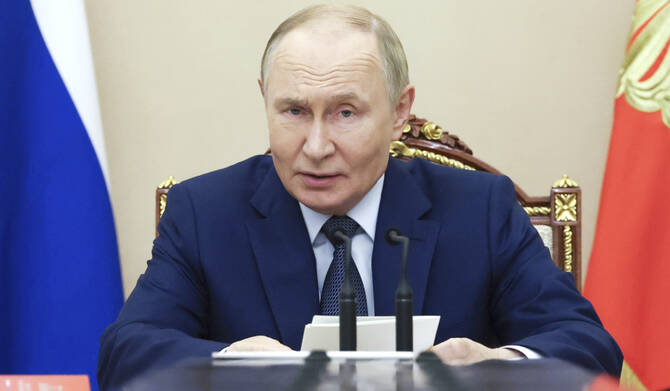
Russian President Vladimir Putin chairs a Security Council meeting at the Kremlin in Moscow, Russia, Monday, Sept. 22, 2025. (AP)
Short Url
Updated 22 September 2025
Follow

Putin offers Trump one-year extension to nuclear weapons treaty

  • The treaty caps the number of deployed strategic nuclear warheads at 1,550 and the number of delivery vehicles — missiles, submarines and bombers — at 700 on each side
  • Russia and the United States have by far the biggest nuclear arsenals in the world, and many experts fear that ending the limits could fuel an arms race as both sides boost strategic weapons deployments

MOSCOW/WASHINGTON: Russian President Vladimir Putin on Monday offered to voluntarily maintain the limits on deployed strategic nuclear weapons set in the 2010 New START accord after it expires in February if the US agreed to do the same.

White House press secretary Karoline Leavitt said Putin’s proposal sounded “pretty good,” but she added that US President Donald Trump would address the offer himself. The agreement is the last US-Russia strategic nuclear arms control accord.

It allowed for only one five-year extension, which Putin and former US President Joe Biden agreed to implement in 2021. The offer, which comes as Ukraine tries to convince Trump to impose harsher sanctions on Russia, was made public by Putin at a meeting of his Security Council.

HIGHLIGHTS

• US-Russia arms control treaty due to expire in February

• Treaty limits nuclear weapons in both countries

• Putin proposes a one-year rollover if Trump does same

“Russia is prepared to continue adhering to the central numerical limits under the New START Treaty for one year after February 5, 2026,” he said.
“Subsequently, based on an analysis of the situation, we will make a decision on whether to maintain these voluntary, self-imposed restrictions.” Trump in July said he would like to maintain the limits on deployed strategic nuclear weapons set in the 2010 New START pact after it expires on February 5. Russia and the United States have by far the biggest nuclear arsenals in the world, and many experts fear that ending the limits could fuel an arms race as both sides boost strategic weapons deployments. The treaty caps the number of deployed strategic nuclear warheads at 1,550 and the number of delivery vehicles — missiles, submarines and bombers — at 700 on each side.

PUTIN UNDER PRESSURE TO END UKRAINE WAR
Putin said his proposal was in the interests of global non-proliferation and could help spur dialogue with Washington about arms control.
“This measure will only be viable if the United States acts in a similar manner, and does not take steps that undermine or violate the existing balance of deterrence capabilities,” Putin said. He has been under pressure from Trump to agree to end the war in Ukraine, something Moscow says is part of a slew of security issues that have raised East-West tensions to their most dangerous level since the Cold War.
The proposal appears to be a unilateral change of policy by Moscow, which has until now insisted it would only engage with Washington on such matters if overall ties — hampered by stark differences over the war in Ukraine — improved.

TALKS ON OVERHAULING TREATY YET TO START
Differences over Ukraine mean the two superpowers have not started talks on renewing or overhauling the treaty, though Trump has spoken of his desire to do a new nuclear arms control deal, albeit with China as well.
Beijing has rejected the idea that it should be included.
Daryl Kimball, executive director of the Arms Control Association advocacy group, said Putin’s offer was “a positive and welcome move.”
Urging Washington to reciprocate, Kimball said Trump and Putin could “help reduce the most immediate existential security threat facing the world.”
Putin said Russia would be monitoring US nuclear arms and defense activity, paying particular attention to plans to beef up missile defenses and proposals to deploy missile interceptors in space.
“The practical implementation of such destabilising actions could nullify our efforts to maintain the status quo in the field of START,” said Putin. “We will respond accordingly.”
Konstantin Kosachyov, a senior Russian senator, said Putin was sending a message to the US that he was ready to enter talks on a new arms control treaty.
“I hope that this signal will be heard and correctly interpreted,” Kosachyov said on Telegram. 


Justice Department faces hurdle in seeking case against Comey as judge finds constitutional problems

Updated 4 sec ago
Follow

Justice Department faces hurdle in seeking case against Comey as judge finds constitutional problems

WASHINGTON: The Justice Department violated the constitutional rights of a close friend of James Comey and must return to him computer files that prosecutors had hoped to use for a potential criminal case against the former FBI director, a federal judge said Friday.
The ruling from US District Judge Colleen Kollar-Kotelly represents not only a stern rebuke of the conduct of Justice Department prosecutors but also imposes a dramatic hurdle to government efforts to seek a new indictment against Comey after an initial one was dismissed last month.
The order concerns computer files and communications that investigators obtained years earlier from Daniel Richman, a Comey friend and Columbia University law professor, as part of a media leak investigation that concluded without charges. The Justice Department continued to hold onto those files and conducted searches of them this fall, without a new warrant, as they prepared a case charging Comey with lying to Congress five years ago.
Richman alleged that the Justice Department violated his Fourth Amendment rights by retaining his records and by conducting new warrantless searches of the files, prompting Kollar-Kotelly to issue an order last week temporarily barring prosecutors from accessing the files as part of its investigation.
The Justice Department said the request for the return of the records was merely an attempt to impede a new prosecution of Comey, but the judge again sided with Richman in a 46-page order Friday that directed the Justice Department to give him back his files.
“When the Government violates the Fourth Amendment’s prohibition on unreasonable searches and seizures by sweeping up a broad swath of a person’s electronic files, retaining those files long after the relevant investigation has ended, and later sifting through those files without a warrant to obtain evidence against someone else, what remedy is available to the victim of the Government’s unlawful intrusion?” the judge wrote.
One answer, she said, is to require the government to return the property to the rightful owner.
The judge did, however, permit the Justice Department to file an electronic copy of Richman’s records under seal with the Eastern District of Virginia, where the Comey investigation has been based, and suggested prosecutors could try to access it later with a lawful search warrant.
The Justice Department alleges that Comey used Richman to share information with the news media about his decision-making during the FBI’s investigation into Hillary Clinton’s use of a private email server. Prosecutors charged the former FBI director in September with lying to Congress by denying that he had authorized an associate to serve as an anonymous source for the media.
That indictment was dismissed last month after a federal judge in Virginia ruled that the prosecutor who brought the case, Lindsey Halligan, was unlawfully appointed by the Trump administration. But the ruling left open the possibility that the government could try again to seek charges against Comey, a longtime foe of President Donald Trump. Comey has pleaded not guilty, denied having made a false statement and accused the Justice Department of a vindictive prosecution.
The Comey saga has a long history.
In June 2017, one month after Comey was fired as FBI director, he testified that he had given Richman a copy of a memo he had written documenting a conversation he had with Trump and had authorized him to share the contents of the memo with a reporter.
After that testimony, Richman permitted the FBI to create an image, or complete electronic copy, of all files on his computer and a hard drive attached to that computer. He authorized the FBI to conduct a search for limited purposes, the judge noted.
Then, in 2019 and 2020, the FBI and Justice Department obtained search warrants to obtain Richman’s email accounts and computer files as part of a media leak investigation that concluded in 2021 without charges. Those warrants were limited in scope, but Richman has alleged that the government collected more information than the warrants allowed, including personal medial information and sensitive correspondence.
In addition, Richman said the Justice Department violated his rights by searching his files in September, without a new warrant, as part of an entirely separate investigation.
“The Court further concludes that the Government’s retention of Petitioner Richman’s files amounts to an ongoing unreasonable seizure,” Kollar-Kotelly wrote. “Therefore, the Court agrees with Petitioner Richman that the Government has violated his Fourth Amendment right against unreasonable searches and seizures.”
