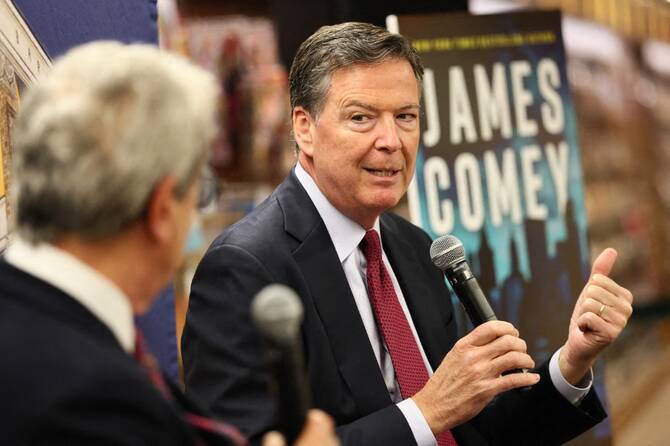
WASHINGTON: The Justice Department violated the constitutional rights of a close friend of James Comey and must return to him computer files that prosecutors had hoped to use for a potential criminal case against the former FBI director, a federal judge said Friday.
The ruling from US District Judge Colleen Kollar-Kotelly represents not only a stern rebuke of the conduct of Justice Department prosecutors but also imposes a dramatic hurdle to government efforts to seek a new indictment against Comey after an initial one was dismissed last month.
The order concerns computer files and communications that investigators obtained years earlier from Daniel Richman, a Comey friend and Columbia University law professor, as part of a media leak investigation that concluded without charges. The Justice Department continued to hold onto those files and conducted searches of them this fall, without a new warrant, as they prepared a case charging Comey with lying to Congress five years ago.
Richman alleged that the Justice Department violated his Fourth Amendment rights by retaining his records and by conducting new warrantless searches of the files, prompting Kollar-Kotelly to issue an order last week temporarily barring prosecutors from accessing the files as part of its investigation.
The Justice Department said the request for the return of the records was merely an attempt to impede a new prosecution of Comey, but the judge again sided with Richman in a 46-page order Friday that directed the Justice Department to give him back his files.
“When the Government violates the Fourth Amendment’s prohibition on unreasonable searches and seizures by sweeping up a broad swath of a person’s electronic files, retaining those files long after the relevant investigation has ended, and later sifting through those files without a warrant to obtain evidence against someone else, what remedy is available to the victim of the Government’s unlawful intrusion?” the judge wrote.
One answer, she said, is to require the government to return the property to the rightful owner.
The judge did, however, permit the Justice Department to file an electronic copy of Richman’s records under seal with the Eastern District of Virginia, where the Comey investigation has been based, and suggested prosecutors could try to access it later with a lawful search warrant.
The Justice Department alleges that Comey used Richman to share information with the news media about his decision-making during the FBI’s investigation into Hillary Clinton’s use of a private email server. Prosecutors charged the former FBI director in September with lying to Congress by denying that he had authorized an associate to serve as an anonymous source for the media.
That indictment was dismissed last month after a federal judge in Virginia ruled that the prosecutor who brought the case, Lindsey Halligan, was unlawfully appointed by the Trump administration. But the ruling left open the possibility that the government could try again to seek charges against Comey, a longtime foe of President Donald Trump. Comey has pleaded not guilty, denied having made a false statement and accused the Justice Department of a vindictive prosecution.
The Comey saga has a long history.
In June 2017, one month after Comey was fired as FBI director, he testified that he had given Richman a copy of a memo he had written documenting a conversation he had with Trump and had authorized him to share the contents of the memo with a reporter.
After that testimony, Richman permitted the FBI to create an image, or complete electronic copy, of all files on his computer and a hard drive attached to that computer. He authorized the FBI to conduct a search for limited purposes, the judge noted.
Then, in 2019 and 2020, the FBI and Justice Department obtained search warrants to obtain Richman’s email accounts and computer files as part of a media leak investigation that concluded in 2021 without charges. Those warrants were limited in scope, but Richman has alleged that the government collected more information than the warrants allowed, including personal medial information and sensitive correspondence.
In addition, Richman said the Justice Department violated his rights by searching his files in September, without a new warrant, as part of an entirely separate investigation.
“The Court further concludes that the Government’s retention of Petitioner Richman’s files amounts to an ongoing unreasonable seizure,” Kollar-Kotelly wrote. “Therefore, the Court agrees with Petitioner Richman that the Government has violated his Fourth Amendment right against unreasonable searches and seizures.”

Justice Department faces hurdle in seeking case against Comey as judge finds constitutional problems
Short Url
https://arab.news/rm38a
Justice Department faces hurdle in seeking case against Comey as judge finds constitutional problems
Refugee firefighters in Mauritania battle bushfires to give back to the community that took them in
MBERA: The men move in rhythm, swaying in line and beating the ground with spindly tree branches as the sun sets over the barren and hostile Mauritanian desert. The crack of the wood against dry grass lands in unison, a technique perfected by more than a decade of fighting bushfires.
There is no fire today but the men — volunteer firefighters backed by the UN refugee agency — keep on training.
In this region of West Africa, bushfires are deadly. They can break out in the blink of an eye and last for days. The impoverished, vast territory is shared by Mauritanians and more than 250,000 refugees from neighboring Mali, who rely on the scarce vegetation to feed their livestock.
For the refugee firefighters, battling the blazes is a way of giving back to the community that took them in when they fled violence and instability at home in Mali.
Newcomers with an old tradition
Hantam Ag Ahmedou was 11 years old when his family left Mali in 2012 to settle in the Mbera refugee camp in Mauritania, 48 kilometers (30 miles) from the Malian border. Like most refugees and locals, his family are herders and once in Mbera, they saw how quickly bushfires spread and how devastating they can be.
“We said to ourselves: There is this amazing generosity of the host community. These people share with us everything they have,” he told The Associated Press. “We needed to do something to lessen the burden.”
His father started organizing volunteer firefighters, at the time around 200 refugees. The Mauritanians had been fighting bushfires for decades, Ag Ahmedou said, but the Malian refugees brought know-how that gave them an advantage.
“You cannot stop bushfires with water,” Ag Ahmedou said. “That’s impossible, fires sometimes break out a hundred kilometers from the nearest water source.”
Instead they use tree branches, he said, to smother the fire.
“That’s the only way to do it,” he said.
The volunteer ‘brigade’
Since 2018, the firefighters have been under the patronage of the UNHCR. The European Union finances their training and equipment, as well as the clearing of firebreak strips to stop the fires from spreading. The volunteers today count over 360 refugees who work with the region’s authorities and firefighters.
When a bushfire breaks out and the alert comes in, the firefighters jump into their pickup trucks and drive out. Once at the site of a fire, a 20-member team spreads out and starts pounding the ground at the edge of the blaze with acacia branches — a rare tree that has a high resistance to heat.
Usually, three other teams stand by in case the first team needs replacing.
Ag Ahmedou started going out with the firefighters when he was 13, carrying water and food supplies for the men. He helped put out his first fire when he was 18, and has since beaten hundreds of blazes.
He knows how dangerous the task is but he doesn’t let the fear control him.
“Someone has to do it,” he said. “If the fire is not stopped, it can penetrate the refugee camp and the villages, kill animals, kill humans, and devastate the economy of the whole region.”
A climate-vulnerable nation
About 90 percent of Mauritania is covered by the Sahara Desert. Climate change has accelerated desertification and increased the pressure on natural resources, especially water, experts say. The United Nations says tensions between locals and refugees over grazing areas is a key threat to peace.
Tayyar Sukru Cansizoglu, the UNHCR chief in Mauritania, said that with the effects of climate change, even Mauritanians in the area cannot find enough grazing land for their own cows and goats — so a “single bushfire” becomes life-threatening for everyone.
When the first refugees arrived in 2012, authorities cleared a large chunk of land for the Mbera camp, which today has more than 150,000 Malian refugees. Another 150,000 live in villages scattered across the vast territory, sometimes outnumbering the locals 10 to one.
Chejna Abdallah, the mayor of the border town of Fassala, said because of “high pressure on natural resources, especially access to water,” tensions are rising between the locals and the Malians.
Giving back
Abderrahmane Maiga, a 52-year-old member of the “Mbera Fire Brigade,” as the firefighters call themselves, presses soil around a young seedling and carefully pours water at its base.
To make up for the vegetation losses, the firefighters have started setting up tree and plant nurseries across the desert — including acacias. This year, they also planted the first lemon and mango trees.
“It’s only right that we stand up to help people,” Maiga said.
He recalls one of the worst fires he faced in 2014, which dozens of men — both refugees and host community members — spent 48 hours battling. By the time it was over, some of the volunteers had collapsed from exhaustion.
Ag Ahmedou said he was aware of the tensions, especially as violence in Mali intensifies and going back is not an option for most of the refugees.
He said this was the life he was born into — a life in the desert, a life of food scarcity and “degraded land” — and that there is nowhere else for him to go. Fighting for survival is the only option.
“We cannot go to Europe and abandon our home,” he said. “So we have to resist. We have to fight.”
There is no fire today but the men — volunteer firefighters backed by the UN refugee agency — keep on training.
In this region of West Africa, bushfires are deadly. They can break out in the blink of an eye and last for days. The impoverished, vast territory is shared by Mauritanians and more than 250,000 refugees from neighboring Mali, who rely on the scarce vegetation to feed their livestock.
For the refugee firefighters, battling the blazes is a way of giving back to the community that took them in when they fled violence and instability at home in Mali.
Newcomers with an old tradition
Hantam Ag Ahmedou was 11 years old when his family left Mali in 2012 to settle in the Mbera refugee camp in Mauritania, 48 kilometers (30 miles) from the Malian border. Like most refugees and locals, his family are herders and once in Mbera, they saw how quickly bushfires spread and how devastating they can be.
“We said to ourselves: There is this amazing generosity of the host community. These people share with us everything they have,” he told The Associated Press. “We needed to do something to lessen the burden.”
His father started organizing volunteer firefighters, at the time around 200 refugees. The Mauritanians had been fighting bushfires for decades, Ag Ahmedou said, but the Malian refugees brought know-how that gave them an advantage.
“You cannot stop bushfires with water,” Ag Ahmedou said. “That’s impossible, fires sometimes break out a hundred kilometers from the nearest water source.”
Instead they use tree branches, he said, to smother the fire.
“That’s the only way to do it,” he said.
The volunteer ‘brigade’
Since 2018, the firefighters have been under the patronage of the UNHCR. The European Union finances their training and equipment, as well as the clearing of firebreak strips to stop the fires from spreading. The volunteers today count over 360 refugees who work with the region’s authorities and firefighters.
When a bushfire breaks out and the alert comes in, the firefighters jump into their pickup trucks and drive out. Once at the site of a fire, a 20-member team spreads out and starts pounding the ground at the edge of the blaze with acacia branches — a rare tree that has a high resistance to heat.
Usually, three other teams stand by in case the first team needs replacing.
Ag Ahmedou started going out with the firefighters when he was 13, carrying water and food supplies for the men. He helped put out his first fire when he was 18, and has since beaten hundreds of blazes.
He knows how dangerous the task is but he doesn’t let the fear control him.
“Someone has to do it,” he said. “If the fire is not stopped, it can penetrate the refugee camp and the villages, kill animals, kill humans, and devastate the economy of the whole region.”
A climate-vulnerable nation
About 90 percent of Mauritania is covered by the Sahara Desert. Climate change has accelerated desertification and increased the pressure on natural resources, especially water, experts say. The United Nations says tensions between locals and refugees over grazing areas is a key threat to peace.
Tayyar Sukru Cansizoglu, the UNHCR chief in Mauritania, said that with the effects of climate change, even Mauritanians in the area cannot find enough grazing land for their own cows and goats — so a “single bushfire” becomes life-threatening for everyone.
When the first refugees arrived in 2012, authorities cleared a large chunk of land for the Mbera camp, which today has more than 150,000 Malian refugees. Another 150,000 live in villages scattered across the vast territory, sometimes outnumbering the locals 10 to one.
Chejna Abdallah, the mayor of the border town of Fassala, said because of “high pressure on natural resources, especially access to water,” tensions are rising between the locals and the Malians.
Giving back
Abderrahmane Maiga, a 52-year-old member of the “Mbera Fire Brigade,” as the firefighters call themselves, presses soil around a young seedling and carefully pours water at its base.
To make up for the vegetation losses, the firefighters have started setting up tree and plant nurseries across the desert — including acacias. This year, they also planted the first lemon and mango trees.
“It’s only right that we stand up to help people,” Maiga said.
He recalls one of the worst fires he faced in 2014, which dozens of men — both refugees and host community members — spent 48 hours battling. By the time it was over, some of the volunteers had collapsed from exhaustion.
Ag Ahmedou said he was aware of the tensions, especially as violence in Mali intensifies and going back is not an option for most of the refugees.
He said this was the life he was born into — a life in the desert, a life of food scarcity and “degraded land” — and that there is nowhere else for him to go. Fighting for survival is the only option.
“We cannot go to Europe and abandon our home,” he said. “So we have to resist. We have to fight.”
© 2025 SAUDI RESEARCH & PUBLISHING COMPANY, All Rights Reserved And subject to Terms of Use Agreement.