

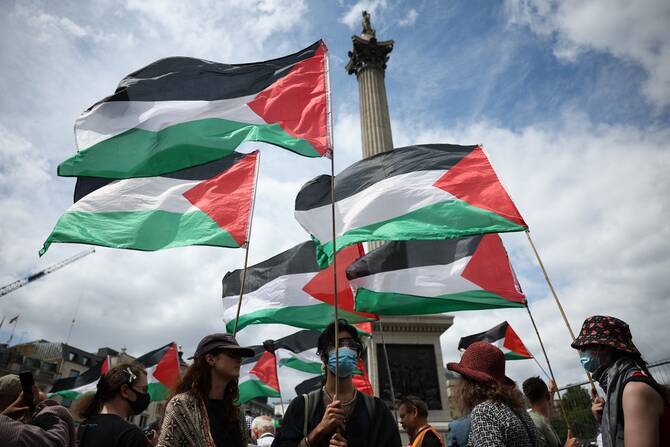

PARIS: French President Emmanuel Macron scored a major diplomatic coup by declaring his intention to recognize a Palestinian state but the move risks being followed by bitter retaliation from Israel while not providing concrete benefits to the Palestinians, analysts and sources say.
Macron sent a shockwave through the international community with his pledge over the summer. His announcement in a speech in New York at a conference on the sidelines of the UN General Assembly on Monday is now to be matched by recognition by nine other states including Australia, Belgium, Canada and the UK, according to the Elysee.
The recognition marks the growing international frustration with Israel over its assault and aid blockades on the Gaza Strip first launched in response to the October 7, 2023 attack on Israel by Palestinian militant group Hamas.
The implications are historic — France and the UK will be the first permanent UN Security Council members to recognize a Palestinian state and, along with Canada, the first G7 members to do so.
“This recognition is not the end of our diplomatic efforts. It is not a symbolic recognition. It is part of a broader and very concrete action,” said French foreign ministry spokesman Pascal Confavreux, pointing to the French-Saudi roadmap that is to accompany the recognition.
Defending the move on Israeli television this week, Macron said it was the “best way to isolate Hamas.”
- ‘Lot of noise’ -
Diplomats from both sides, asking not to be named, are expecting reprisals from Israel in the wake of the move although the retaliation is not expected to extend to Israel cutting diplomatic relations with France.
Israeli Prime Minister Benjamin Netanyahu could shut down France’s consulate in Jerusalem which is intensively used by Palestinians or annex part of the West Bank where Israel has expanded settlements in defiance of international outrage, they said.
“There is going to be a lot of noise,” said one diplomat, asking not to be named.
“The Israelis are prepared for anything, and the French response is likely to be quite limited,” said Agnes Levallois, deputy president of the Paris-based Institute for Research and Study of the Mediterranean and Middle East.
“Ultimately, it is the Palestinians who have the most to lose in this crisis,” she said, adding the move needed to be followed by sanctions against Israel to have any impact.
“The annexation of the West Bank is a clear red line,” warned a French presidential official, asking not to be named. “It is obviously the worst possible violation of UN resolutions.”
The United States also vehemently opposes the move and its ambassador to Paris, Charles Kushner, has made his feelings clear in a series of posts on X denouncing “unmet French conditions” for the recognition.
“From the beginning, we have made it clear that recognition of a Palestinian state by France, without any conditions, would complicate the situation on the ground rather than advance peace,” Joshua Zarka, Israel’s ambassador to France, told AFP.
Zarka said France should have not taken the step without demanding that all the Israeli hostages held by Hamas were released first.
But the Palestinian representative in France, Hala Abou Hassira, said France needed to go further, urging “concrete sanctions, such as an arms embargo on Israel, a severance of relations with Israel which includes the total termination of the association agreement between the European Union and Israel.”
- ‘Diplomatic lever’ -
After months of wavering on the issue, Macron made the decision on the plane traveling from the Egyptian border point of El-Arish in April where he met wounded Palestinians and could witness the suffering caused by the blockade, people close to him said.
Politically embattled at home — Macron just appointed his seventh prime minister — and failing despite intense efforts to end Russia’s war on Ukraine, the recognition gives the president a chance to seal a concrete step in his legacy.
He sees this recognition “as a diplomatic lever to put pressure on Netanyahu,” said a person close to him, asking not to be named.
For former ambassador Michel Duclos, resident fellow at the Montaigne Institute, “this could become a success for France,” in line with the French “no” under late president Jacques Chirac to oppose the American invasion of Iraq in 2003.


