Israel boycott calls spread as celebs and artists speak out

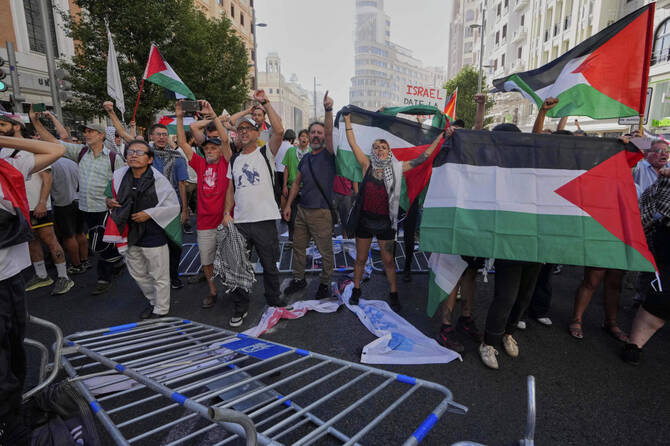
FILE- Pro-Palestinian protesters block the road in an attempt to disrupt the 21st stage of the Spanish cycling race La Vuelta, from Alalpardo to Madrid, Spain, Sunday, Sept. 14, 2025. (AP)
Short Url
Updated 20 September 2025
Follow

Israel boycott calls spread as celebs and artists speak out

  • With most Western governments resistant to major economic sanctions, musicians, celebrities and writers are hoping to build public pressure for more action
  • The open letter from Film Workers for Palestine has gathered thousands of signatories who have pledged to cut ties with any Israeli institutions “implicated in genocide.”

PARIS: From the music, film to publishing industries, growing numbers of Western artists are calling for a cultural boycott of Israel over the Gaza war, hoping to emulate the success of the apartheid-era blockade of South Africa.
With most Western governments resistant to major economic sanctions, musicians, celebrities and writers are hoping to build public pressure for more action.
“There is absolutely no doubt in my mind that, globally, we’re at a tipping point,” British actor Khalid Abdalla (“The Kite Runner,” “The Crown“) told AFP after signing a petition calling for a boycott of some Israeli cinema bodies.
The open letter from Film Workers for Palestine has gathered thousands of signatories, including Emma Stone and Joaquin Phoenix, who have pledged to cut ties with any Israeli institutions “implicated in genocide.”
“The avalanche is happening now, and it’s across spheres. It’s not just in the film worker sphere,” Abdalla added during an interview on Friday.
At this week’s Emmy Awards, winner after winner, from Javier Bardem to “Hacks” actor Hannah Einbinder, spoke about Gaza, echoing similar statements at the Venice Film Festival earlier this month.
On Thursday, British trip-hop pioneers Massive Attack announced they were joining a music collective called “No Music for Genocide” that will see artists try to block the streaming of their songs in Israel.
Elsewhere, Israel faces being boycotted at the Eurovision song contest, authors have signed open letters, while Spanish Prime Minister Pedro Sanchez is leading a push to exclude the country from sports events.
Israeli conductor Ilan Volkov announced last week at a concert in Britain that he would no longer perform in his home country.
“I think we are seeing a situation which is comparable to the boycott movement against apartheid South Africa,” Hakan Thorn, a Swedish academic at the University of Gothenburg who wrote a book on the South Africa boycott movement.
“There was definitely a shift in the spring of this year when the world saw the images of the famine in Gaza,” added the sociologist.

“Anti-Semitism”

The international boycott of South Africa’s white supremacist government began in earnest in the early 1960s after a massacre of black protesters by police in the Sharpeville township.
It culminated with artists and sports teams refusing to play there, with boycott busters such as Queen or Frank Sinatra facing widespread public criticism.
Thorn says many public figures were reluctant to speak out about the Gaza war, which was sparked by the October 7, 2023 attack by Palestinian militant group Hamas which left 1,219 people dead in Israel, most of them civilians.
Israel’s retaliatory strikes have killed more than 65,000 people, also mostly civilians, according to figures from Gaza’s health ministry, which the UN considers reliable.
“The history of the Holocaust and criticism of the pro-Palestinian movement for being antisemitic has been a serious obstacle to a broader mobilization against what Israel is doing right now,” explained Thorn.
A campaign to boycott Israel, known as the Boycott, Divestment and Sanctions (BDS) movement, began 20 years ago over the country’s occupation of Palestinian territory.
The Israeli government accuses its supporters of being antisemitic and Prime Minister Benjamin Netanyahu frequently labels critics as “Hamas sympathizers.”
David Feldman, who heads the Institute for the Study of Antisemitism at Birkbeck College at the University of London, said such statements have created “a lack of confidence over what the boundaries of antisemitism actually are.”
“Any eruption of antisemitism is concerning, but any attempt right now to identify the movement to boycott Israel with antisemitism is missing the point,” he told AFP.
“It is a vehicle of protest against Israel’s destruction of Gaza and the ongoing murder of people.”

Apartheid lessons 

Although the anti-apartheid movement is referenced by today’s campaigners against the Gaza war, history provides some sobering lessons for them.
After the start of the South Africa boycott movement, it took 30 years before the regime fell, exposing the limits of international pressure campaigns.
“By the early 1970s, it’s true to say that boycott was the defining principle of a self-identified global anti-apartheid movement, but the movement on its own was not enough,” Feldman, who wrote a book about boycotts, added.
The real pain was caused by the gradual asphyxiation of the South African economy as companies and banks withdrew under pressure, while the end of the Cold War sharply increased the country’s isolation.
Inside Israel, many artists worry about the consequences of the boycott movement.
Israeli screenwriter Hagai Levi (“Scenes from a Marriage,” “The Affair“) told AFP earlier this month that “90 percent of people in the artistic community” were against the war.
“They’re struggling, and boycotting them is actually weakening them.”


Ukraine to give revised peace plans to US as Kyiv readies for more talks with its coalition partners

Updated 10 December 2025
Follow

Ukraine to give revised peace plans to US as Kyiv readies for more talks with its coalition partners

  • Ukraine’s European allies are backing Zelensky’s effort to ensure that any settlement is fair and deters future Russian attacks.
  • The French government said Ukraine’s allies — dubbed the “Coalition of the Willing” — will discuss the negotiations Thursday by video

KYIV: Ukraine is expected to hand its latest peace proposals to US negotiators Wednesday, President Volodymyr Zelensky said, a day ahead of his urgent talks with leaders and officials from about 30 other countries supporting Kyiv’s effort to end the war with Russia on acceptable terms.
As tension builds around US President Donald Trump’s push for a settlement and calls for an election in Ukraine, Zelensky said his country would be ready for such a vote within three months if partners can guarantee safe balloting during wartime and if its electoral law can be altered.
Washington’s goal of a swift compromise to stop the fighting that followed Russia’s all-out invasion in February 2022 is reducing Kyiv’s room for maneuvering. Zelensky is walking a tightrope between defending Ukrainian interests and showing Trump he is willing to make some compromises.
Ukraine’s European allies are backing Zelensky’s effort to ensure that any settlement is fair and deters future Russian attacks.
The French government said Ukraine’s allies — dubbed the “Coalition of the Willing” — will discuss the negotiations Thursday by video. Zelensky said it would include those countries’ leaders.
“We need to bring together 30 colleagues very quickly. And it’s not easy, but nevertheless we will do it,” he said late Tuesday.
Zelensky’s openness to an election was a response to comments by Trump in which he questioned Ukraine’s democracy and suggested the Ukrainian leader was using the war as an excuse not to stand before voters. Those comments echo similar remarks often made by Russian President Vladimir Putin.
Zelensky told reporters late Tuesday he is “ready” for an election but would need help from the US and possibly Europe to ensure its security. He suggested Ukraine could be ready to hold balloting in 60 to 90 days if that proviso is met.
“To hold elections, two issues must be addressed: primarily, security — how to conduct them, how to do it under strikes, under missile attacks; and a question regarding our military — how they would vote,” Zelensky said.
“And the second issue is the legislative framework required to ensure the legitimacy of elections,” he said.
Previously, Zelensky had pointed out that a ballot can’t legally take place while martial law — imposed due to Russia’s invasion — is in place. He has also asked how a vote could happen when civilian areas of Ukraine are being bombarded by Russia and almost 20 percent of the country is under Moscow’s occupation.
Zelensky said he has asked lawmakers from his party to draw up legislative proposals allowing for an election while Ukraine is under martial law.
Ukrainians have on the whole supported Zelensky’s arguments, and have not clamored for an election. Under the law that is in force, Zelensky’s rule is legitimate.
Putin has repeatedly complained that Zelensky can’t legitimately negotiate a peace settlement because his five-year term that began in 2019 has expired.
US seeks closer ties with Russia
A new US national security strategy released Dec. 5 made it clear that Trump wants to improve Washington’s relationship with Moscow and “reestablish strategic stability with Russia.”
The document also portrays European allies as weak.
Russian Foreign Minister Sergey Lavrov praised Trump’s role in the Ukraine peace effort, saying in a speech to the upper house of parliament that Moscow appreciates his “commitment to dialogue.” Trump, Lavrov said, is “the only Western leader” who shows “an understanding of the reasons that made war in Ukraine inevitable.”
Trump’s peace efforts have run into sharply conflicting demands from Moscow and Kyiv.
The initial US proposal was heavily slanted toward Russia’s demands. To counter that, Zelensky has turned to his European supporters.
Zelensky met this week with the leaders of Britain, Germany and France in London, the heads of NATO and the European Union in Brussels, and then to Rome to meet the Italian premier and Pope Leo XIV.
Zelensky said three documents were being discussed with American and European partners — a 20-point framework document that is constantly changing, a document on security guarantees, and a document about Ukraine’s recovery.
Military aid for Ukraine declines
Europe’s support is uneven, however, and that has meant a decrease in military aid since the Trump administration this year cut off supplies to Kyiv unless they were paid for by other NATO countries.
Foreign military help for Ukraine fell sharply over the summer, and that trend continued through September and October, a German body that tracks international help for Ukraine said Wednesday.
Average annual aid, mostly provided by the US and Europe, was about 41.6 euros billion ($48.4 billion) between 2022–24. But so far this year Ukraine has received just 32.5 billion euros ($37.8 billion), the Kiel Institute said.
“If this slower pace continues in the remaining months (of the year), 2025 will become the year with the lowest level of new aid allocations” since the war began, it said.
This year, Denmark, Finland, Norway and Sweden have substantially increased their help for Ukraine, while Germany nearly tripled its average monthly allocations and France and the UK both more than doubled their contributions, the Kiel Institute said.
On the other hand, it said, Spain recorded no new military aid for Kyiv in 2025 while Italy reduced its low contributions by 15 percent compared with 2022–2024.