

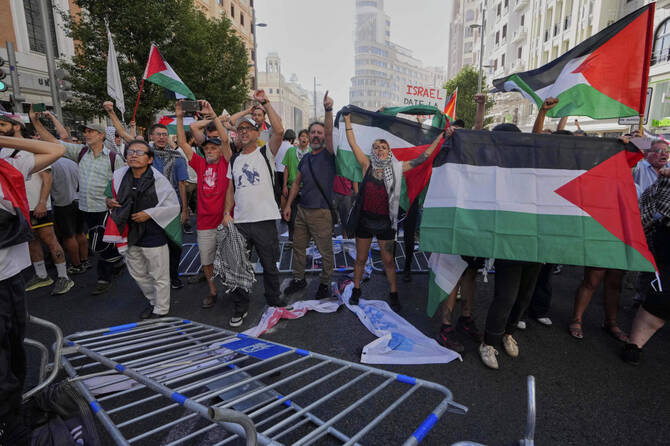

PARIS: From the music, film to publishing industries, growing numbers of Western artists are calling for a cultural boycott of Israel over the Gaza war, hoping to emulate the success of the apartheid-era blockade of South Africa.
With most Western governments resistant to major economic sanctions, musicians, celebrities and writers are hoping to build public pressure for more action.
“There is absolutely no doubt in my mind that, globally, we’re at a tipping point,” British actor Khalid Abdalla (“The Kite Runner,” “The Crown“) told AFP after signing a petition calling for a boycott of some Israeli cinema bodies.
The open letter from Film Workers for Palestine has gathered thousands of signatories, including Emma Stone and Joaquin Phoenix, who have pledged to cut ties with any Israeli institutions “implicated in genocide.”
“The avalanche is happening now, and it’s across spheres. It’s not just in the film worker sphere,” Abdalla added during an interview on Friday.
At this week’s Emmy Awards, winner after winner, from Javier Bardem to “Hacks” actor Hannah Einbinder, spoke about Gaza, echoing similar statements at the Venice Film Festival earlier this month.
On Thursday, British trip-hop pioneers Massive Attack announced they were joining a music collective called “No Music for Genocide” that will see artists try to block the streaming of their songs in Israel.
Elsewhere, Israel faces being boycotted at the Eurovision song contest, authors have signed open letters, while Spanish Prime Minister Pedro Sanchez is leading a push to exclude the country from sports events.
Israeli conductor Ilan Volkov announced last week at a concert in Britain that he would no longer perform in his home country.
“I think we are seeing a situation which is comparable to the boycott movement against apartheid South Africa,” Hakan Thorn, a Swedish academic at the University of Gothenburg who wrote a book on the South Africa boycott movement.
“There was definitely a shift in the spring of this year when the world saw the images of the famine in Gaza,” added the sociologist.
“Anti-Semitism”
The international boycott of South Africa’s white supremacist government began in earnest in the early 1960s after a massacre of black protesters by police in the Sharpeville township.
It culminated with artists and sports teams refusing to play there, with boycott busters such as Queen or Frank Sinatra facing widespread public criticism.
Thorn says many public figures were reluctant to speak out about the Gaza war, which was sparked by the October 7, 2023 attack by Palestinian militant group Hamas which left 1,219 people dead in Israel, most of them civilians.
Israel’s retaliatory strikes have killed more than 65,000 people, also mostly civilians, according to figures from Gaza’s health ministry, which the UN considers reliable.
“The history of the Holocaust and criticism of the pro-Palestinian movement for being antisemitic has been a serious obstacle to a broader mobilization against what Israel is doing right now,” explained Thorn.
A campaign to boycott Israel, known as the Boycott, Divestment and Sanctions (BDS) movement, began 20 years ago over the country’s occupation of Palestinian territory.
The Israeli government accuses its supporters of being antisemitic and Prime Minister Benjamin Netanyahu frequently labels critics as “Hamas sympathizers.”
David Feldman, who heads the Institute for the Study of Antisemitism at Birkbeck College at the University of London, said such statements have created “a lack of confidence over what the boundaries of antisemitism actually are.”
“Any eruption of antisemitism is concerning, but any attempt right now to identify the movement to boycott Israel with antisemitism is missing the point,” he told AFP.
“It is a vehicle of protest against Israel’s destruction of Gaza and the ongoing murder of people.”
Apartheid lessons
Although the anti-apartheid movement is referenced by today’s campaigners against the Gaza war, history provides some sobering lessons for them.
After the start of the South Africa boycott movement, it took 30 years before the regime fell, exposing the limits of international pressure campaigns.
“By the early 1970s, it’s true to say that boycott was the defining principle of a self-identified global anti-apartheid movement, but the movement on its own was not enough,” Feldman, who wrote a book about boycotts, added.
The real pain was caused by the gradual asphyxiation of the South African economy as companies and banks withdrew under pressure, while the end of the Cold War sharply increased the country’s isolation.
Inside Israel, many artists worry about the consequences of the boycott movement.
Israeli screenwriter Hagai Levi (“Scenes from a Marriage,” “The Affair“) told AFP earlier this month that “90 percent of people in the artistic community” were against the war.
“They’re struggling, and boycotting them is actually weakening them.”


