WASHINGTON: US President Donald Trump on Friday ordered an annual $100,000 fee be added to H-1B skilled worker visas, creating potentially major repercussions for the tech industry where such permits are prolific.
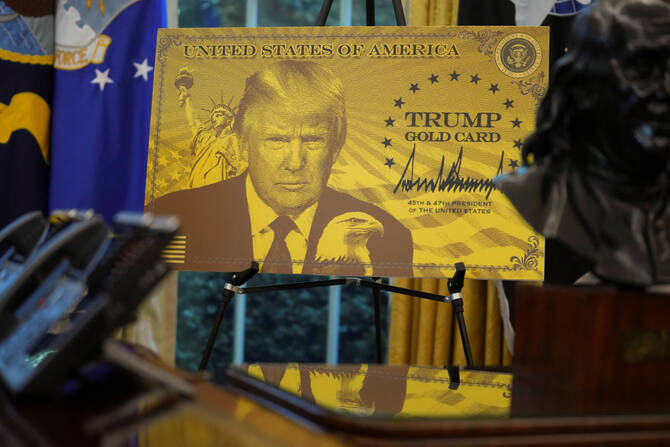
The new measure, which could likely face legal challenges, was announced alongside the introduction of a $1 million “gold card” residency program that Trump had previewed months earlier.
“The main thing is, we’re going to have great people coming in, and they’re going to be paying,” Trump told reporters as he signed the orders in the Oval Office.
H-1B visas allow companies to sponsor foreign workers with specialized skills --- such as scientists, engineers, and computer programmers — to work in the United States, initially for three years, but extendable to six years.
The United States awards 85,000 H-1B visas per year on a lottery system, with India accounting for around three-quarters of the recipients.
Large technology firms rely on Indian workers who either relocate to the United States or come and go between the two countries.
Tech entrepreneurs — including Trump’s former ally Elon Musk — have warned against targeting H-1B visas, saying that the United States does not have enough homegrown talent to fill important tech sector job vacancies.
“All the big companies are on board,” said Commerce Secretary Howard Lutnick, who joined Trump in the Oval Office.
Trump has had the H-1B program in his sights since his first term in office, but faced court challenges to his earlier approach, which targeted the types of jobs that qualify. The current iteration has become the latest move in the major immigration crackdown of his second term.
According to Trump’s order, the fee will be required for those seeking to enter the country beginning Sunday, with the Homeland Security secretary able to exempt individuals, entire companies, or entire industries.
The order expires in a year, though Trump can extend it.
The number of H-1B visa applications has risen sharply in recent years, with a peak in approvals in 2022 under Democratic president Joe Biden.
In contrast, the peak in rejections was recorded in 2018, during Trump’s first term in the White House.
The United States approved approximately 400,000 H-1B visas in 2024, two-thirds of which were renewals.
Trump also signed an order creating a new expedited pathway to US residency for people who pay $1 million, or for corporate sponsors to pay $2 million.
“I think it’s going to be tremendously successful,” Trump added.

Trump hits H-1B visas, a tech industry favorite, with $100,000 fee
https://arab.news/4bs33
Trump hits H-1B visas, a tech industry favorite, with $100,000 fee
- H-1B visas allow companies to sponsor foreign workers with specialized skills to work in the US, initially for three years, but extendable to six years
Modi’s rooftop solar push slowed by reluctant lenders, states
- The shortfalls represent the latest challenge to India’s efforts to nearly double clean energy capacity to 500 gigawatts by 2030
SINGAPORE/MUMBAI/BHUBANESWAR, India: Indian Prime Minister Narendra Modi’s push to accelerate the rollout of rooftop solar power is falling short of targets despite heavy subsidies due to loan delays and limited support from state utilities, vendors and analysts say.
The shortfalls represent the latest challenge to India’s efforts to nearly double clean energy capacity to 500 gigawatts by 2030, and come as the government plans to suspend clean energy tendering targets amid a mounting backlog of awarded projects yet to be built.
Challenges to plans to increase solar uptake may mean India maintains its reliance on coal-fired power.
India’s Ministry for New and Renewable Energy created its subsidy program for residential solar panel installations in February 2024, covering up to 40 percent of the costs.
But residential installations at 2.36 million are well below the ministry’s target of 4 million by March, according to data from the program’s website.
“Banks’ reluctance to lend and states’ hesitance to promote the schemes could derail India’s efforts to transition away from coal,” said Shreya Jai, the lead energy analyst at research firm Climate Trends in New Delhi.
Roughly three in five rooftop solar applications filed on the scheme’s website are yet to be approved while about 7 percent have been rejected, according to government data on the program, known as the PM Surya Ghar.
In a statement to Reuters about the pending applications, the renewable energy ministry pointed to accelerating installations which have benefited over 3 million households, and said the scheme enables state-owned utilities to reduce subsidy payouts to keep residential power bills in check.
“The loan rejection rate varies across states,” the statement said.
Under PM Surya Ghar, consumers apply and select a vendor who handles paperwork and arranges bank financing for solar panels. After loan approval and installation, the vendor submits proof, after which the government subsidy is credited to the bank.
BANK DELAYS
However, banks have been rejecting or delaying loans for numerous reasons including lack of documentation, which they say is necessary to protect public funds.
“We are working with the government to push for some standard documentation, because it is necessary to avoid bad loans. Currently if loans go bad, banks can take away these panels but what will we do with these panels?” said a senior official at a major government-owned bank.
Chamrulal Mishra, a solar vendor in the eastern Indian state of Odisha, said applications are often rejected because the customer has missed electricity payments or because land records are still in the name of deceased relatives.
Residents there dispute the claims that they have missed payments, which they attribute to administrative errors after a change in utility ownership decades prior.
A spokesperson for India’s Department of Financial Services, which regulates the country’s banks, said they have responded to consumer feedback to allow co-applicants for loans to clear up title claims and the simplification of documentation requirements.
The Renewable Energy Association of Rajasthan said some banks are making collateral demands for loans under 200,000 Indian rupees ($2,208.87), despite scheme guidelines not requiring them to, which is constraining solar power additions.
State Bank of India and Punjab National Bank, some of the country’s largest lenders, did not reply to requests for comment on the matter.
State-owned utilities are also not promoting rooftop solar as much, as they are concerned about the loss of revenue as sales move off the electric grid.
“Wealthier households typically have high electricity consumption, tariffs and reliable roof access. When they shift from the grid, it leaves a larger financial burden,” said Niteesh Shanbog, an analyst at Rystad Energy.