

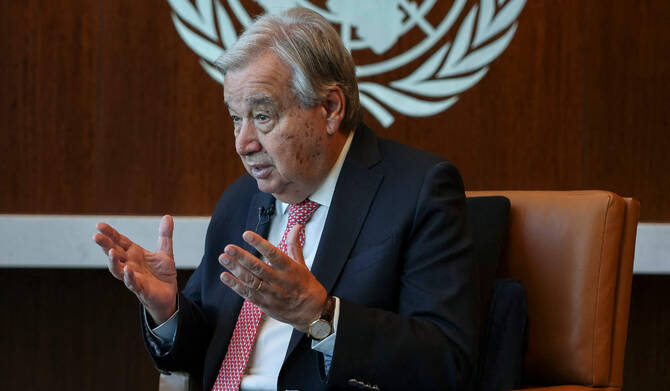
UNITED NATIONS, United States: United Nations Secretary-General Antonio Guterres told AFP Friday the world should not be “intimidated” by Israel and its creeping annexation of the occupied West Bank.
In an interview at UN headquarters in New York, he also called for more ambitious climate action saying that efforts to limit global warming to 1.5 Celsius above pre-industrial levels were at risk of “collapsing.”
Guterres spoke to AFP ahead of the UN’s signature high-level week at which 10 countries will recognize a Palestinian state, according to France — over fierce Israeli objections.
The meeting of more than 140 heads of state and government, which paralyzes a corner of Manhattan for a week each year, will likely be dominated by the future of the Palestinians and the war in Gaza.
Israel has reportedly threatened to annex the West Bank if Western nations press ahead with the recognition plan at the UN gathering.
But Guterres said, “We should not feel intimidated by the risk of retaliation.”
“With or without doing what we are doing, these actions would go on and at least there is a chance to mobilize international community to put pressure for them not to happen,” he said.
“What we are witnessing in Gaza is horrendous,” Guterres said as Israel threatened “unprecedented force” in its ongoing assault on Gaza City.
“It is the worst level of death and destruction that I’ve seen my time as Secretary-General, probably my life and the suffering of the Palestinian people cannot be described — famine, total lack of effective health care, people living without adequate shelters in huge concentration areas,” he said.
Israel’s far-right Finance Minister Bezalel Smotrich has called for annexation of swaths of the West Bank with an aim to “bury the idea of a Palestinian state” after several countries joined the French push on statehood.
But Israel’s staunch ally the United States has held back from any criticism of the war in Gaza or vows to annex the West Bank — and excoriated its allies who have vowed to recognize a Palestinian state.
- Climate goals face collapse -
Also on the agenda will be efforts to combat climate change which Guterres warned are floundering.
Guterres said efforts to cap climate warming at 1.5 Celsius above pre-industrial levels were in trouble.
The climate goals for 2035 of the countries that signed the Paris Agreement, also known as Nationally Determined Contributions (NDCs), were initially expected to be submitted several months ago.
However, uncertainties related to geopolitical tensions and trade rivalries have slowed the process.
“We are on the verge of this objective collapsing,” he told AFP.
“We absolutely need countries to come... with climate action plans that are fully aligned with 1.5 degrees (Celsius), that cover the whole of their economies and the whole of their greenhouse gas emissions,” he said.
“It is essential that we have a drastic reduction of emissions in the next few years if you want to keep the 1.5 degrees Celsius limit alive.”
Less than two months before COP30 climate meeting in Brazil, dozens of countries have been slow to announce their plans — particularly China and the European Union, powers considered pivotal for the future of climate diplomacy.
Efforts to combat the impact of man-made global warming have taken a backseat to myriad crises in recent years that have included the coronavirus pandemic and several wars, with Guterres seeking to reignite the issue.
The UN hopes that the climate summit co-chaired Wednesday in New York by Guterres and Brazilian President Luiz Inacio Lula da Silva will be an opportunity to breathe life into efforts ahead of COP30.
Guterres said he was concerned that Nationally Determined Contributions, or national climate action plans, may not ultimately support the goal of limiting global warming to 1.5 degrees Celsius above pre-industrial levels.
“It’s not a matter to panic. It’s a matter to be determined, to put all pressure for countries.”
Containing global warming to1.5C compared to the pre-industrial era 1850-1900 is the most ambitious goal of the 2015 Paris Agreement. But many scientists agree that this threshold will most likely be reached before the end of this decade, as the planet continues to burn more and more oil, gas, and coal.
The climate is already on average 1.4C warmer today, according to current estimates from the European observatory Copernicus.


