

Punjab declares monsoon over as floods affect 45 million, destroy 2.5 million acres of crops

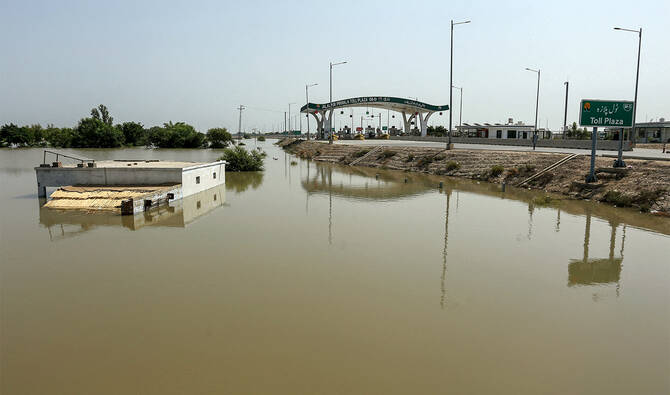
A general view of a closed motorway damaged by floodwater at Jalalpur Pirwala, in the Multan district of Punjab province, Pakistan, on September 17, 2025. (AFP)
Short Url
Updated 19 September 2025
Follow

Punjab declares monsoon over as floods affect 45 million, destroy 2.5 million acres of crops

  • Nearly 1,006 killed nationwide since late June, including 123 in Punjab since Aug. 26
  • 1,779 livestock lost, 2 million evacuated, relief efforts ongoing as waters recede

KARACHI: Authorities in Pakistan’s Punjab province on Friday declared the 2025 monsoon season officially over, saying floodwaters that had surged through major rivers in late August were now receding, after one of the deadliest and most destructive monsoons in the country’s history.

The disaster has left at least 1,006 people dead nationwide since the monsoon season began on June 26, including 123 deaths in Punjab since Aug. 26, the worst spell of the season, according to the Provincial Disaster Management Authority (PDMA). In total, nearly 300 people have been killed in Punjab since the start of the monsoons.

More than 44.7 million people in Punjab alone have been affected by the rains and deluges, while crops on 2.48 million acres of farmland and nearly 1,800 livestock are lost. 

The scale of destruction has reinforced fears of long-term food insecurity in Pakistan’s breadbasket province.

“Today, I inform you from PDMA Punjab that our monsoon practically is almost over now and now no strong or even weak system is forecasted for the next week,” DG PDMA Punjab Irfan Ali Kathia told reporters on Friday. 

He said major rivers including the Chenab, Ravi and Sutlej had returned to normal or below-normal levels.

Kathia said around 106,000 people were still living in relief camps across southern Punjab districts such as Multan, Jalalpur Pirwala and Muzaffargarh. 

At the height of the crisis, some 500 relief camps had been established, supported by 425 mobile and fixed medical units.

On crops, Kathia reported the biggest losses were to rice (44 percent of inundated area), followed by corn (16 percent), sugarcane (13 percent), and cotton (5 percent). 

“Approximately 2,482,617 acres of crops have been inundated in Punjab,” he said, adding that a digital survey starting Sept. 24 would assess crop, livestock, structural and human losses for compensation.

The floods had also killed 1,779 animals, with 824 more missing. Kathia said the government had already transported more than 2 million animals to safety.

He credited rescue agencies for saving 2.4 million people during the peak flood, with 37,000 boat trips conducted by Punjab’s Rescue 1122 and the Pakistan Army.

The PDMA chief said the M5 Motorway, linking the city of Multan with other parts of Punjab, had been badly affected by floodwaters in a 22-kilometer stretch between Jalalpur Pirwala and Jhangra, where 73 culverts came under stress, of which five were damaged. 

“The water is receding gradually,” he said, noting repairs were underway with support from the National Highway Authority and federal agencies.

Pakistan, which contributes only one percent of global greenhouse gas emissions, is among the countries most severely affected by climate change.

Catastrophic floods in 2022 killed 1,700 people, affected 33 million and caused over $30 billion in economic damage.


Pakistan’s JF-17 fighter jet draws ‘strong interest’ at Riyadh defense exhibition

Updated 13 sec ago
Follow

Pakistan’s JF-17 fighter jet draws ‘strong interest’ at Riyadh defense exhibition

  • Jets showcased as Pakistan seeks to expand defense exports
  • Interest in JF-17 has heightened after May 2025 conflict with India 

ISLAMABAD: Pakistan’s JF-17 Thunder fighter jet has drawn “strong interest” at the World Defense Exhibition in Riyadh, Pakistan’s state broadcaster said on Sunday, as Islamabad promotes the aircraft to international buyers at one of the region’s largest defense industry events.

The exhibition brings together defense officials, manufacturers and military delegations from dozens of countries, offering a platform for arms exporters to showcase equipment and pursue new contracts amid heightened global and regional security concerns.

Saudi Arabia has sought to position Riyadh as a regional hub for defense and aerospace exhibitions, using such events to foster partnerships and attract international manufacturers as part of broader diversification efforts. 

Last year Islamabad signed a mutual defense pact with Riyadh and is reportedly discussing another defense agreement involving Saudi Arabia and Turkiye, although details have not been made public.

“At the World Defense Exhibition in Riyadh, the Pakistan Air Force’s JF-17 Thunder has attracted strong interest from visitors and defense experts, standing out among fighter jets displayed by the US, Saudi Arabia and other countries,” state broadcaster Pakistan Television reported.

Islamabad is attending the exhibition in the backdrop of talks with at least 13 countries, six to eight of which are in an advanced stage, for deals involving JF-17 jets made jointly with China as well as training aircraft, drones, and weapons systems, according to recent media reports. 

Interest in the JF-17 jets has been bolstered by its operational visibility following the Pakistan-India military confrontation in May 2025, which Pakistani officials and defense analysts have cited as reinforcing the aircraft’s combat credibility.

Islamabad has increasingly positioned the JF-17 as a cost-effective multirole combat aircraft for countries seeking alternatives to high-end Western fighter jets. The aircraft is already in service with several foreign air forces and remains central to Islamabad’s defense export strategy.

Countries engaged in talks include Sudan, Saudi Arabia, Indonesia, Morocco, Ethiopia, and Nigeria as well as the government in eastern Libya led by Khalifa Haftar. Discussions on JF-17s and other weapons with Bangladesh and Iraq have been publicly acknowledged by Pakistan’s military, although more details have not been made public.

Almost all the potential buyers are Muslim-majority nations, like Pakistan. Many are from the predominantly Muslim Middle East, where Pakistan has historically been a security provider.