Philippines ‘ghost’ flood projects leave residents stranded

1 / 2
This photo taken on September 15, 2025 shows an unfinished dike in Calumpit, Bulacan. (AFP)
2 / 2
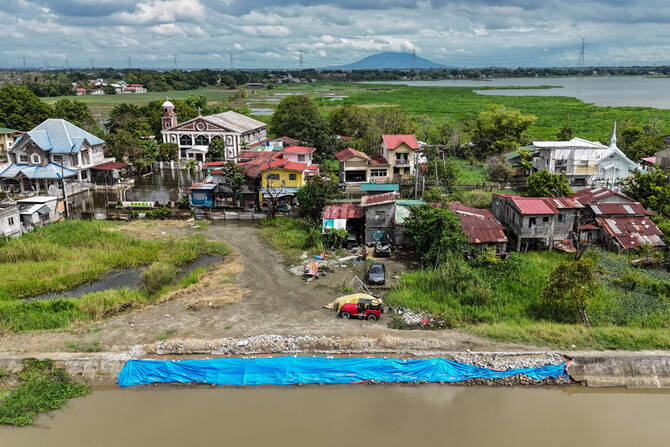
This aerial photo taken on September 15, 2025 shows a damaged dike in a village in Calumpit, Bulacan. (AFP)
Short Url
Updated 19 September 2025
Follow

Philippines ‘ghost’ flood projects leave residents stranded

  • Anger has been growing over so-called ghost infrastructure since President Ferdinand Marcos put the issue center-stage in a state of the union address after weeks of deadly flooding
  • Greenpeace estimates some $17.6 billion in funds may have been bilked from climate-related projects since 2023, much of it meant for communities at risk from rising sea levels

PLARIDEL, Philippines: The dike meant to protect the Philippine town cost taxpayers nearly $2 million, but when a minister visited this month he found little more than dirt hastily dumped along the river’s banks.
Residents of Plaridel town in Bulacan province, north of the capital Manila, could have told him what happened — contractors had only just begun a project that government officials marked “completed” more than a year earlier.
The dike is one of more than 100 flood-control projects at the center of one of the country’s biggest corruption scandals in decades.
It has already sparked leadership changes in both houses of Congress, but the real impact is among communities left without protection, many of them strung along rivers in the Bulacan region.
“We carry our children to school when the water is high,” Leo Francisco, a construction worker and father of two, told AFP in the village of Bulusan.
“Inside our house, the water is up to our thighs,” the 35-year-old said.
“On the road... sometimes knee-high, sometimes ankle-high. These are ordinary days — not typhoons.”
A flood control project intended to remedy the issue, like so many identified in recent weeks, has never been finished.
“The dike is incomplete, so the water washes in. Even in the built-up sections, the water still gets through from underneath because the pilings are shallow,” Francisco said.


This aerial photo taken on September 15, 2025 shows an unfinished dike in Plaridel, Bulacan. More than 100 flood-control projects are at the center of the country's biggest corruption scandal in decades. (AFP)

In nearby Plaridel, AFP saw a pair of masons bathing themselves near a half-built dike with exposed metal rods.
The taxpayer money paid for the dike “was clearly stolen,” Public Works Minister Vince Dizon said after visiting the site.
He called it an obvious “ghost project” and said he had fired the district’s chief engineer and two others.

‘The dike is worthless’

Anger has been growing over so-called ghost infrastructure since President Ferdinand Marcos put the issue center-stage in a state of the union address after weeks of deadly flooding.
Greenpeace estimates some $17.6 billion in funds may have been bilked from climate-related projects since 2023, much of it meant for communities that are slowly sinking due to groundwater over-extraction and rising sea levels.
Marcos himself has visited sites caught up in the scandal and slammed the poor quality of the dike in the village of Frances.
“You can crush the cement mix used with your bare hands. They short-changed the cement,” he said, pledging to hold those responsible to account.
Residents said they were pleased to see Marcos but were “waiting for him to deliver.”
“The dike is worthless. It’s full of holes,” said Nelia de los Reyes Bernal, a health worker.
Schoolchildren now wear rubber boots to class after a spike in cases of the bacterial disease leptospirosis and athlete’s foot, she said.
“Construction began last year but it has not been completed, supposedly because funds ran out,” the 51-year-old added.
“There’s no storm and yet the water is rising... We can no longer use the downstairs rooms of our houses. We’ve moved our kitchens to the second floors.”

‘Both guilty’

In Plaridel, 81-year-old Elizabeth Abanilla said she had not followed hearings on the scandal because she doesn’t own a television, but felt contractors were not the only ones to blame.
“It’s the fault of those who gave them money,” she said.
“They should not have handed it over before the job is completed. Both of them are guilty.”
The Philippines has a long history of scandals involving public funds, and high-ranking politicians have typically escaped serious jail time even if convicted of graft.
Thousands are expected to turn out for a protest in the capital on Sunday demanding justice — including prison for those found guilty of involvement in the bogus infrastructure projects.
But for construction worker Francisco, who says the floods are killing his livelihood, that kind of outcome is barely worth dreaming about.
“For me, what’s important is that they return the money,” he said.
“It’s up to God what is to be done with them.”


Zelensky presses EU to tap Russian assets at crunch summit

Updated 3 sec ago
Follow

Zelensky presses EU to tap Russian assets at crunch summit

  • “Russian assets must be used to defend against Russian aggression and rebuild what was destroyed by Russian attacks. It’s moral. It’s fair. It’s legal,” Zelensky said
  • German Chancellor Friedrich Merz was among those agreeing strongly as he said there was “no better option“

Brussels: Ukrainian President Volodymyr Zelensky told EU leaders Thursday they had the “moral” and legal right to use frozen Russian assets to fund Kyiv — as pressure grew on key player Belgium to drop its opposition at a summit showdown.
The 27-nation bloc is scrambling to bolster its ally Ukraine, as US President Donald Trump pushes for a deal with President Vladimir Putin to end the fighting.
Officials have insisted leaders’ talks in Brussels will last as long as it takes to hammer out an agreement, saying both Ukraine’s survival — nearly four years into the war — and Europe’s credibility are at stake.
“We will not leave the European summit without a solution for the funding of Ukraine,” European Commission head Ursula von der Leyen said.
The EU’s executive wants to fund a loan to Ukraine by using frozen assets from Russia’s central bank, though it is holding on to a back-up plan for the bloc to raise the money itself.
The EU estimates Ukraine needs an extra 135 billion euros ($159 billion) to stay afloat over the next two years — with the cash crunch set to start in April.
Zelensky said Kyiv needed a decision on its financing by the end of the year and that the move could give it more leverage in talks to end the war.
“Russian assets must be used to defend against Russian aggression and rebuild what was destroyed by Russian attacks. It’s moral. It’s fair. It’s legal,” Zelensky said.
German Chancellor Friedrich Merz was among those agreeing strongly as he said there was “no better option.”
But Belgium’s Prime Minister Bart De Wever — who held talks with Zelensky on the sidelines — seemed unconvinced so far.
“I have not seen a text that could persuade me to give Belgium’s agreement,” he told Belgian lawmakers before the summit kicked off.
The vast bulk of the assets are held by international deposit organization Euroclear in Belgium, and the government fears it could face crippling financial and legal reprisals from Moscow.
EU officials say they have gone out of their way to allay Belgian worries and that multiple layers of protection — including guarantees from other member states — mean the risks are minimal.
“At this stage, the guarantees offered by the Commission remain insufficient,” De Wever said.

- Ukraine’s looming cash crunch -

In a bid to plug Kyiv’s yawning gap, the Commission has proposed tapping 210 billion euros of frozen assets, initially to provide Kyiv 90 billion euros over two years.
The unprecedented scheme would see the funds loaned to the EU, which would then loan them on to Ukraine.
Kyiv would then only pay back the “reparations loan” once the Kremlin compensates it for the damage.
In theory, other EU countries could override Belgium and ram the initiative through with a weighted majority, but that would be a nuclear option that few see as likely for now.
De Wever insisted that the EU should go for its alternative plan of raising money itself — but diplomats said that option had been shelved as it needed unanimity and Hungary was firmly against.
Bubbling close to the surface of the EU’s discussion are the US efforts to forge a deal to end the war.
Zelensky said Ukrainian and US delegations would hold new talks on Friday and Saturday in the United States.
He said he wanted Washington to give more details on the guarantees it could offer to protect Ukraine from another invasion.
“What will the United States of America do if Russia comes again with aggression?” he asked. “What will these security guarantees do? How will they work?“