


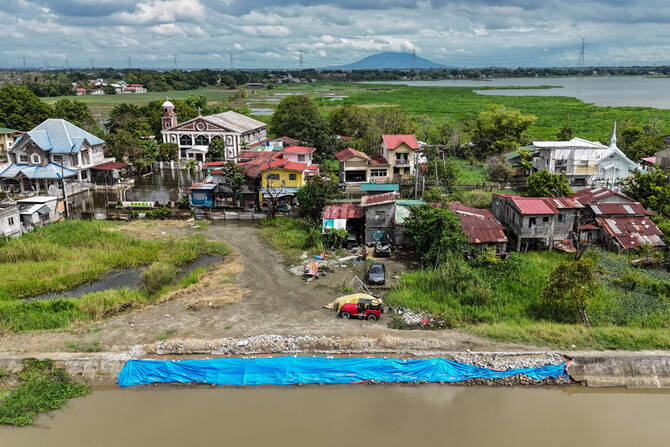

PLARIDEL, Philippines: The dike meant to protect the Philippine town cost taxpayers nearly $2 million, but when a minister visited this month he found little more than dirt hastily dumped along the river’s banks.
Residents of Plaridel town in Bulacan province, north of the capital Manila, could have told him what happened — contractors had only just begun a project that government officials marked “completed” more than a year earlier.
The dike is one of more than 100 flood-control projects at the center of one of the country’s biggest corruption scandals in decades.
It has already sparked leadership changes in both houses of Congress, but the real impact is among communities left without protection, many of them strung along rivers in the Bulacan region.
“We carry our children to school when the water is high,” Leo Francisco, a construction worker and father of two, told AFP in the village of Bulusan.
“Inside our house, the water is up to our thighs,” the 35-year-old said.
“On the road... sometimes knee-high, sometimes ankle-high. These are ordinary days — not typhoons.”
A flood control project intended to remedy the issue, like so many identified in recent weeks, has never been finished.
“The dike is incomplete, so the water washes in. Even in the built-up sections, the water still gets through from underneath because the pilings are shallow,” Francisco said.

This aerial photo taken on September 15, 2025 shows an unfinished dike in Plaridel, Bulacan. More than 100 flood-control projects are at the center of the country's biggest corruption scandal in decades. (AFP)
In nearby Plaridel, AFP saw a pair of masons bathing themselves near a half-built dike with exposed metal rods.
The taxpayer money paid for the dike “was clearly stolen,” Public Works Minister Vince Dizon said after visiting the site.
He called it an obvious “ghost project” and said he had fired the district’s chief engineer and two others.
‘The dike is worthless’
Anger has been growing over so-called ghost infrastructure since President Ferdinand Marcos put the issue center-stage in a state of the union address after weeks of deadly flooding.
Greenpeace estimates some $17.6 billion in funds may have been bilked from climate-related projects since 2023, much of it meant for communities that are slowly sinking due to groundwater over-extraction and rising sea levels.
Marcos himself has visited sites caught up in the scandal and slammed the poor quality of the dike in the village of Frances.
“You can crush the cement mix used with your bare hands. They short-changed the cement,” he said, pledging to hold those responsible to account.
Residents said they were pleased to see Marcos but were “waiting for him to deliver.”
“The dike is worthless. It’s full of holes,” said Nelia de los Reyes Bernal, a health worker.
Schoolchildren now wear rubber boots to class after a spike in cases of the bacterial disease leptospirosis and athlete’s foot, she said.
“Construction began last year but it has not been completed, supposedly because funds ran out,” the 51-year-old added.
“There’s no storm and yet the water is rising... We can no longer use the downstairs rooms of our houses. We’ve moved our kitchens to the second floors.”
‘Both guilty’
In Plaridel, 81-year-old Elizabeth Abanilla said she had not followed hearings on the scandal because she doesn’t own a television, but felt contractors were not the only ones to blame.
“It’s the fault of those who gave them money,” she said.
“They should not have handed it over before the job is completed. Both of them are guilty.”
The Philippines has a long history of scandals involving public funds, and high-ranking politicians have typically escaped serious jail time even if convicted of graft.
Thousands are expected to turn out for a protest in the capital on Sunday demanding justice — including prison for those found guilty of involvement in the bogus infrastructure projects.
But for construction worker Francisco, who says the floods are killing his livelihood, that kind of outcome is barely worth dreaming about.
“For me, what’s important is that they return the money,” he said.
“It’s up to God what is to be done with them.”


