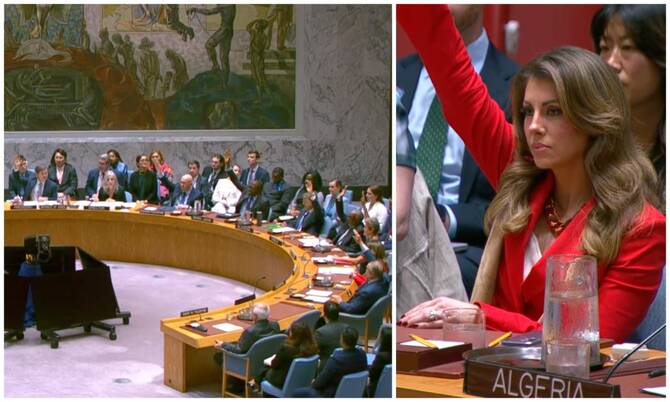
US again vetoes UN Security Council resolution demanding permanent Gaza ceasefire

The US (Morgan Ortagus, right) on Thursday vetoed a UN Security Council resolution that called for an immediate and permanent ceasefire in Gaza, as well as the lifting of all restrictions on humanitarian aid deliveries to the enclave. (Screenshot/UNTV)
Short Url
Updated 18 September 2025
Follow

US again vetoes UN Security Council resolution demanding permanent Gaza ceasefire

  • It marks the 6th time the US has used its power of veto to block such a move since the war between Israel and Hamas began nearly 2 years ago
  • The other 14 members of the council voted in favor of the resolution, which was tabled by its 10 elected members

NEW YORK: The US on Thursday vetoed a UN Security Council resolution that called for an immediate and permanent ceasefire in Gaza, as well as the lifting of all restrictions on humanitarian aid deliveries to the enclave.

The draft resolution, tabled by the 10 elected members of the 15-member council, received 14 votes in favor. It was the sixth time since the start of the war between Israel and Hamas nearly two years ago that the US has used the power of veto it holds as one of the five permanent members of the council.

The veto was delivered by US representative Morgan Ortagus and the resolution therefore failed despite the near-unanimous support.

Washington has consistently argued that UN ceasefire resolutions risk undermining peace negotiations on the ground, as well as Israel’s ability to take action against Hamas and its “right to self-defense.” Critics accuse US authorities of shielding Israel from international accountability.

“Colleagues, US opposition to this resolution will come as no surprise,” Ortagus, a senior US policy adviser, said before the vote.

“It fails to condemn Hamas or recognize Israel’s right to defend itself, and it wrongly legitimizes the false narratives benefiting Hamas, which have sadly found currency in this council.”

Other council members “ignored” US warnings about the “unacceptable” language and instead adopted “performative action designed to draw a veto,” she added.

The text of the resolution expressed alarm at reports of a growing famine and worsening humanitarian crisis in Gaza, condemned the use of starvation as a weapon of war, and voiced concern over the expansion of Israeli military operations. It also reaffirmed obligations on states under the principles of international law, including the protection of civilians and the rejection of forced displacements.

It demanded three key measures: an immediate, unconditional and permanent ceasefire agreement respected by all parties; the immediate and unconditional release of all hostages held by Hamas and other groups; and the lifting of all Israeli restrictions on the entry and distribution of humanitarian aid, alongside the restoration of essential services in Gaza. It asked the UN secretary-general to report back to the council within 30 days on implementation of the resolution.

Algeria, one of the leading proponents of the resolution, expressed dismay at another failure by the Security Council to act on the situation in Gaza, and apologized to Palestinians for not doing enough to save the lives of civilians.

The country’s ambassador to the UN, Amar Bendjama, said that despite the failure to pass the resolution, “14 courageous members of this Security Council raised their voice. They have acted with conscience and in the cause of the international public opinion.”


Federal judge rules Kilmar Abrego Garcia can’t be re-detained by immigration authorities

Updated 5 sec ago
Follow

Federal judge rules Kilmar Abrego Garcia can’t be re-detained by immigration authorities

  • Abrego Garcia has an American wife and child and has lived in Maryland for years

U.S. Immigration and Customs Enforcement cannot re-detain Kilmar Abrego Garcia because a 90-day detention period has expired and the government has no viable plan for deporting him, a federal judge ruled on Tuesday.
The Salvadoran national’s case has become a focal point in the immigration debate after he was mistakenly deported to his home country last year. Since his return, he has been fighting a second deportation to a series of African countries proposed by Department of Homeland Security officials.
The government “made one empty threat after another to remove him to countries in Africa with no real chance of success,” U.S. District Judge Paula Xinis, in Maryland, wrote in her Tuesday order. “From this, the Court easily concludes that there is no ‘good reason to believe’ removal is likely in the reasonably foreseeable future.”
Homeland Security did not immediately respond to a request for comment on Tuesday.
Abrego Garcia has an American wife and child and has lived in Maryland for years, but he immigrated to the U.S. illegally as a teenager. In 2019, an immigration judge ruled that he could not be deported to El Salvador because he faced danger there from a gang that had threatened his family. By mistake, he was deported there anyway last year.
Facing public pressure and a court order, President Donald Trump’s administration brought him back in June, but only after securing an indictment charging him with human smuggling in Tennessee. He has pleaded not guilty. Meanwhile, Trump officials have said he cannot stay in the U.S. In court filings, officials have said they intended to deport him to Uganda, Eswatini, Ghana, and Liberia.
In her Tuesday order, Xinis noted the government has “purposely — and for no reason — ignored the one country that has consistently offered to accept Abrego Garcia as a refugee, and to which he agrees to go.” That country is Costa Rica.
Abrego Garcia's attorney, Simon Sandoval-Moshenberg, argued in court that immigration detention is not supposed to be a punishment. Immigrants can only be detained as a way to facilitate their deportation and cannot be held indefinitely with no viable deportation plan.
“Since Judge Xinis ordered Mr. Abrego Garcia released in mid-December, the government has tried one trick after another to try to get him re-detained,” Sandoval-Moshenberg wrote in an email on Tuesday. “In her decision today, she recognized that if the government were truly trying to remove Mr. Abrego Garcia from the United States, they would have sent him to Costa Rica long before today.”
The government should now engage in a good-faith effort to work out the details of removal to Costa Rica, Sandoval-Moshenberg wrote.