

Pakistan reports current account surplus in Jan. owing to improved trade, remittances

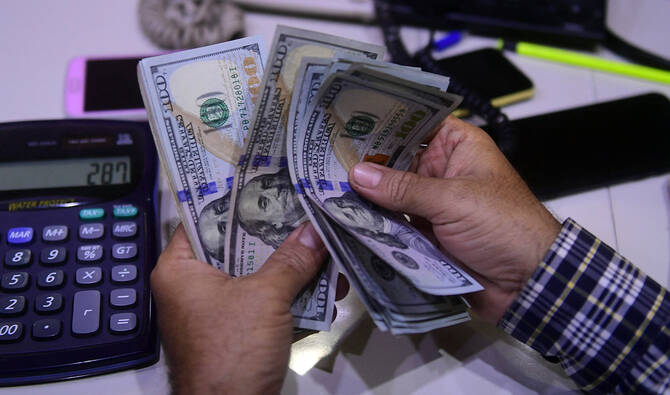
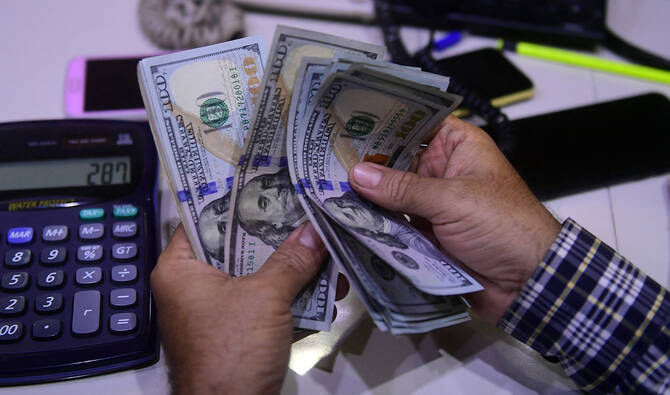
A dealer counts US dollars at a money exchange market in Karachi, Pakistan, on March 2, 2023. (AFP/File)
Short Url
Updated 17 February 2026
Follow

Pakistan reports current account surplus in Jan. owing to improved trade, remittances

  • Pakistan’s exports crossed the $3 billion mark in Jan. as the country received $3.5 billion in remittances
  • Last month, IMF urged Pakistan to accelerate pace of structural reforms to strengthen economic growth

ISLAMABAD: Pakistan recorded a current account surplus of more than $120 million in January, the country’s finance adviser said on Tuesday, attributing it to improved trade balance and remittance inflows.

Pakistan’s exports rebounded in January 2026 after five months of weak performance, rising 3.73 percent year on year and surging 34.96 percent month on month, according to data released by the country’s statistics bureau.

Exports crossed the $3 billion mark for the first time in January to reach $3.061 billion, compared to $2.27 billion in Dec. 2025. The country received $3.5 billion in foreign remittances in Jan. 2026.

Khurram Schehzad, an adviser to the finance minister, said Pakistan reported a current account surplus of $121 million in Jan., compared to a current account deficit of $393 million in the same month last year.

“Improved trade balance in January 2026, strong remittance inflows, and sustained momentum in services exports (IT/Tech) continue to reinforce the country’s external account position,” he said on X.

Pakistan has undergone a difficult period of stabilization, marked by inflation, currency depreciation and financing gaps, and international rating agencies have acknowledged improvements after Islamabad began implementing reforms such as privatizing loss-making, state-owned enterprises (SOEs) and ending subsidies as part of a $7 billion International Monetary Fund (IMF) loan program.

Late last month, the IMF urged Pakistan to accelerate the pace of these structural reforms to strengthen economic growth.

Responding to questions from Arab News at a virtual media roundtable on emerging markets’ resilience, IMF’s director of the Middle East and Central Asia Jihad Azour said Islamabad’s implementation of the IMF requirements had been “strong” despite devastating floods that killed more than 1,000 people and devastated farmland, forcing the government to revise its 4.2 percent growth target to 3.9 percent.

“What is important going forward in order to strengthen growth and to maintain the level of macroeconomic stability is to accelerate the structural reforms,” he said at the meeting.

Azour underlined Pakistan’s plans to privatize some of the SOEs and improve financial management of important public entities, particularly power companies, as an important way for the country to boost its capacity to cater to the economy for additional exports.

“This comes in addition to the effort that the authorities have made in order to reform their tariffs, which will allow the private sector of Pakistan to become more competitive,” the IMF official said.


Pakistan says defense pact with Saudi Arabia elevated brotherly ties to ‘new heights’

Updated 6 sec ago
Follow

Pakistan says defense pact with Saudi Arabia elevated brotherly ties to ‘new heights’

  • Pakistan, Saudi Arabia signed strategic defense pact last year pledging aggression against one will be treated as attack on both
  • Deputy PM Ishaq Dar says enduring bonds with Islamic and Arab nations form vital pillar of Pakistan’s foreign policy 

ISLAMABAD: Deputy Prime Minister Ishaq Dar said on Wednesday that Pakistan’s defense pact with Saudi Arabia elevated its brotherly ties with the Kingdom to “new heights,” stressing that close ties with Arab and Islamic nations form a key pillar of Islamabad’s foreign policy. 

Pakistan and Saudi Arabia signed a Strategic Mutual Defense Agreement on Sept. 17 last year, pledging that aggression against one country would be treated as an attack on both, enhancing joint deterrence and formalizing decades of military and security cooperation.

Both nations agreed in October 2025 to launch an economic cooperation framework to strengthen trade and investment ties. 

“In the Middle East, our landmark Strategic Mutual Defense Agreement with Saudi Arabia has elevated our brotherly ties to new heights,” Dar said while speaking at the Pakistan Governance Forum 2026 event in Islamabad. 

The Pakistani deputy prime minister was speaking on the topic “Navigating International Relations Amidst Changing Geo-Politics.”

Dar noted that Pakistan has reinforced partnerships with other Middle Eastern nations such as the UAE, Qatar, Jordan, Oman, Egypt and Bahrain. He said these partnerships have yielded “concrete agreements” in investment, agriculture, infrastructure, and energy sectors. 

“Our enduring bonds with Islamic and Arab nations form a vital pillar of our foreign policy, and we will continue to expand our partnerships across Asia, Latin America, and Africa,” he said. 

Dar pointed out that the presidents of Kazakhstan, Uzbekistan and Kyrgyzstan have undertaken visits to Pakistan in recent months, reflecting Central Asian nations’ desire to boost cooperation with Islamabad.

On South Asia, the Pakistani deputy PM said Pakistan has successfully transformed its fraternal ties with Bangladesh into “a substantive partnership.”

“Similarly, the trilateral mechanism involving China, Pakistan, and Bangladesh has been launched with a view to expanding and deepening regional cooperation and synergy,” the Pakistani minister said. 

He said Islamabad has strengthened its “all-weather” partnership with China via the second phase of the multi-billion-dollar China-Pakistan Economic Corridor agreement and “unwavering support” from both sides for each other’s core interests. 

Dar said Pakistan had also reinvigorated its partnership with the US, advancing cooperation in trade, technology, investment, and regional stability. 

“This calibrated approach has enhanced our ability to navigate complexity with skill and confidence, ensuring that our national interests are served without compromising our core foreign policy principles,” he said.