

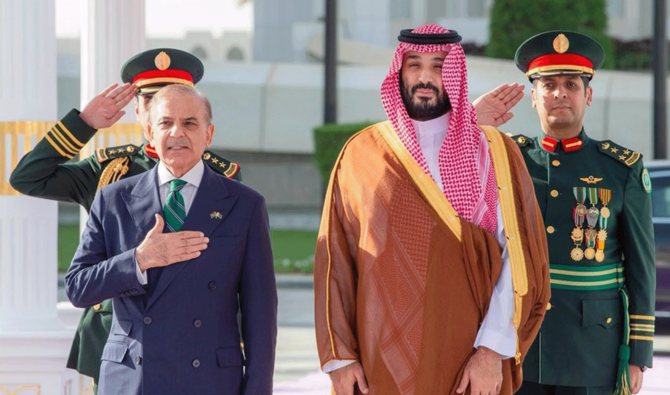

KARACHI: Saudi Arabia and Pakistan signed a Strategic Mutual Defense Agreement on Wednesday pledging that aggression against one country would be treated as an attack on both, in what experts described as a landmark move that reflects shifting global alignments and decades of close cooperation between the two allies.
The accord was concluded in Riyadh during Prime Minister Shehbaz Sharif’s meeting with Saudi Crown Prince Mohammed bin Salman.
Sharing a copy of the joint statement on X early on Thursday, Saudi Defense Minister Khalid bin Salman described the two nations as “One front against any aggressor ... Always and forever.”
Pakistani analysts meanwhile said the agreement underscored both countries’ intent to formalize long-standing security ties while also reflecting broader shifts in the regional and global order.
“The defense pact between Pakistan and KSA [Kingdom of Saudi Arabia] … will have a long-term impact on the power matrix of both South Asia and the Middle East,” Huma Baqai, an academic and foreign affairs expert, told Arab News.
“This development is definitely indicative of a changing global order and new alliances in the making. It may also result in a domino effect of more Gulf and Arab states seeking such alliances with Pakistan.”
She said Saudi Arabia’s decision reflected recognition of Pakistan’s military capabilities, demonstrated during its May 2025 conflict with India.
The two South Asian neighbors fought a four-day war earlier this year after an attack in Indian-administered Kashmir that New Delhi blamed on Islamabad. Pakistan denied involvement, but the hostilities — the deadliest since 2019 — left more than 70 people dead before a US-brokered ceasefire took hold.
In Islamabad’s telling, it shot down at least six Indian planes during the fighting and forced New Delhi to agree to a ceasefire.
Security analyst Syed Muhammad Ali described the accord as “international recognition that Pakistan is not just a South Asian power but a power which can contribute toward preserving peace and security in the Middle East as well.”
“Saudi confidence in Pakistan’s military is evidence that the international community views Pakistan as a capable and responsible power after Islamabad gave a befitting response to New Delhi in the May 2025 conflict,” he added.
Defense analyst Maj. Gen. (r) Muhammad Samrez Salik said the agreement would build on more than eight decades of close security ties between the two countries:
“The latest defense pact will augur well for the defense and security of both nations and for regional stability. KSA has recognized that and decided to benefit from Pakistan’s military capabilities. I expect and hope that KSA will also help Pakistan achieve economic stability.”
Expert Baqai added that the pact could also be seen “as a positive development which would definitely have a ripple effect on the Pakistani economy.”
Earlier on Thursday, Prime Minister Sharif wrote on X that talks with the Saudi crown prince covered a wide range of issues, including regional challenges and steps to enhance bilateral cooperation.
“On the bilateral front, I greatly value HRH’s consistent support and his keen interest in expanding Saudi investments, trade and business ties between our two countries,” he posted.
“It is my fervent prayer that Pakistan–Saudi Arabia’s friendship continues to flourish and attain new heights of glory.”


