Analysts hail Saudi-Pakistan defense pact as step toward regional stability

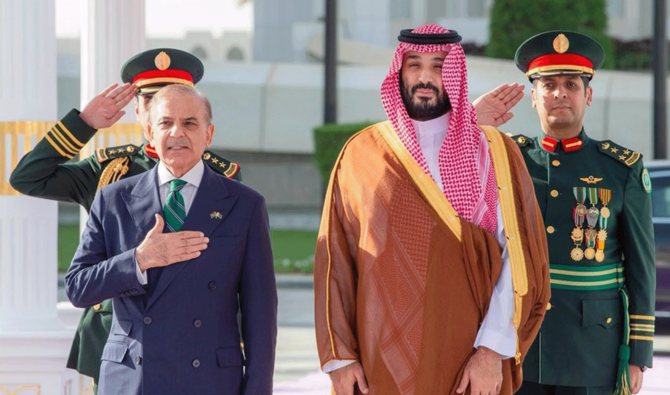
Pakistan's Prime Minister, Shehbaz Sharif (left) with Saudi Crown Prince, Mohammad bin Salman, receiving guard of honor upon his arrival to Saudi Arabia on September 17, 2025. (Government of Pakistan)
Short Url
Updated 18 September 2025
Follow

Analysts hail Saudi-Pakistan defense pact as step toward regional stability

  • Agreement says attack on one country will be treated as attack on both
  • Analysts call accord a sign of changing global order and new alliances

KARACHI: Saudi Arabia and Pakistan signed a Strategic Mutual Defense Agreement on Wednesday pledging that aggression against one country would be treated as an attack on both, in what experts described as a landmark move that reflects shifting global alignments and decades of close cooperation between the two allies.

The accord was concluded in Riyadh during Prime Minister Shehbaz Sharif’s meeting with Saudi Crown Prince Mohammed bin Salman. 

Sharing a copy of the joint statement on X early on Thursday, Saudi Defense Minister Khalid bin Salman described the two nations as “One front against any aggressor ... Always and forever.”

Pakistani analysts meanwhile said the agreement underscored both countries’ intent to formalize long-standing security ties while also reflecting broader shifts in the regional and global order.

“The defense pact between Pakistan and KSA [Kingdom of Saudi Arabia] … will have a long-term impact on the power matrix of both South Asia and the Middle East,” Huma Baqai, an academic and foreign affairs expert, told Arab News. 

“This development is definitely indicative of a changing global order and new alliances in the making. It may also result in a domino effect of more Gulf and Arab states seeking such alliances with Pakistan.”

She said Saudi Arabia’s decision reflected recognition of Pakistan’s military capabilities, demonstrated during its May 2025 conflict with India. 

The two South Asian neighbors fought a four-day war earlier this year after an attack in Indian-administered Kashmir that New Delhi blamed on Islamabad. Pakistan denied involvement, but the hostilities — the deadliest since 2019 — left more than 70 people dead before a US-brokered ceasefire took hold.

In Islamabad’s telling, it shot down at least six Indian planes during the fighting and forced New Delhi to agree to a ceasefire.

Security analyst Syed Muhammad Ali described the accord as “international recognition that Pakistan is not just a South Asian power but a power which can contribute toward preserving peace and security in the Middle East as well.” 

“Saudi confidence in Pakistan’s military is evidence that the international community views Pakistan as a capable and responsible power after Islamabad gave a befitting response to New Delhi in the May 2025 conflict,” he added. 

Defense analyst Maj. Gen. (r) Muhammad Samrez Salik said the agreement would build on more than eight decades of close security ties between the two countries: 

“The latest defense pact will augur well for the defense and security of both nations and for regional stability. KSA has recognized that and decided to benefit from Pakistan’s military capabilities. I expect and hope that KSA will also help Pakistan achieve economic stability.”

Expert Baqai added that the pact could also be seen “as a positive development which would definitely have a ripple effect on the Pakistani economy.”

Earlier on Thursday, Prime Minister Sharif wrote on X that talks with the Saudi crown prince covered a wide range of issues, including regional challenges and steps to enhance bilateral cooperation.

“On the bilateral front, I greatly value HRH’s consistent support and his keen interest in expanding Saudi investments, trade and business ties between our two countries,” he posted. 

“It is my fervent prayer that Pakistan–Saudi Arabia’s friendship continues to flourish and attain new heights of glory.”


Islamabad dismisses claims about paying up to 8 percent interest on foreign loans as ‘misleading’

Updated 22 February 2026
Follow

Islamabad dismisses claims about paying up to 8 percent interest on foreign loans as ‘misleading’

  • Pakistan has long relied on external loans to help bridge persistent gaps in public finances and foreign exchange reserves
  • Pakistan’s total external debt, liabilities stand at $138 billion at an overall average cost of around 4 percent, ministry says

KARACHI: Pakistan’s finance ministry on Sunday dismissed as “misleading” claims that the country is paying up to 8 percent interest on external loans, saying the overall average cost of external public debt is approximately 4 percent.

Pakistan has long relied on external loans to help bridge persistent gaps in public finances and foreign exchange reserves, driven largely by a narrow tax base, chronic trade deficits, rising debt-servicing costs and repeated balance-of-payments pressures.

Over the decades, successive governments have turned to multilateral and bilateral lenders, including the International Monetary Fund, the World Bank and the Asian Development Bank, to support budgetary needs and shore up foreign exchange reserves.

The finance ministry on Sunday issued a clarification in response to a “recent press commentary” regarding the country’s external debt position and associated interest payments, and said the figures required contextual explanation to ensure accurate understanding of Pakistan’s external debt profile.

“Pakistan’s total external debt and liabilities currently stand at $138 billion. This figure, however, encompasses a broad range of obligations, including public and publicly guaranteed debt, debt of Public Sector Enterprises (both guaranteed and non-guaranteed), bank borrowings, private-sector external debt, and intercompany liabilities to direct investors. It is therefore important to distinguish this aggregate figure from External Public (Government) Debt, which amounts to approximately $92 billion,” it said.

“Of the total External Public Debt, nearly 75 percent comprises concessional and long-term financing obtained from multilateral institutions (excluding the IMF) and bilateral development partners. Only about 7 percent of this debt consists of commercial loans, while another 7 percent relates to long-term Eurobonds. In light of this composition, the claim that Pakistan is paying interest on external loans ‘up to 8 percent’ is misleading.

The overall average cost of External Public Debt is approximately 4 percent, reflecting the predominantly concessional nature of the borrowing portfolio.”

With respect to interest payments, public external debt interest outflows increased from $1.99 billion in Fiscal Year (FY) 2022 to $3.59 billion in FY2025, representing an increase of 80.4 percent, not 84 percent as reported. In absolute terms, interest payments rose by $1.60 billion over this period, not $1.67 billion, it said.

According to the State Bank of Pakistan’s records, Pakistan’s total debt servicing payments to specific creditors during the period under reference were as follows: the IMF received $1.50 billion, of which $580 million constituted interest; Naya Pakistan Certificates payments totaled $1.56 billion, including $94 million in interest; the Asian Development Bank received $1.54 billion, including $615 million in interest; the World Bank received $1.25 billion, including $419 million in interest; and external commercial loans amounted to nearly $3 billion, of which $327 million represented interest payments.

“While interest payments have increased in absolute terms, this rise cannot be attributed solely to an expansion in the debt stock,” the ministry said. “Although the overall debt stock has increased slightly since FY2022, the additional inflows have primarily originated from concessional multilateral sources and the IMF’s Extended Fund Facility (EFF) under the ongoing IMF-supported program.”

Pakistan secured a $7 billion IMF bailout in Sept. 2024 as part of Prime Minister Shehbaz Sharif’s efforts to stabilize the South Asian economy that narrowly averted a default in 2023. The government has since been making efforts to boost trade and bring in foreign investment to consolidate recovery.

“It is also important to note that the increase in interest payments reflects prevailing global interest rate dynamics. In response to the inflation surge of 2021–22, the US Federal Reserve raised the federal funds rate from 0.75-1.00 percent in May 2022 to 5.25–5.50 percent by July 2023. Although rates have since moderated to around 3.75 percent, they remain significantly higher than 2022 levels,” the finance ministry said.

“The government remains committed to prudent debt management, transparency, and the continued strengthening of Pakistan’s macroeconomic stability,” it added.